


Pros and cons table of owing a new business
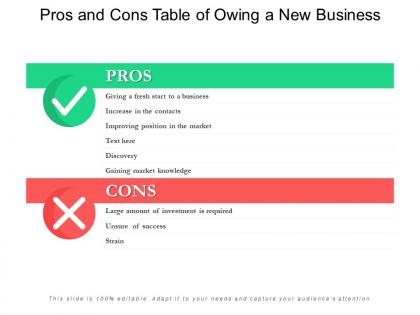




Try Before you Buy Download Free Sample Product
 Impress Your
 Audience
 100%
100% Editable
 Save Hours
 of Time


Conduct discussions in a calm environment with our Pros And Cons Table Of Owing A New Business. Ensure arguments don't get hectic.
People who downloaded this PowerPoint presentation also viewed the following :
Pros and cons table of owing a new business with all 5 slides:
Effectively clarify all doubts with our Pros And Cons Table Of Owing A New Business. Folks will begin to heed your advice.




FAQs for Pros and cons table of owing
Essential steps include developing a comprehensive business plan, conducting thorough market research, securing adequate funding, choosing the appropriate legal structure, and establishing operational systems. These foundational elements work together by minimizing risks, streamlining launch processes, and positioning ventures for sustainable growth, with many entrepreneurs finding that early strategic planning ultimately delivers competitive advantages and operational efficiency.
Identifying your target market involves analyzing demographics, psychographics, purchasing behaviors, pain points, and market size through surveys, competitor research, and customer interviews. Start by creating detailed buyer personas, then validate assumptions through focus groups or pilot testing with potential customers in specific segments like millennials in urban areas or small business owners, ultimately enabling you to tailor messaging and product features for maximum market penetration.
Finance options for entrepreneurs include personal savings, bank loans, angel investors, venture capital, crowdfunding, and government grants or SBA loans. These funding sources enable startups by providing initial capital, operational resources, and strategic partnerships, with many entrepreneurs finding that combining multiple options, such as personal investment with angel funding, ultimately delivers greater financial flexibility and reduced risk while accelerating business growth.
A business plan is essential for securing funding, guiding strategic decisions, and measuring progress, with key elements including executive summary, market analysis, financial projections, marketing strategy, and operational structure. This comprehensive document enables entrepreneurs to identify potential challenges, attract investors, and establish clear milestones, with many successful startups finding that detailed planning significantly increases their chances of long-term viability and growth.
Common legal requirements include business registration and licensing, tax identification numbers, industry-specific permits, employment law compliance, and intellectual property protections. These requirements vary significantly by sector, with healthcare and financial services facing stricter regulations than retail or consulting businesses, ultimately ensuring legal compliance while enabling sustainable growth and competitive market positioning.
Creating a unique value proposition requires identifying your target customers' specific pain points, analyzing competitor gaps, and highlighting your distinctive solutions, pricing strategies, or service approaches. Through comprehensive market research and customer feedback, new businesses can pinpoint underserved needs, develop specialized expertise, and communicate clear benefits that resonate with their audience, ultimately delivering competitive advantage and stronger customer loyalty in increasingly crowded markets.
Effective strategies include creating professional social media profiles, developing SEO-optimized website content, engaging with industry communities, leveraging email marketing campaigns, and establishing consistent brand messaging across platforms. These approaches streamline customer acquisition by building credibility, enhancing visibility, and facilitating direct engagement, with many new businesses finding that strategic online presence delivers faster market penetration and sustainable competitive advantage.
Determining the right pricing strategy involves analyzing competitor pricing, calculating your costs and desired profit margins, understanding your target market's price sensitivity, and considering your brand positioning. Many new businesses find success using value-based pricing in premium markets or competitive pricing in saturated sectors, ultimately delivering sustainable profitability while attracting customers.
Content marketing, social media engagement, email campaigns, local SEO optimization, and referral programs deliver maximum impact for budget-conscious startups. These cost-effective strategies enable new businesses to build brand awareness, generate leads, and establish customer relationships without significant advertising spend, with many entrepreneurs finding that consistent content creation and community engagement ultimately drive sustainable growth and competitive advantage.
Building brand identity requires understanding your target audience's values, needs, and preferences through market research, surveys, and competitor analysis. Develop consistent visual elements, messaging, and brand voice across all touchpoints, with many successful businesses finding that authentic storytelling, clear value propositions, and regular customer engagement ultimately deliver stronger emotional connections and competitive advantage.
Networking enables new businesses to access mentors, potential customers, strategic partners, investors, and industry insights that accelerate growth and sustainability. Through professional associations, local business groups, and industry events, entrepreneurs build relationships that deliver referrals, collaborative opportunities, and market intelligence, while establishing credibility in increasingly competitive markets.
Customer feedback enables new businesses to refine products, identify market gaps, enhance user experience, and prioritize development resources strategically. Through systematic collection via surveys, reviews, and direct interactions, startups can pivot quickly, reduce costly mistakes, and build customer-centric solutions, ultimately delivering improved satisfaction and competitive advantage in increasingly crowded markets.
New business owners commonly face cash flow management, customer acquisition, competition navigation, regulatory compliance, and operational scaling challenges. These obstacles can be overcome by developing detailed financial projections, implementing targeted marketing strategies, conducting thorough market research, and building strong operational systems, with many successful entrepreneurs finding that strategic planning and adaptable execution ultimately deliver sustainable growth and competitive advantage.
Creating a strong initial customer base requires leveraging personal networks, offering exceptional introductory value, implementing referral programs, establishing strategic partnerships, and maintaining active social media engagement. Through targeted outreach and consistent value delivery, many new ventures find that combining competitive pricing with outstanding customer service generates organic word-of-mouth marketing, ultimately building sustainable momentum and long-term customer loyalty.
**INPUT**: What metrics should I track to measure the success of my new business? **OUTPUT**: Essential metrics for new businesses include revenue growth, customer acquisition cost, monthly recurring revenue, cash flow, and customer lifetime value. These financial indicators streamline decision-making by revealing profitability trends, operational efficiency, and market traction, with many entrepreneurs finding that tracking these metrics simultaneously enables faster pivots and sustainable scaling in increasingly competitive markets.
No Reviews