Quality Improvement Plan In Nursing And Healthcare
Try Before you Buy Download Free Sample Product
Audience
Editable
of Time
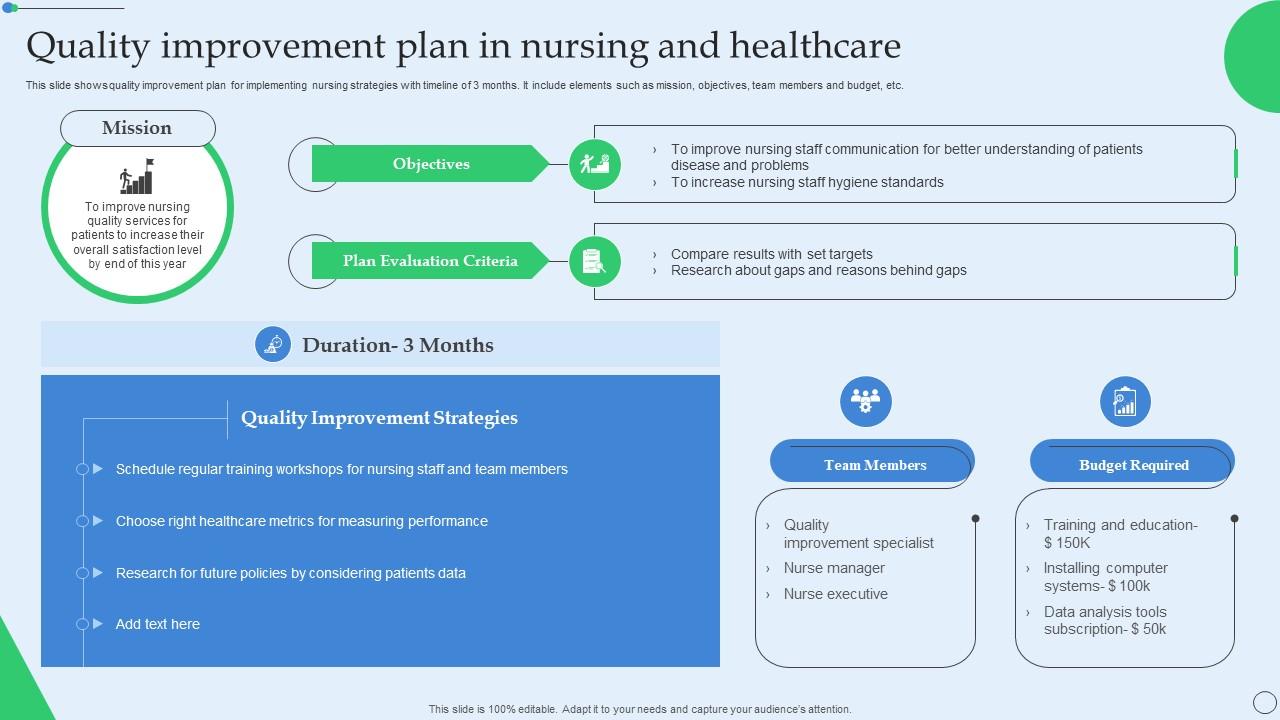
This slide shows quality improvement plan for implementing nursing strategies with timeline of 3 months. It include elements such as mission, objectives, team members and budget, etc.
People who downloaded this PowerPoint presentation also viewed the following :
Quality Improvement Plan In Nursing And Healthcare with all 6 slides:
Use our Quality Improvement Plan In Nursing And Healthcare to effectively help you save your valuable time. They are readymade to fit into any presentation structure.
FAQs for Quality Improvement Plan In
Key methodologies for implementing quality improvement in healthcare include Lean Six Sigma, Plan-Do-Study-Act cycles, root cause analysis, clinical audits, and benchmarking against best practices. These approaches enhance patient safety, streamline care delivery, and reduce medical errors by standardizing processes, eliminating waste, and fostering continuous improvement, with many hospitals finding that strategic implementation ultimately delivers better patient outcomes and operational efficiency.
Patient feedback can be effectively integrated through systematic collection methods, real-time monitoring systems, structured analysis processes, and direct incorporation into care protocols and staff training programs. Healthcare organizations leverage digital platforms, patient surveys, and feedback loops to identify improvement opportunities, enhance patient experiences, and reduce readmission rates, with many hospitals finding that transparent feedback integration ultimately delivers measurably better outcomes and competitive advantage.
Data analytics plays a crucial role in healthcare quality improvement by identifying patterns in patient outcomes, treatment effectiveness, medication errors, readmission rates, and resource utilization across departments. Through predictive modeling and real-time monitoring, hospitals and clinics can pinpoint inefficiencies, reduce costs, and enhance patient safety, with many healthcare systems finding that data-driven insights ultimately deliver measurable improvements in care quality and operational efficiency.
Interdisciplinary teams contribute to healthcare quality improvement by combining diverse clinical expertise, leveraging different professional perspectives, and ensuring comprehensive patient care approaches. Through collaborative protocols, these teams streamline communication between doctors, nurses, pharmacists, and specialists, ultimately reducing medical errors, improving patient outcomes, and enhancing operational efficiency across hospital departments and healthcare systems.
Common barriers to quality improvement in healthcare organizations include resource constraints, resistance to change, fragmented communication systems, regulatory compliance complexities, and inadequate staff training programs. These challenges can be addressed through strategic technology integration, comprehensive change management protocols, and cross-departmental collaboration initiatives, with many hospitals finding that systematic approaches ultimately enhance patient outcomes while reducing operational costs.
Healthcare leaders can foster continuous quality improvement by establishing clear quality metrics, providing regular training on improvement methodologies, encouraging staff feedback and suggestions, recognizing and rewarding quality initiatives, and implementing transparent communication about outcomes. Through these approaches, organizations create environments where staff feel empowered to identify inefficiencies and propose solutions, ultimately delivering enhanced patient care, reduced errors, and improved operational efficiency across departments.
Effective quality improvement metrics include patient safety indicators, clinical outcome measures, patient satisfaction scores, readmission rates, and process efficiency metrics. These measurements enable healthcare organizations to track progress systematically, with many hospitals finding that combining patient-centered outcomes with operational efficiency data delivers comprehensive insights, ultimately enhancing care quality while reducing costs and improving competitive positioning.
Patient safety intersects with quality improvement through systematic approaches like standardized protocols, error reporting systems, evidence-based practices, and continuous monitoring that reduce preventable harm while enhancing care delivery. Healthcare organizations leverage these integrated strategies to minimize medical errors, improve patient outcomes, and streamline clinical workflows, ultimately delivering safer experiences and competitive operational advantages.
Best practices for training healthcare staff in quality improvement include structured LEAN and Six Sigma methodologies, hands-on simulation exercises, interdisciplinary team workshops, mentorship programs, and continuous education modules. These approaches enhance patient safety, streamline operational efficiency, and reduce medical errors, with many hospitals finding that comprehensive training ultimately delivers improved patient outcomes and significant cost reductions.
Healthcare organizations ensure stakeholder engagement through transparent communication, collaborative planning sessions, shared decision-making processes, regular feedback mechanisms, and outcome-sharing practices. These approaches streamline buy-in by involving clinicians, patients, administrators, and community partners in initiative design and implementation, with many hospitals finding that inclusive engagement ultimately delivers sustained improvements, reduced resistance to change, and enhanced patient care outcomes.
**INPUT**: What innovations in technology are currently driving quality improvement in healthcare? **OUTPUT**: Healthcare quality innovations include artificial intelligence diagnostics, electronic health records integration, telemedicine platforms, predictive analytics, and automated medication systems. These technologies streamline patient care by reducing diagnostic errors, enhancing care coordination, and accelerating treatment decisions, with many hospitals finding that strategic implementation ultimately delivers improved patient outcomes and operational efficiency. --- **Word count: 54 words** ✓
Lean and Six Sigma principles enhance healthcare quality by eliminating waste, reducing variation, and streamlining patient flow through systematic process analysis and data-driven improvements. These methodologies enable hospitals and clinics to minimize medication errors, reduce patient wait times, and optimize resource allocation, with many healthcare systems finding that strategic implementation delivers faster patient care, lower operational costs, and significantly improved clinical outcomes.
Regulatory standards create structured frameworks that guide healthcare quality improvement through compliance requirements, standardized protocols, performance metrics, and accountability measures. While these standards ensure patient safety and consistent care delivery, they also present implementation challenges and resource demands, with many healthcare organizations finding that strategic alignment with regulations ultimately enhances operational efficiency and competitive positioning.
Telehealth services enhance quality improvement through real-time monitoring, expanded access to specialists, reduced wait times, and improved care coordination between providers. By enabling remote consultations and continuous patient monitoring, healthcare organizations streamline care delivery, minimize hospital readmissions, and ultimately deliver more personalized treatment experiences while reducing operational costs.
Healthcare providers balance quality improvement and cost containment through strategic technology adoption, process optimization, and preventive care initiatives that reduce long-term expenses while enhancing patient outcomes. By implementing data analytics for early intervention, streamlining administrative workflows, and focusing on value-based care models, hospitals and clinics achieve operational efficiency and improved patient satisfaction, ultimately delivering sustainable cost reductions.
-
Kudos to SlideTeam for achieving the high success rate in delivering the top-notch slides.Â
-
Amazing variety of PowerPoint slides. Really helpful in designing professional presentations.Â