


Quality management roadmap powerpoint presentation slides




Try Before you Buy Download Free Sample Product
 Impress Your
 Audience
 100%
100% Editable
 Save Hours
 of Time


Use content-ready Quality Management Roadmap PowerPoint Presentation Slides to analyse and eliminate the errors within the processes of an organization to improve the overall quality of the final product or service. Fill the gaps, streamline supply chain management, and enhance the customer experience using content-ready quality management roadmap PPT templates. This complete PowerPoint deck will help you execute the activities and tasks required to achieve the desired level of excellence. Incorporate professionally designed quality management roadmap PPT templates for the continual improvement. Add strategy, data, and plan to the roadmap to merge the quality discipline into the culture, tasks, activities of the organization. Use these roadmaps for quality management and quality assurance in your organization. These PowerPoint templates are completely customizable. You can edit the color, text, and icon as per your convenience. Add your content and you are good to implement the quality check in your organization. Enable joie-de-vivre to grow with our Quality Management Roadmap Powerpoint Presentation Slides. Give folks a chance to feel carefree.
People who downloaded this PowerPoint presentation also viewed the following :
Content of this Powerpoint Presentation
Slide 1: This slide introduces Quality Management roadmap. State Your Company Name and begin.
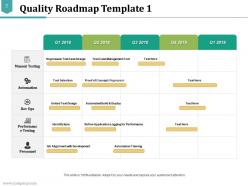
Slide 2: This slide presents Quality Roadmap Template 1 with these of the five options- Manual Testing, Automation, Dev Ops, Performance Testing, Personnel.
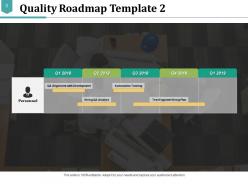
Slide 3: This slide showcases Quality Roadmap Template 2 with these of the factors- QA Alignment with Development, Automation Training, Hiring QA Analyst, Test Engineer Hiring Plan, Personnel.
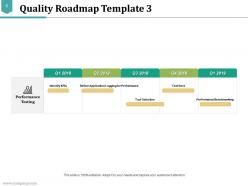
Slide 4: This slide presents Quality Roadmap Template 3 with these of the points- Performance Testing, Identify KPIs, Refine Application Logging for Performance, Performance Benchmarking, Tool Selection.
Slide 5: This slide showcases Quality Roadmap Template 4 with these of the parameters- Dev Ops, United Test Design, Automated Build & Deploy, Integration Tool, Automated Unit Test, Test Environment.
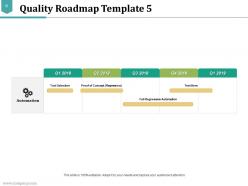
Slide 6: This slide presents Quality Roadmap Template 5 with these of the factors- Automation, Tool Selection, Proof of Concept (Regression), Full Regression Automation.
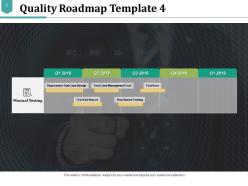
Slide 7: This slide showcases Quality Roadmap Template 6 with these of main parameters- Manual Testing, Regression Test Case Design, Test Case Management Tool, Test Exit Report, Risk Based Testing.
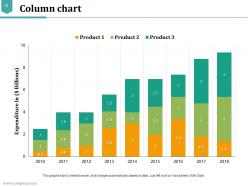
Slide 8: This slide presents Column chart. You can add the comparison.
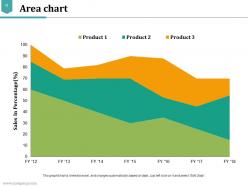
Slide 9: This is an Area Chart slide for product/entity comparison.
Slide 10: This slide is titled Additional Slides to move forward.
Slide 11: This is a Vision, Mission and Goals slide. State them here.
Slide 12: This is an Our Team slide with name, image &text boxes to put the required information.
Slide 13: This is an About Us slide showing Our Company, Value Client, and Premium services as examples.
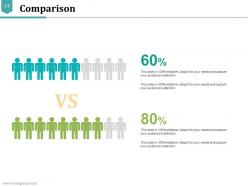
Slide 14: This slide shows Comparison of Positive Factors v/s Negative Factors with thumbsup and thumb down imagery.
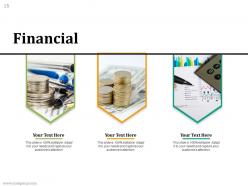
Slide 15: This is a Financial Score slide to show financial aspects here.
Slide 16: This is a Thank You image slide with Address, Email and Contact number.
Quality management roadmap powerpoint presentation slides with all 16 slides:
March forward with our Quality Management Roadmap Powerpoint Presentation Slides. They are aware of the exact drill.






FAQs for Quality management roadmap
Key components of an effective quality management roadmap include process standardization, performance metrics and KPIs, continuous improvement frameworks, risk assessment protocols, and stakeholder engagement strategies. These elements work together by establishing clear quality benchmarks, enabling systematic monitoring and feedback loops, and fostering organizational accountability, with many companies finding that structured roadmaps deliver reduced defects, enhanced customer satisfaction, and sustained competitive advantage.
Organizations identify and prioritize quality improvement initiatives through systematic data analysis, stakeholder feedback collection, risk assessments, and performance gap evaluation against industry benchmarks. These approaches enable companies to focus resources on high-impact areas like customer complaint patterns or operational bottlenecks, ultimately delivering enhanced efficiency and competitive advantage while reducing costs.
Leadership drives quality management roadmap success by establishing clear vision, allocating necessary resources, fostering organizational culture change, and maintaining consistent commitment throughout implementation phases. Through strategic oversight and employee engagement, leaders enable seamless adoption across departments, streamline quality processes, and ultimately deliver improved operational efficiency and competitive advantage in increasingly quality-focused markets.
Data analytics enhances quality management decision-making by identifying patterns in defects, predicting potential failures, and optimizing processes through real-time monitoring. Through predictive analytics and statistical analysis, manufacturers streamline production workflows, reduce waste, and accelerate corrective actions, with many organizations finding that data-driven insights ultimately deliver improved product quality and significant cost reductions.
Several proven methodologies can be integrated into a quality management roadmap, including Six Sigma, Lean Manufacturing, Total Quality Management (TQM), ISO standards, and Kaizen continuous improvement approaches. These methodologies work synergistically by eliminating waste, reducing defects, standardizing processes, and fostering employee engagement, with many organizations finding that strategic combination delivers enhanced operational efficiency and sustainable competitive advantage.
Organizations should address cultural resistance through comprehensive change management, including transparent communication about benefits, employee training programs, leadership modeling, and incremental implementation phases. By involving resistant team members in the planning process, celebrating early wins, and demonstrating how quality improvements enhance daily workflows, companies can transform skepticism into engagement, ultimately building sustainable quality cultures.
Effective quality management metrics include defect rates, customer satisfaction scores, first-pass yield, process capability indices, and cost of quality measurements. These KPIs enable organizations to monitor operational efficiency, identify improvement opportunities, and demonstrate ROI, with many manufacturing and service companies finding that combining leading indicators like process compliance with lagging indicators like customer complaints delivers comprehensive quality visibility and competitive advantage.
Stakeholder engagement in quality management involves regular communication, clear role definitions, feedback mechanisms, and collaborative decision-making processes. Organizations achieve this through structured meetings, cross-functional teams, and transparent reporting systems, with many finding that early involvement in planning phases and continuous updates throughout implementation cycles ultimately delivers stronger buy-in and sustainable quality outcomes.
Essential tools include quality management software, statistical process control systems, document management platforms, audit management solutions, and data analytics dashboards. These technologies streamline compliance tracking, automate reporting processes, and enable real-time monitoring across operations, with many organizations finding that integrated platforms significantly reduce manual oversight while enhancing transparency and accelerating corrective actions.
Customer feedback influences quality management roadmap development by identifying performance gaps, highlighting priority improvement areas, and revealing customer expectations that drive strategic planning. Through systematic feedback analysis, organizations can align quality initiatives with actual customer needs, prioritize resources more effectively, and create measurable outcomes that enhance satisfaction, ultimately delivering competitive advantage and stronger market positioning.
Best practices for maintaining ongoing quality improvements include establishing continuous monitoring systems, implementing regular review cycles, fostering a culture of innovation, setting progressive benchmarks, and maintaining cross-functional collaboration. These approaches enable organizations to build momentum beyond initial achievements, with many companies finding that sustained improvement requires evolving metrics, employee engagement initiatives, and adaptive strategies that drive competitive advantage in increasingly demanding markets.
Organizations ensure compliance with industry-specific quality standards through systematic documentation, regular internal audits, employee training programs, and continuous monitoring systems. By implementing standardized procedures, conducting compliance assessments, and maintaining detailed records, companies across healthcare, manufacturing, and financial services streamline regulatory adherence while ultimately delivering enhanced operational efficiency and competitive advantage.
A quality management roadmap aligns with business strategy by establishing clear quality objectives that support revenue goals, operational efficiency targets, and customer satisfaction metrics. Through strategic integration, organizations streamline compliance processes, enhance product reliability, and accelerate market delivery timelines, with many companies finding that systematic quality planning ultimately delivers competitive advantage and sustainable growth across all business units.
Common pitfalls include inadequate stakeholder buy-in, insufficient resource allocation, unrealistic timelines, poor change management, and lack of continuous monitoring mechanisms. Organizations often underestimate the cultural shift required, with many manufacturing and healthcare institutions finding that resistance to new processes, inadequate training programs, and failure to integrate quality metrics into daily operations ultimately derail implementation efforts.
A quality management roadmap should be reviewed quarterly for operational adjustments and updated annually for strategic alignment, with additional reviews triggered by regulatory changes, market shifts, or organizational restructuring. Many organizations find that combining scheduled reviews with milestone-based assessments enables continuous improvement while maintaining strategic focus, ultimately delivering enhanced compliance, operational efficiency, and competitive advantage in an increasingly regulated business environment.
No Reviews