Quantum computing development roadmap quantum computing it ppt template
Try Before you Buy Download Free Sample Product
Audience
Editable
of Time
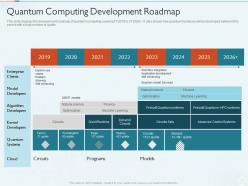
This slide displays the development roadmap of quantum computing covering FY2019 to FY2026. It also shows how quantum hardware will be developed between this period with a high number of qubits.
People who downloaded this PowerPoint presentation also viewed the following :
Quantum computing development roadmap quantum computing it ppt template with all 2 slides:
Use our Quantum Computing Development Roadmap Quantum Computing IT Ppt Template to effectively help you save your valuable time. They are readymade to fit into any presentation structure.
FAQs for Quantum computing development roadmap quantum computing
So most roadmaps focus on a few big things. First up is quantum advantage for actual useful stuff - not just Google's 2019 flex. IBM wants 100,000+ qubits by 2033 which honestly sounds insane but apparently that's what we need. Error-corrected logical qubits are another huge milestone. Then there's fault-tolerant computing - basically running long algorithms without everything falling apart from errors. Timeline-wise, companies are shooting for commercially viable systems by early 2030s, though honestly who knows if that'll stick. I'd follow IBM and Google's quarterly updates since they're always tweaking their roadmaps anyway.
Honestly, it depends a lot on what you're trying to solve. Shor's algorithm is crazy fast for factoring - like exponentially better than anything classical. Grover's gives you a solid quadratic boost for searching databases, which is decent but not mind-blowing. Then you've got stuff like variational quantum eigensolvers that are still kinda experimental. We don't really know how they'll scale up yet. The real trick is figuring out if your specific problem actually has a quantum advantage first. Don't just assume quantum = faster, because that's not always true. Match the algorithm to what you're actually doing.
So qubits are the main thing holding quantum computers back from getting bigger. More stable qubits = more complex problems you can solve. But here's what's tricky - you need both lots of them AND good quality ones. Having a thousand crappy qubits won't beat 50 really solid ones for most stuff. Decoherence and error rates are still major headaches honestly. The real goal is keeping quantum coherence working across bigger and bigger qubit groups. Oh and error correction is where all the exciting breakthroughs are happening - that's the game changer for scaling up.
Dude, error correction is the make-or-break thing for quantum computers. Current qubits are ridiculously fragile - they lose their quantum state almost instantly from tiny disturbances. Any real computation just turns to garbage without fixing those errors constantly. Good error correction can boost success rates from maybe 50-90% up to 99.9%+, which is actually usable. But here's the kicker - you need like hundreds of physical qubits just to make one reliable "logical" qubit. It's honestly kind of insane when you think about it. So yeah, always check what their error correction plan looks like.
Dude, quantum computing is wild but messy right now. The states are crazy fragile - any little interference kills them (that's decoherence). Error rates are insane compared to regular computers. Plus you need temps near absolute zero, which is nuts. It's honestly like building with soap bubbles sometimes! More qubits = harder to keep everything stable. Oh and if you're thinking about quantum stuff, hybrid approaches work best. Mix classical and quantum processing - that's where you'll actually see results instead of just burning money on experimental tech.
So quantum computing's gonna totally wreck today's encryption - but it'll also give us quantum cryptography that's basically uncrackable. The real game-changer though? Materials science. You'll be able to simulate molecular stuff that's impossible right now - like figuring out better batteries, new superconductors, drug interactions. Classical computers just hit a wall with all that exponential complexity, but quantum ones naturally work in those same quantum states. Timeline's anyone's guess honestly. I'd keep an eye on what IBM and Google are doing to see when this actually matters for whatever industry you're in.
So quantum supremacy is when quantum computers finally beat regular computers at specific tasks - but honestly, most of those tasks are pretty useless right now. Google did it in 2019 with some random number thing that was basically just showing off. The stuff that'll actually matter is when they crack real problems like drug research or breaking encryption. That's called "quantum advantage" and we're not there yet. Right now I'd just think about what problems you deal with that might benefit from this tech eventually, so you're not scrambling to catch up later when it actually works for normal people.
So quantum simulators use qubits that can be in multiple states at once - wild concept, right? Regular computers just crunch through problems step by step with 1s and 0s. That's why quantum ones are crazy good at stuff like molecular modeling and crypto problems. Supercomputers? They're basically just brute force machines throwing more power at everything. Works fine until you hit quantum-level calculations where they completely fall apart. Here's the thing though - quantum simulators aren't automatically better at everything. They're more like specialized tools that destroy certain problems but suck at others.
Honestly, the simulators and debuggers we have right now are pretty clunky. But start messing around with Qiskit or Cirq anyway - they're evolving super fast and you'll pick up the quantum thinking patterns. What we really need are better high-level languages that hide all the physics complexity. Error correction tools that actually work would be nice too. The visualization stuff for quantum states is getting better but still feels janky. Oh, and hybrid frameworks that don't make you want to pull your hair out when connecting quantum and classical parts. Even the imperfect tools today will teach you tons though.
Honestly, these partnerships are pretty smart. Universities bring all the theoretical research and fresh talent, while companies have the money and actual hardware to build stuff. IBM's doing this really well with their quantum network. Students get to work with real quantum computers instead of just reading about them in textbooks - which is huge. The research moves faster too since academics handle the science-y parts while industry deals with making things actually work at scale. I'd definitely look for programs with industry connections if you're serious about quantum research. Way better than being stuck in pure theory land, you know?
Honestly, quantum computers are gonna break all our current encryption eventually - like, everything from your bank account to private messages could be exposed. The whole thing makes me a bit nervous because only big tech companies and certain countries will get access first, creating these crazy power imbalances. We're looking at tech that'll completely change drug discovery, AI, financial modeling - the works. Companies should start working on quantum-resistant security like yesterday. Also pushing for policies that don't just benefit the usual suspects would be smart before this thing really takes off.
So there's tons of money flowing into quantum right now. The US National Quantum Initiative is throwing billions at it, and Europe has their Quantum Flagship doing similar stuff. China's dumping massive cash too but they're super secretive about numbers - typical. IBM, Google, Microsoft are all racing each other to crack quantum advantage first, which is honestly fun to watch. Oh, and definitely keep an eye on NSF and DOE grant announcements if you're serious about this field. They're usually good indicators of what's coming next.
So basically, the US lets companies like IBM and Google run wild with innovation, while China just dumps government money everywhere. Europe's doing their whole coordinated thing with Quantum Flagship - very them, honestly. Canada and Australia are getting weird and niche with quantum communications stuff. It's wild how political this has all gotten! For your planning though, think about what you actually need. US kills it on hardware breakthroughs. China's all about scaling things up fast. Europe's obsessed with making standards for everything. Map out which partnerships actually make sense for what you're trying to do.
Linear algebra and quantum mechanics are basically requirements - can't get around those. Python's your best bet for programming, plus Qiskit or Cirq for the quantum stuff. The math feels overwhelming at first but it starts making sense after a while. You'll also want to get decent with classical algorithms and optimization since quantum and classical computing work together a lot. Oh, and problem decomposition is huge. Start with online courses that mix theory with actual coding - way better than just reading about it. Most of the real work happens in simulation anyway, so get comfortable with that early.
Dude, quantum computing is gonna be huge for climate stuff. These machines can simulate new materials in ways that would take regular computers forever - we're talking better batteries, more efficient solar panels, crazy good carbon capture tech. IBM and Google are already running experiments on this. The supply chain optimization is wild too, like real-time power grid management that actually works. Honestly, I think quantum chemistry is where we'll see the first big wins. It's not just theoretical anymore - this stuff is actually happening now and it's pretty exciting.
-
Informative presentations that are easily editable.
-
It saves your time and decrease your efforts in half.
-
Excellent template with unique design.