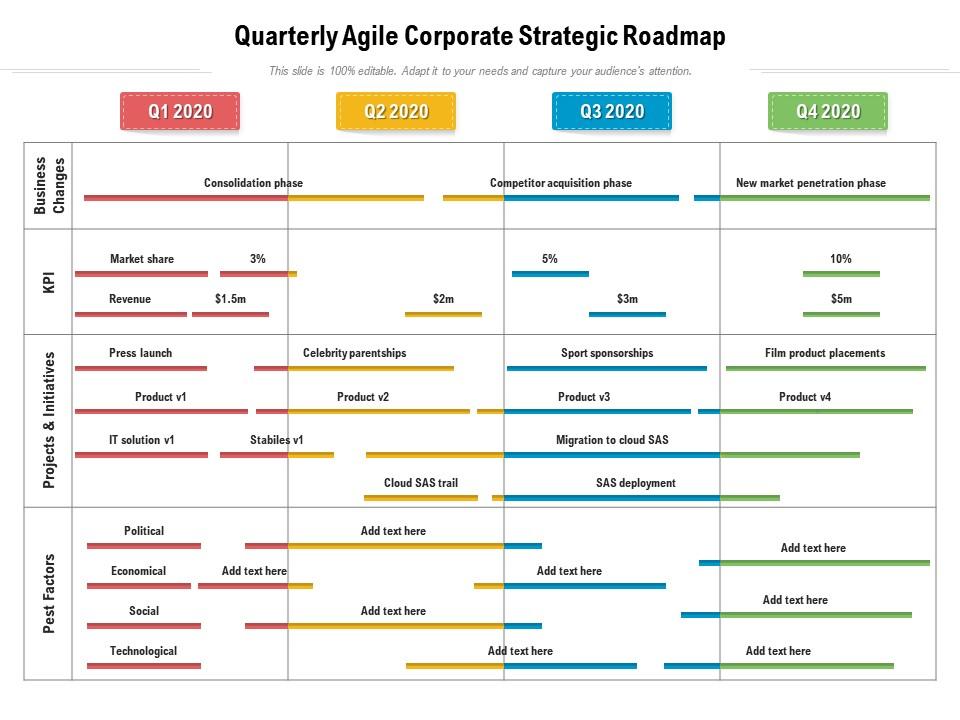
Feuille de route stratégique d'entreprise trimestrielle Agile

Rating:
84%
Quarterly agile corporate strategic roadmap
Slide 1 of 2
Favourites Favourites

Try Before you Buy Download Free Sample Product

Audience Impress Your
Audience
Editable 100%
Editable
Time Save Hours
of Time
The Biggest Sale is ending soon in
0
0
:
0
0
:
0
0
Rating:
84%

Caractéristiques de ces diapositives de présentation PowerPoint :

Modèle PowerPoint de présentation de la feuille de route stratégique d'entreprise Agile trimestrielle. Cette présentation PPT est compatible avec Google Slides, elle est donc facilement accessible. Vous pouvez télécharger et enregistrer cette mise en page PowerPoint dans différents formats tels que PDF, PNG et JPG. Ce thème PPT est disponible dans les formats d'image 4,3 et 16,9. Ce modèle PowerPoint est personnalisable afin que vous puissiez modifier la taille de la police, le type de police, la couleur et les formes selon vos besoins.

FAQs for Quarterly agile

So you'll need themes, epics, timeframes, and success metrics as your main building blocks. Focus on outcomes over features - like "improve user onboarding" not "build login page." I totally botched this when I started and went way too detailed lol. Set up quarterly or monthly swim lanes showing what each team's working toward, plus map out dependencies between workstreams. Each theme should clearly show business value and user impact. Oh and definitely keep it flexible - review regularly since agile roadmaps change as you learn. That's honestly the hardest part but super crucial.

So the big thing is flexibility - Agile roadmaps change constantly while waterfall locks everything down upfront. You're basically updating every few sprints based on what's actually happening vs. pretending you know exactly what'll happen 6 months from now (which honestly never works out anyway). Traditional planning focuses on hitting specific features by exact dates. Agile cares more about outcomes and keeps timelines loose. Instead of "we need X feature by March," think more like "we want to improve user retention this quarter." Way less stressful when priorities inevitably shift.

Honestly, roadmaps are lifesavers for getting your whole team aligned on where you're going. No more confused faces in standups when someone asks "why are we building this?" Your team actually understands the bigger picture. Stakeholder meetings become so much easier too - you can literally point to stuff and show what's happening. I use mine constantly for prioritization calls. Oh, and when things inevitably change (because they always do), it's way less stressful to explain the shifts. Just review it monthly with everyone. Trust me, it'll save you tons of headaches down the road.

So for backlog prioritization, I'd start with MoSCoW - it's dead simple and stakeholders actually get it. Value vs effort matrices are solid too, especially when you need those quick wins to show progress. RICE scoring gets more detailed if your team likes data (though honestly, sometimes it feels like overkill). The Kano model's pretty cool for figuring out what actually makes customers happy vs just checking boxes. Story mapping works well when you're trying to see the bigger user journey. My advice? Don't overthink it - just pick whichever method clicks with your team and actually use it consistently.

Start collecting feedback from stakeholders right away - like monthly check-ins where you walk through what you're prioritizing. Don't just gather their thoughts though, actually show them how their input changed your decisions. Honestly, the hardest part is when everyone wants different things (spoiler: they always do). Be upfront about those trade-offs. My process is pretty simple: collect feedback, figure out what matters most, then circle back to explain what you changed and why. Keeps people happy and prevents those awkward "wait, this isn't what we asked for" conversations down the road.

Check your roadmap every sprint or monthly - whatever you pick, just stick with it. Don't rely on gut feelings when making changes. Use real stuff instead: retrospective data, what users are actually saying, shifting business needs. Random updates when things feel weird? That approach sucks, honestly. Regular reviews work way better. Oh, and always loop in stakeholders before you change anything. Document your reasoning too - trust me, you'll forget why you made decisions faster than you think. Treat it like a living doc, not some carved-in-stone masterpiece.

Think of agile roadmaps as your GPS for product development. You've got your big company goals, right? Roadmaps help break those down into themes and epics that teams can actually tackle day-to-day. Everyone sees how their work connects to the bigger picture. The trick is staying flexible - priorities will shift, trust me. But you still need clarity so teams know why they're building stuff. I'd start by looking at your current sprint goals and mapping them back to strategic objectives. You'll probably find some gaps pretty quickly.

So time-boxing is basically putting hard deadlines on everything - your sprints, releases, all that planning stuff. It stops teams from getting stuck in analysis paralysis forever (trust me, I've seen it happen). You're forced to make decisions and move on instead of debating features until the end of time. Fixed time periods also mean you hit natural checkpoints where you can step back and see if you're still heading in the right direction. Maybe pivot if things aren't working. The trick is being honest about what you can actually get done - don't cram three weeks of work into two. Try mapping your roadmap to 2-week boxes first and see how it feels.

Honestly, forget about just tracking story points and velocity - that stuff doesn't tell you if you're actually building what matters. Focus on the real outcomes instead. Customer satisfaction scores, how many people are using your new features, time-to-market for big releases. I've seen too many teams nail their sprint goals but completely miss the mark on business impact. Revenue impact is huge. User engagement with what you ship. How often you're changing direction based on feedback (which isn't always bad, btw). The whole point is figuring out if your roadmap items are moving the needle, not just getting crossed off.

So if you're looking at Agile roadmap tools, start with Jira's roadmap thing if you're already in their ecosystem. ProductPlan and Roadmunk are pretty decent for cleaner visuals that stakeholders actually like looking at. But honestly? I've watched teams crush it using just Miro or even PowerPoint - which feels weird to admit but whatever works, right? The real trick isn't finding the perfect tool, it's picking something everyone will keep updated instead of abandoning after two weeks. Try a few free versions first before spending money on anything fancy.

Look, quarterly reviews are the absolute minimum - monthly's way better if your team can handle it. Get feedback from customers and your dev teams constantly about what's actually working vs. what sounded brilliant six months ago. Your roadmap isn't some holy document, it's more like... I dunno, a GPS that should reroute when there's traffic? Set priorities but don't marry them. Always build in buffer time for weird opportunities or when everything goes sideways. Honestly, just schedule your next review meeting this week before you forget.

Oh man, don't get too detailed - it's a roadmap, not your entire project plan. Teams always cram way too many features in there and then wonder why everyone's disappointed. Keep your timelines loose and focus on what you're trying to achieve, not just shipping stuff. The biggest mistake though? Treating it like some binding contract instead of something that'll change as you learn. Get your stakeholders involved early or you'll regret it later. Think of it more like telling a story about where you're headed - then actually review and tweak it regularly based on reality.

So with Scrum, you're basically planning sprint by sprint - your roadmap gets updated after each review cycle. Way more iterative. Kanban's totally different though, it's like this living thing that just flows with whatever's happening. Super flexible but can feel chaotic sometimes. SAFe throws more structure at you with those Program Increments. Makes everything predictable, which is nice, but you lose some of that quick pivot ability. Honestly? Just match your roadmap updates to whatever cadence you're already doing. Don't overthink it - if you're reviewing sprints every two weeks, update your roadmap then too.

So cross-functional teams are a game-changer for Agile roadmaps. No more waiting around for other departments to get back to you - developers, designers, testers, and product folks just work together directly. Decisions happen fast, problems get fixed on the spot. Way better than that endless email chain nightmare we've all been through. You'll actually ship working features each sprint instead of passing around incomplete stuff. My old company learned this the hard way. Just figure out what skills your next roadmap piece needs and grab those people for one team.

Honestly, Agile roadmaps are pretty great for catching problems before they blow up in your face. Instead of finding out you're screwed at the very end, you're breaking everything into smaller pieces so issues pop up during sprints when you can actually do something about it. The whole feedback thing means you're constantly checking - am I about to drive off a cliff here? Everyone stays in the loop too, so stakeholders can yell "wait, stop!" when they spot trouble. Oh, and use your retrospectives to talk through what risks showed up and how to tweak your roadmap. That's where the real learning happens.

Ratings and Reviews

84% of 100
Review Form
Write a review
Most Relevant Reviews
  1. 80%

    by Clay Castillo

    Informative presentations that are easily editable.
  2. 80%

    by O'Neill Reyes

    Content of slide is easy to understand and edit.
  3. 100%

    by Christian Brooks

    Much better than the original! Thanks for the quick turnaround.
  4. 80%

    by Courtney Griffin

    Out of the box and creative design.
  5. 80%

    by Wilson Cooper

    Professional and unique presentations.

5 Item(s)

per page: