

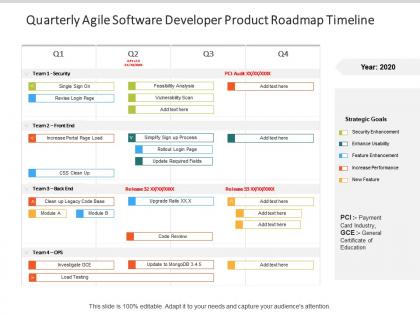
Quarterly agile software developer product roadmap timeline




Try Before you Buy Download Free Sample Product
 Impress Your
 Audience
 100%
100% Editable
 Save Hours
 of Time


Visualize your work plan and communicate your ideas impactfully with our pre designed Quarterly Agile Software Developer Product Roadmap Timeline. Showcase the detailed overview of the project, the key deliverables, and the milestones to be achieved with the help of our fully customizable PowerPoint layout. You can easily emphasize on the project goals and discuss all the activities involved in an easy to comprehend manner by utilizing our professionally designed PPT theme. This roadmap PowerPoint layout is a perfect strategic planning tool that can help in keeping the project on track. With our attractive PowerPoint theme, you can articulate the workflow, track the work progress, and have a clear vision of the goal to be achieved. Download this versatile Quarterly Agile Software Developer Product Roadmap Timeline and save your hours of work.
People who downloaded this PowerPoint presentation also viewed the following :
Quarterly agile software developer product roadmap timeline with all 2 slides:
Give your audience a fulfilling experience. They will find our Quarterly Agile Software Developer Product Roadmap Timeline elevating.
FAQs for Quarterly agile software developer
Key metrics for a Quarterly Agile Roadmap include velocity tracking, sprint completion rates, story point accuracy, feature delivery timelines, and customer satisfaction scores. These metrics enable organizations to monitor progress, identify bottlenecks, and optimize resource allocation, with many development teams finding that combining quantitative performance data with qualitative feedback ultimately delivers enhanced project visibility and strategic alignment.
Teams prioritize features and initiatives through value-based scoring, stakeholder impact analysis, technical feasibility assessment, and strategic alignment evaluation. This structured approach enables organizations to balance customer needs, business objectives, and resource constraints, with many development teams finding that quarterly prioritization cycles streamline delivery timelines and enhance competitive positioning.
Effective retrospective best practices include structured data collection, cross-functional team participation, outcome-focused analysis, stakeholder feedback integration, and actionable insight documentation. These approaches enhance quarterly planning by identifying delivery bottlenecks, resource optimization opportunities, and strategic alignment gaps, with many organizations finding that systematic retrospectives ultimately deliver improved roadmap accuracy and enhanced team performance.
Cross-functional collaboration enhances Quarterly Agile Roadmap effectiveness by improving communication between teams, aligning diverse perspectives on priorities, and reducing silos that create bottlenecks. Through regular cross-team planning sessions, organizations streamline development cycles, accelerate decision-making, and deliver more cohesive products, with many finding that integrated collaboration ultimately drives faster time-to-market and stronger competitive advantage.
Quarterly Agile Roadmap visualization tools include Jira, Azure DevOps, Roadmunk, ProductPlan, and Aha!, enabling teams to track sprints, dependencies, and deliverables across quarters. These platforms streamline planning by integrating with development workflows, facilitating stakeholder communication, and providing real-time progress tracking, with many organizations finding that visual roadmaps enhance alignment and accelerate delivery timelines.
**INPUT**: How often should the Quarterly Agile Roadmap be revisited or adjusted during the quarter? **OUTPUT**: Quarterly Agile Roadmaps should be revisited bi-weekly or monthly, with formal adjustments made based on sprint retrospectives, stakeholder feedback, and changing market conditions. This cadence enables organizations to maintain strategic alignment while remaining responsive to emerging opportunities, with many teams finding that regular touchpoints streamline resource allocation and ultimately deliver enhanced project outcomes.
Stakeholder feedback serves as a critical input for quarterly agile roadmaps, influencing priority adjustments, feature refinements, resource allocation, and strategic direction changes based on real user needs and market conditions. Through regular feedback loops, product teams can pivot roadmap elements, validate assumptions, and ensure deliverables align with business objectives, ultimately enhancing customer satisfaction and competitive positioning.
Agile frameworks like Scrum and Kanban significantly influence quarterly roadmap creation by providing structured sprint planning, iterative delivery cycles, and continuous feedback loops that enable adaptive prioritization. These methodologies streamline roadmap development through regular retrospectives, backlog refinement, and cross-functional collaboration, with many organizations finding that this approach delivers greater flexibility, faster time-to-market, and enhanced stakeholder alignment.
The ideal duration for planning a Quarterly Agile Roadmap is typically 2-4 weeks, allowing teams to balance detailed preparation with adaptive responsiveness to changing market conditions. This timeframe enables organizations to conduct thorough stakeholder consultations, prioritize features strategically, and align cross-functional teams, while maintaining sufficient flexibility to pivot quickly when new opportunities or customer feedback emerges.
Organizations align their Quarterly Agile Roadmap with strategic business objectives by establishing clear priority frameworks, conducting regular stakeholder reviews, mapping feature deliverables to business outcomes, and maintaining flexible sprint planning cycles. Through strategic roadmap sessions, companies streamline product development, enhance cross-functional collaboration, and accelerate time-to-market, with many finding that quarterly alignment delivers measurable ROI and competitive advantage.
Common pitfalls include overcommitting to rigid timelines, neglecting stakeholder alignment, underestimating technical dependencies, failing to incorporate feedback loops, and creating overly detailed plans too far ahead. Teams should maintain flexibility while balancing ambition with realistic capacity, with many organizations finding that quarterly reviews and adaptive planning deliver better outcomes than fixed roadmaps.
MVP integration into quarterly agile roadmaps involves defining core features for each quarter, prioritizing user feedback loops, and establishing measurable success criteria that align with long-term product vision. This approach enables teams to deliver incremental value while validating assumptions, with many software companies and startups finding that quarterly MVP releases accelerate market validation and reduce development costs.
Effective risk management techniques in Quarterly Agile Roadmaps include continuous risk assessment, dependency mapping, stakeholder impact analysis, contingency planning, and regular retrospectives. These approaches enable teams to identify potential bottlenecks early, prioritize high-impact issues, and maintain delivery momentum, with many organizations finding that proactive risk mitigation ultimately enhances project predictability and stakeholder confidence.
Teams ensure alignment between Quarterly Agile Roadmaps and customer expectations through regular feedback collection, stakeholder reviews, priority validation sessions, and continuous market research. Through customer journey mapping and user story refinement, organizations streamline product development cycles, enhance delivery predictability, and minimize feature-market gaps, ultimately delivering higher satisfaction rates and stronger competitive positioning.
Continuous improvement enables teams to refine future Quarterly Agile Roadmaps by analyzing past sprint performance, identifying bottlenecks, and incorporating stakeholder feedback into planning processes. Through retrospectives and data-driven insights, organizations streamline resource allocation, enhance delivery predictability, and adapt roadmap priorities, with many teams finding that iterative refinement ultimately delivers more accurate timelines and stronger strategic alignment.
No Reviews