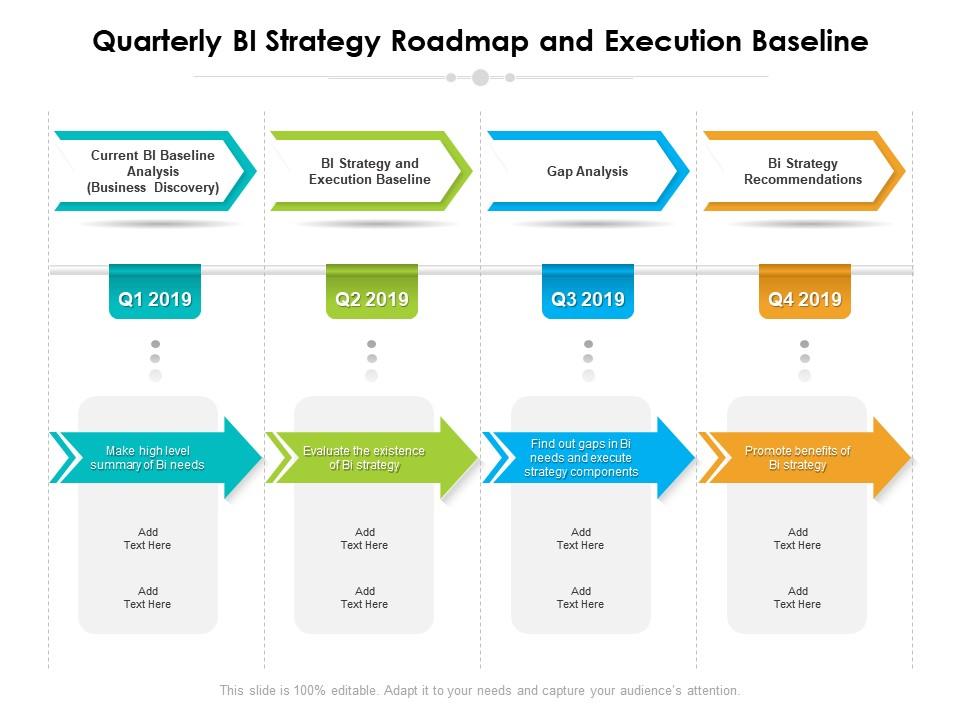
Feuille de route trimestrielle de la stratégie BI et ligne de base d'exécution
Try Before you Buy Download Free Sample Product
Audience
Editable
of Time
Un plan d'action bien pensé facilite l'exécution et augmente considérablement les chances de succès. Assurez-vous d'atteindre toutes les étapes dans les délais en introduisant notre feuille de route trimestrielle de la stratégie BI et notre ligne de base d'exécution entièrement personnalisables. Rationalisez les informations liées au travail, le budget, le calendrier, les livrables clés, les repères et les principales étapes impliquées, le tout en un seul endroit pour donner un aperçu organisé du projet en utilisant notre thème PowerPoint. Minimisez le décalage temporel et augmentez l'efficacité du travail en fournissant un aperçu du processus grâce à notre mise en page PowerPoint de feuille de route largement étudiée. Le codage couleur aide à mettre en évidence le processus et attire l'attention du public. Téléchargez notre feuille de route stratégique trimestrielle et notre ligne de base d'exécution pour identifier les problèmes éventuels en un temps beaucoup plus court et proposer des solutions. Organisez une session de brainstorming productive avec votre personnel en utilisant notre outil de visualisation de plan d'action.
Caractéristiques de ces diapositives de présentation PowerPoint :
Présentation de la feuille de route trimestrielle de la stratégie BI et de la diapositive PowerPoint de base d'exécution. Cette présentation PPT est compatible avec Google Slides, elle est donc facilement accessible. Ce thème PPT est disponible dans les formats d'image 4,3 et 16,9. Ce modèle PowerPoint est personnalisable afin que vous puissiez modifier la taille de la police, le type de police, la couleur et les formes selon vos besoins. Vous pouvez télécharger et enregistrer cette mise en page PowerPoint dans différents formats tels que PDF, PNG et JPG.
People who downloaded this PowerPoint presentation also viewed the following :
Feuille de route trimestrielle de la stratégie BI et référence d'exécution avec les 2 diapositives :
Utilisez notre feuille de route trimestrielle de la stratégie BI et notre ligne de base d'exécution pour vous aider efficacement à gagner un temps précieux. Ils sont prêts à l'emploi pour s'adapter à n'importe quelle structure de présentation.
FAQs for Quarterly bi strategy roadmap
Here's what I'd focus on: quarterly goals that actually connect to business results, plus regular check-ins with stakeholders. Data governance is huge too - can't stress that enough. Build automated dashboards with KPIs leadership actually cares about (not vanity metrics). Most BI strategies crash because they're way too abstract, so yours needs to give people insights they'll genuinely use. Oh, and feedback loops are clutch - monthly reviews let you pivot when things aren't working. Honestly? Start small. Pick 2-3 critical business questions you need answered this quarter and nail those first.
Honestly, data analytics is a total game-changer for your quarterly planning. Instead of just guessing what'll work, you actually get real-time insights showing what's performing and what's bombing. The predictive analytics part? That's where it gets really cool - you can catch trends early and pivot before things go sideways. I'd definitely set up some automated dashboards so you're not stuck digging through Excel when your boss randomly asks for numbers (been there, not fun). You can also break down performance by customer segments or channels. Way better than waiting until quarter-end to realize you were completely off track.
Honestly, pick three things to watch: whether teams actually use your dashboards, how fast they can make decisions from the data, and if it's moving the business needle. I've seen so many beautiful dashboards that literally no one touches - such a waste. Query speed matters too because slow data just pisses people off. Same with accuracy obviously. Don't try tracking everything right away though. Grab 2-3 metrics your stakeholders care about and stick with those. Way better than drowning in measurements you'll never look at.
Look, first thing - connect your BI projects to actual business goals each quarter. Skip the pretty dashboards that just sit there collecting dust (we've all built those). Focus on stuff that keeps your executives up at night. Regular check-ins with stakeholders are crucial - priorities shift constantly and you don't want to be working on outdated metrics. Honestly, I'd rather have an ugly report that drives real decisions than a gorgeous one nobody touches. Bottom line: pick KPIs that clearly show revenue impact, cost savings, or better customer experience. Everything you deliver should tie back to measurable results.
Honestly, tech is make-or-break for quarterly BI stuff. Your data integration tools pull everything from different systems, then analytics platforms crunch the numbers. Visualization is where it gets interesting though - turns boring spreadsheets into dashboards people actually want to look at. Without decent infrastructure you're just guessing each quarter. Oh, and don't skimp on training your team first - I've seen that backfire badly. Get platforms that'll grow with you instead of buying twice.
Honestly, most people screw this up by launching stuff first then scrambling to figure out what to measure later. You'll want to pick your success metrics upfront - like revenue impact, cost savings, user engagement, whatever makes sense for your thing. Compare everything against your baseline from before you started. I'd stick with maybe 2-3 core metrics instead of tracking every possible data point (trust me, you won't look at half of it anyway). Track both the quick wins like adoption rates AND the bigger picture stuff like actual revenue. Monthly check-ins work well to catch problems early.
Honestly, the biggest mistake is trying to do everything at once - total recipe for burnout. Talk to your actual users first, not just what you think they want (learned this the hard way). Skip the vague goals like "better insights" and pick real metrics you can track. Don't rip out your whole BI setup either, that's just asking for trouble. Oh and resist making dashboards that look cool but nobody actually uses. Start with something small that works, then build from there. You've got time to fix everything, just not in your first 90 days.
Okay so first thing - figure out who actually owns what data because that's where everything falls apart. Get marketing, sales, finance and IT in the same room every two weeks to check progress on your KPIs. I'd create dashboards everyone can actually read (not just the data nerds). Pick someone in each department to be your BI champion - they'll translate the tech stuff into real business moves. Most teams think they're aligned but they're totally not. Schedule those cross-department reviews now before you lose another quarter to miscommunication.
Honestly, start with KPIs that actually move the needle - forget those vanity metrics that just look pretty in slides. Clean data is everything; I'd rather have boring accurate numbers than a flashy dashboard built on garbage. Get your data collection automated wherever you can, then loop in your end users early because they'll catch weird stuff you totally missed. Oh and set up those regular stakeholder reviews so you're not just hoarding data like some weird dragon. The whole point is making decisions, right? Monthly check-ins will save you from realizing you've been tracking the wrong things three months later.
So quarterly reviews are the bare minimum, but honestly? Markets move way too fast now for that to be enough. I'd do quick monthly check-ins - maybe 30 minutes with your key people - to see if your metrics still make sense. Really depends on your industry though. If you're launching stuff constantly or things are changing fast, you might need to pivot more often. Just don't go crazy and confuse everyone by switching directions every week. The deeper strategy stuff can wait for those quarterly sessions.
Honestly, quarterly BI check-ins are a game changer for keeping everyone on the same page. You get these regular touchpoints where stakeholders actually know what's coming instead of random reports flying around (which is honestly kind of messy). Trust builds up because people can plan around your schedule. Plus you're showing the good and bad stuff proactively - way better than waiting for someone to come asking questions. I'd start by figuring out who needs what level of detail, then build some standard dashboards they can check between meetings. The predictability alone makes such a difference.
Honestly, quarterly BI reviews are a game changer - way better than those painful annual deep dives nobody looks forward to. Every three months you're getting fresh insights and can actually pivot when things go sideways. Markets move fast these days, so checking your data quarterly is like... I dunno, updating your GPS mid-trip instead of just winging it. You'll catch issues before they blow up. Plus you can ditch metrics that aren't pulling their weight anymore. My advice? Pick 3-5 KPIs that actually matter to your business, build some decent dashboards around them, and stick to the schedule.
So basically, old-school quarterly reviews just tell you what already went down - like reading yesterday's newspaper. BI strategy is totally different because you're working with live data to actually see what's coming. Gone are the days of endless spreadsheets and those gut-feeling decisions (thank god). Now you can pull real-time info from everywhere to spot trends before they hit you. Problems get caught early instead of blindsiding you three months later. Honestly? You'll stop wasting time building reports and start making moves that actually matter for your business.
Don't just tack on qualitative stuff at the end - weave it into your whole quarterly process from the start. Schedule regular chats with stakeholders, customers, team retrospectives throughout the quarter. Honestly, this beats staring at dashboards all day. Create some simple way to capture and sort these insights so they actually inform your data analysis. The magic happens when you connect the "what" from your numbers with the "why" from people's feedback. I'd set up a basic template where you document both types side-by-side for each business area. Way more useful than pure spreadsheet hell.
Honestly, quarterly BI tracking is clutch for sustainability stuff. You're checking carbon footprint, waste, energy use every three months - not too much data overload but often enough to catch issues. Leadership eats this up when they see both profit and planet numbers going up (shocking, I know). Three months gives you time to actually fix problems instead of just panicking over daily fluctuations. The best part? You can tie sustainability wins directly to business results. Makes it way harder for anyone to dismiss green initiatives as just "nice to have" fluff when you've got solid quarterly data backing everything up.
No Reviews