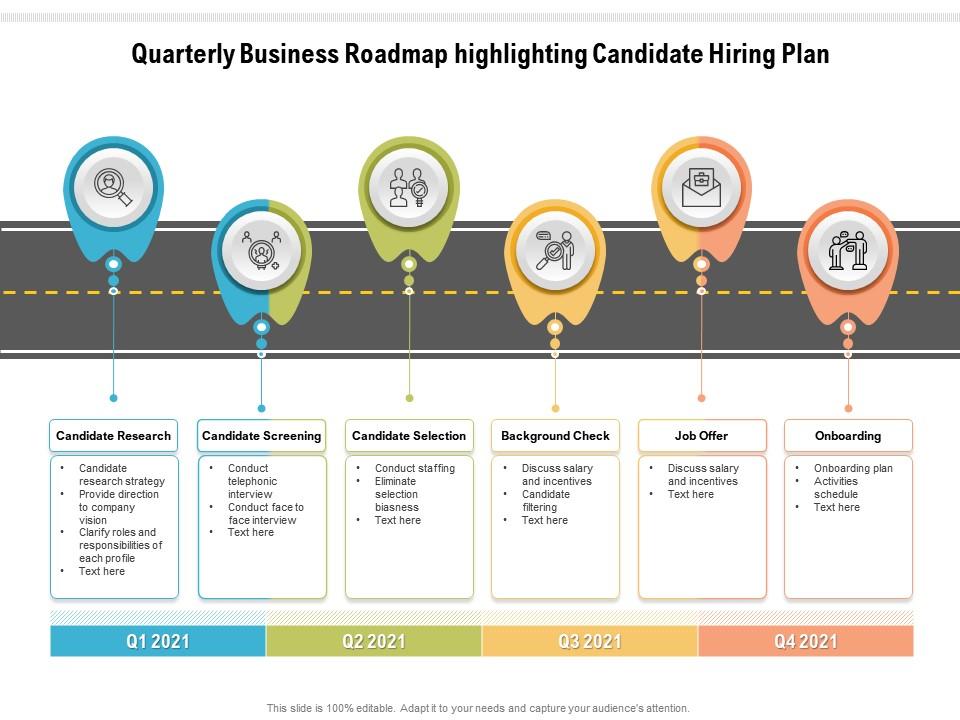
Roteiro de Negócios Trimestral Destacando o Plano de Contratação de Candidatos
Try Before you Buy Download Free Sample Product
Audience
Editable
of Time
Visualize seu plano de trabalho e comunique suas ideias de forma impactante com nosso Roteiro de Negócios Trimestral Preconcebido, Destacando o Plano de Contratação de Candidatos. Apresente a visão geral detalhada do projeto, as principais entregas e os marcos a serem alcançados com a ajuda de nosso layout de PowerPoint totalmente personalizável. Você pode facilmente enfatizar os objetivos do projeto e discutir todas as atividades envolvidas de uma maneira fácil de compreender, utilizando nosso tema PPT projetado profissionalmente. Este layout de PowerPoint de roteiro é uma ferramenta de planejamento estratégico perfeita que pode ajudar a manter o projeto nos trilhos. Com nosso atraente tema PowerPoint, você pode articular o fluxo de trabalho, acompanhar o andamento do trabalho e ter uma visão clara do objetivo a ser alcançado. Baixe este versátil Roteiro de Negócios Trimestral Destacando o Plano de Contratação de Candidatos e economize suas horas de trabalho.
Características destes slides de apresentação do PowerPoint:
Apresentando o Roteiro de Negócios Trimestral, Destacando o Plano de Contratação do Candidato, slide do PowerPoint. Este tema PPT está disponível nas proporções 4,3 e 16,9. Este modelo do PowerPoint é personalizável para que você possa modificar o tamanho da fonte, o tipo de fonte, a cor e as formas de acordo com suas necessidades. Esta apresentação PPT é compatível com o Google Slides, portanto, é facilmente acessível. Você pode baixar e salvar este layout do PowerPoint em diferentes formatos, como PDF, PNG e JPG.
People who downloaded this PowerPoint presentation also viewed the following :
Conteúdo desta apresentação em PowerPoint
Roteiro de negócios trimestral destacando o plano de contratação de candidatos com todos os 2 slides:
Use nosso Roteiro de Negócios Trimestral Destacando o Plano de Contratação de Candidatos para ajudá-lo efetivamente a economizar seu valioso tempo. Eles são readymade para caber em qualquer estrutura de apresentação.
FAQs for Quarterly business roadmap highlighting
**INPUT**: What key factors should be considered when developing a candidate hiring plan? **OUTPUT**: Key factors include defining role requirements, establishing timeline and budget parameters, identifying sourcing channels, creating evaluation criteria, and determining team responsibilities. These strategic components streamline recruitment by aligning stakeholder expectations, optimizing resource allocation, and ensuring consistent candidate assessment, with many organizations finding that comprehensive planning reduces time-to-hire and enhances overall hiring quality. [Word count: 54 words]
Organizations align hiring plans with business goals by conducting strategic workforce planning, identifying skill gaps, forecasting future needs, and mapping roles to specific objectives. This strategic alignment enables companies to recruit talent that directly supports growth initiatives, operational efficiency, and competitive positioning, with many businesses finding that structured hiring plans reduce time-to-fill and enhance overall performance outcomes.
Employer branding significantly impacts hiring plan effectiveness by attracting quality candidates, reducing recruitment costs, and accelerating the hiring process through enhanced company reputation and visibility. Strong employer branding enables organizations to compete for top talent more effectively, with companies in competitive sectors like technology and finance finding that authentic brand messaging ultimately delivers faster placements and higher candidate acceptance rates.
Data-driven decision-making enhances candidate selection by leveraging analytics to identify top talent, predict job performance, and reduce hiring bias through objective metrics and standardized assessments. Through advanced algorithms and performance data, organizations streamline recruitment processes, improve candidate quality, and achieve faster hiring cycles, with many companies finding that data-driven approaches deliver better employee retention and reduced turnover costs.
Strategies to attract diverse candidates include partnering with diverse professional organizations, posting on niche job boards, implementing blind resume screening, expanding recruitment to HBCUs and community colleges, and using inclusive language in job descriptions. These approaches streamline talent acquisition by broadening reach, minimizing unconscious bias, and creating welcoming environments, with many organizations finding that diverse teams ultimately deliver enhanced innovation and competitive advantage.
Best practices for creating compelling job descriptions include clearly defining role responsibilities, emphasizing growth opportunities, showcasing company culture, using inclusive language, and specifying required qualifications versus preferred skills. These elements attract quality candidates by highlighting career development potential, work-life balance, and meaningful impact, while many organizations find that authentic, specific descriptions significantly improve candidate quality and reduce hiring timeline inefficiencies.
Technology and recruitment software streamline hiring by automating candidate screening, centralizing applicant data, and accelerating communication workflows throughout the selection process. These platforms enable HR teams to reduce time-to-hire significantly, enhance candidate experiences through seamless interactions, and ultimately deliver better talent acquisition outcomes while minimizing administrative overhead.
Methods to evaluate hiring plan effectiveness include time-to-fill metrics, cost-per-hire analysis, candidate quality assessments, retention rates, and hiring manager satisfaction scores. These evaluation approaches enable organizations to streamline recruitment processes, optimize resource allocation, and enhance candidate experiences, with many companies finding that regular assessment delivers improved hiring outcomes and stronger competitive advantage in talent acquisition.
Cultural fit and organizational values significantly influence candidate selection by aligning employee behaviors with company objectives, reducing turnover rates, and enhancing team cohesion. Through structured interviews and values-based assessments, organizations in sectors like technology and healthcare evaluate candidates' alignment with core principles, ultimately delivering stronger workplace relationships, improved retention, and sustained competitive advantage in talent acquisition.
Employee referrals should serve as a strategic cornerstone in comprehensive hiring plans, typically generating 25-40% of quality hires through enhanced cultural fit, faster onboarding, and reduced recruitment costs. These programs streamline talent acquisition by leveraging existing networks, improving retention rates, and accelerating time-to-hire, with many organizations finding that referred candidates demonstrate stronger long-term performance and engagement.
Organizations utilize social media in recruitment by leveraging LinkedIn for professional networking, Facebook and Instagram for employer branding, Twitter for job announcements, and YouTube for company culture videos. These platforms enhance candidate reach, reduce hiring costs, and enable targeted advertising, with many companies finding that strategic social media presence attracts top talent while showcasing workplace culture effectively.
Key metrics include time-to-fill, cost-per-hire, quality of hire scores, candidate satisfaction ratings, and retention rates within the first year. These measurements enable organizations to streamline recruitment processes, optimize resource allocation, and enhance candidate experiences, with many companies finding that tracking these indicators ultimately delivers faster hiring cycles and stronger long-term employee performance.
Hiring managers can be trained through structured interview techniques, behavioral assessment methods, unconscious bias recognition, and standardized evaluation frameworks. These training programs enhance assessment accuracy by teaching competency-based questioning, reference verification processes, and cultural fit evaluation, with many organizations finding that consistent training reduces hiring errors and improves candidate selection outcomes.
Common pitfalls include unclear role requirements, limited sourcing channels, lengthy approval processes, inadequate candidate communication, and lack of diversity considerations. These oversights can result in missed talent opportunities, extended time-to-fill metrics, and poor candidate experiences, with many organizations finding that streamlined processes and clear communication protocols ultimately deliver stronger hiring outcomes and competitive talent acquisition advantage.
Onboarding practices integrate into hiring plans through structured timeline development, role-specific training modules, mentorship assignments, and performance milestone tracking from day one. This strategic combination enables organizations to reduce turnover, accelerate productivity, and enhance employee engagement, with many companies finding that seamless hiring-to-onboarding transitions deliver stronger retention rates and faster time-to-value outcomes.
No Reviews