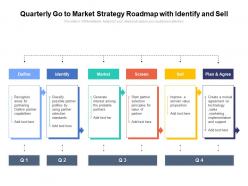
Vierteljährliche Markteinführungsstrategie-Roadmap mit Identifizieren und Verkaufen
Try Before you Buy Download Free Sample Product
Audience
Editable
of Time
Ein gut durchdachter Aktionsplan erleichtert die Ausführung und erhöht die Erfolgschancen erheblich. Stellen Sie sicher, dass Sie alle Meilensteine innerhalb der Fristen erreichen, indem Sie unsere vollständig anpassbare Roadmap für die vierteljährliche Go-to-Market-Strategie mit Identifizieren und Verkaufen einführen. Optimieren Sie die arbeitsbezogenen Informationen, das Budget, den Zeitrahmen, die wichtigsten Ergebnisse, Meilensteine und wichtigen Schritte an einem Ort, um einen organisierten Überblick über das Projekt zu erhalten, indem Sie unser PowerPoint-Design verwenden. Minimieren Sie Zeitverzögerungen und steigern Sie die Arbeitseffizienz, indem Sie mit unserem umfassend recherchierten Roadmap-PowerPoint-Layout Einblick in den Prozess geben. Die Farbcodierung hilft bei der Hervorhebung des Prozesses und erregt die Aufmerksamkeit des Publikums. Laden Sie unsere praktische vierteljährliche Go-to-Market-Strategie-Roadmap mit Identifizieren und Verkaufen herunter, um mögliche Problembereiche in viel kürzerer Zeit zu identifizieren und Lösungen vorzuschlagen. Führen Sie ein produktives Brainstorming mit Ihren Mitarbeitern durch, indem Sie unser Aktionsplan-Visualisierungstool verwenden.
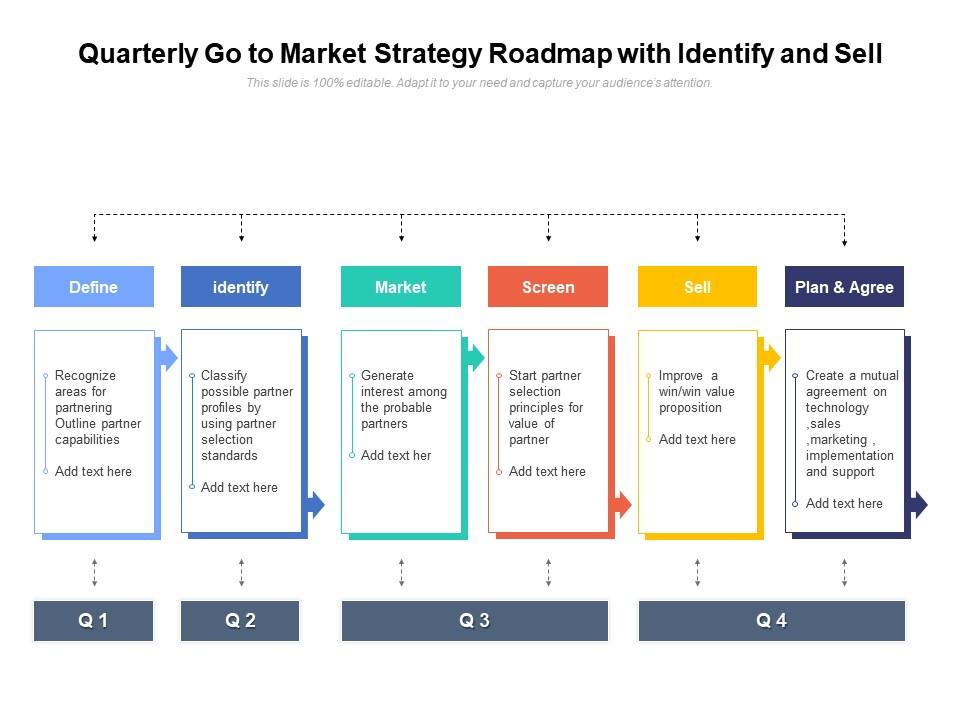
Merkmale dieser PowerPoint-Präsentationsfolien:
Präsentation der vierteljährlichen Go-to-Market-Strategie-Roadmap mit PowerPoint-Folie „Identifizieren und Verkaufen“. Diese PPT-Präsentation ist mit Google Slides kompatibel und daher leicht zugänglich. Dieses PPT-Design ist in den Seitenverhältnissen 4,3 und 16,9 verfügbar. Diese PowerPoint-Vorlage ist anpassbar, sodass Sie die Schriftgröße, den Schriftarttyp, die Farbe und die Formen gemäß Ihren Anforderungen ändern können. Sie können dieses PowerPoint-Layout in verschiedenen Formaten wie PDF, PNG und JPG herunterladen und speichern.
People who downloaded this PowerPoint presentation also viewed the following :
Vierteljährliche Go-to-Market-Strategie-Roadmap mit Identifizieren und Verkaufen mit allen 2 Folien:
Bieten Sie Ihrem Publikum ein erfüllendes Erlebnis. Sie finden unsere vierteljährliche Go-to-Market-Strategie-Roadmap mit Identifizieren und Verkaufen.
FAQs for Quarterly go to market strategy roadmap with
Key components include target market identification, value proposition development, pricing strategy, distribution channels, sales methodology, and competitive positioning. These elements work together by defining customer segments, articulating unique benefits, and establishing scalable pathways to market, with many organizations finding that strategic alignment across these components accelerates market entry and drives sustainable revenue growth.
Companies identify their target market through comprehensive market research, customer segmentation analysis, competitive landscape assessment, demographic profiling, and behavioral pattern studies. This strategic combination enables businesses to pinpoint high-value customer segments, understand purchasing behaviors, and tailor messaging effectively, with many organizations finding that precise targeting significantly reduces acquisition costs while accelerating market penetration and revenue growth.
Competitive analysis shapes go-to-market strategy by identifying market gaps, revealing pricing opportunities, uncovering positioning strategies, and highlighting differentiation points. Through comprehensive competitor research, organizations can refine their value propositions, adjust pricing models, and select optimal distribution channels, ultimately enabling them to enter markets with strategic advantages and avoid costly positioning mistakes.
Businesses can effectively outline their USP by identifying specific customer pain points, analyzing competitor gaps, defining measurable value propositions, and articulating clear differentiation factors. Through targeted market research and customer feedback analysis, companies in sectors like SaaS, retail, and financial services streamline messaging, enhance brand positioning, and ultimately deliver stronger market penetration and competitive advantage.
Go-to-market success metrics include customer acquisition cost, conversion rates, revenue growth, market penetration, customer lifetime value, and time-to-market indicators. These measurements enable organizations to assess market reception, optimize resource allocation, and refine strategic approaches, with many companies finding that tracking both leading and lagging indicators ultimately delivers competitive advantage and sustainable growth.
Pricing strategies significantly impact go-to-market execution by influencing customer acquisition, market positioning, and competitive differentiation across target segments. Strategic pricing enables businesses to accelerate market penetration, optimize revenue streams, and establish brand perception, with many organizations finding that value-based pricing models enhance customer relationships while premium positioning delivers sustainable competitive advantage and improved profit margins.
Common pitfalls include inadequate market research, unclear value propositions, misaligned sales and marketing teams, insufficient customer segmentation, and unrealistic timeline expectations. These challenges often stem from rushing to market without proper validation, with many organizations finding that thorough preparation, cross-functional alignment, and iterative testing ultimately deliver stronger market penetration and sustainable competitive advantage.
Businesses can align sales and marketing teams through shared revenue goals, unified customer personas, integrated CRM systems, regular cross-team meetings, and collaborative content creation. This strategic alignment streamlines lead handoffs, eliminates messaging inconsistencies, and accelerates customer acquisition cycles, with many organizations finding that coordinated teams deliver 36% higher customer retention and significantly faster market penetration.
Customer feedback is crucial for refining go-to-market strategies because it reveals actual market needs, pricing sensitivities, messaging effectiveness, and channel preferences that assumptions often miss. Through direct customer insights, companies can adjust their positioning, streamline their sales processes, and enhance their value propositions, ultimately delivering more targeted solutions and competitive advantage in an increasingly customer-driven marketplace.
Digital marketing significantly enhances go-to-market effectiveness by enabling precise audience targeting, real-time performance tracking, and scalable customer acquisition across multiple channels. Through social media campaigns, content marketing, and data analytics, companies can accelerate brand awareness, generate qualified leads, and optimize messaging based on customer feedback, ultimately delivering faster market penetration and measurable ROI.
Product positioning defines how your offering differentiates from competitors, communicates unique value propositions, and resonates with target customer segments within specific market categories. This strategic foundation guides messaging frameworks, pricing strategies, and channel selection, with many organizations finding that clear positioning accelerates market penetration, enhances customer acquisition, and ultimately delivers stronger competitive advantage across diverse industries.
Companies can leverage partnerships by accessing complementary customer bases, sharing distribution channels, co-developing products, pooling marketing resources, and utilizing partner expertise in new markets. Strategic alliances enable businesses to accelerate market entry, reduce customer acquisition costs, and enhance credibility, with many organizations finding that collaborative go-to-market approaches deliver faster scaling and competitive positioning.
Effective international market entry strategies include joint ventures with local partners, direct investment in subsidiaries, licensing agreements, franchising models, and strategic acquisitions. These approaches enable organizations to leverage local market knowledge, navigate regulatory requirements, and establish distribution channels, with many companies finding that combining multiple entry methods across different regions ultimately delivers faster market penetration and sustainable competitive advantage.
Customer personas aid go-to-market strategy development by defining target segments, identifying pain points, informing messaging frameworks, guiding channel selection, and shaping product positioning. These detailed profiles enable organizations to tailor their approach across marketing, sales, and product teams, ultimately delivering more resonant campaigns and higher conversion rates in an increasingly competitive marketplace.
Best practices for creating a compelling go-to-market presentation include defining clear target audiences, articulating unique value propositions, outlining competitive positioning, establishing measurable success metrics, and presenting realistic implementation timelines. These strategic elements work together by aligning stakeholders around market opportunities, demonstrating revenue potential, and building investor confidence, ultimately enabling organizations to secure funding and accelerate market entry.
No Reviews