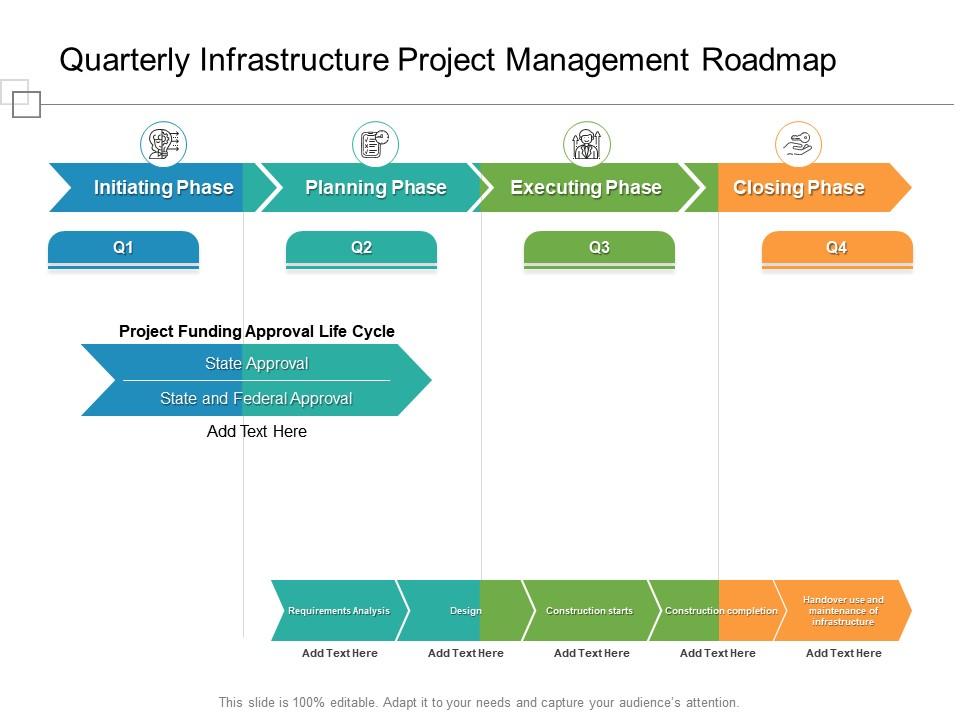
Guía trimestral de gestión de proyectos de infraestructura

Quarterly infrastructure project management roadmap
Slide 1 of 2
Favourites Favourites

Try Before you Buy Download Free Sample Product

Audience Impress Your
Audience
Editable 100%
Editable
Time Save Hours
of Time
The Biggest Sale is ending soon in
0
0
:
0
0
:
0
0

Características de estas diapositivas de presentación de PowerPoint:

Presentación de la plantilla trimestral de PowerPoint para la hoja de ruta de gestión de proyectos de infraestructura. Esta presentación PPT es compatible con Google Slides, por lo que es fácilmente accesible. Puede descargar y guardar este diseño de PowerPoint en diferentes formatos como PDF, PNG y JPG. Este tema de PPT está disponible en relaciones de aspecto de 4,3 y 16,9. Esta plantilla de PowerPoint se puede personalizar para que pueda modificar el tamaño de fuente, el tipo de fuente, el color y las formas según sus requisitos.

FAQs for Quarterly infrastructure

Infrastructure roadmaps should include current state assessment, future technology requirements, security frameworks, scalability considerations, and budget allocation timelines. These elements work together by identifying gaps, prioritizing investments, and establishing clear milestones, with many organizations finding that comprehensive roadmaps reduce implementation costs while ensuring seamless integration and long-term operational efficiency.

Organizations align their infrastructure roadmap with strategic vision by conducting comprehensive business-technology assessments, establishing clear performance metrics, and creating cross-functional governance teams that bridge IT and business leadership. This strategic alignment enables companies across sectors like financial services, healthcare, and manufacturing to prioritize technology investments that directly support revenue growth, operational efficiency, and competitive differentiation, ultimately delivering measurable business outcomes.

Effective methodologies include infrastructure auditing, capacity planning assessments, performance benchmarking, gap analysis, and stakeholder requirement mapping. These approaches streamline evaluation by identifying current system limitations, resource utilization patterns, and scalability constraints, with many organizations finding that combining technical assessments with business impact analysis delivers comprehensive insights for strategic infrastructure planning and competitive advantage.

Organizations should prioritize infrastructure projects by evaluating business impact, technical dependencies, resource requirements, and timeline constraints, while aligning with strategic objectives and risk tolerance. Through systematic assessment frameworks, companies can sequence initiatives that deliver quick wins alongside foundational capabilities, with many finding that balancing immediate operational improvements with long-term scalability investments ultimately maximizes returns and competitive advantage.

Emerging technologies can be integrated through phased implementation approaches, compatibility assessments, pilot program deployments, strategic vendor partnerships, and gradual system migrations that minimize operational disruption. Organizations in sectors like manufacturing and healthcare successfully layer AI, cloud computing, and IoT solutions onto existing frameworks, ultimately delivering enhanced efficiency and competitive advantage while preserving critical legacy investments.

Stakeholder engagement ensures infrastructure roadmaps align with diverse organizational needs, technical requirements, and business objectives through collaborative input, feedback loops, and consensus building. Effective engagement involving IT teams, business leaders, and end users delivers comprehensive planning, reduces implementation resistance, and accelerates adoption, with many organizations finding that inclusive roadmap development ultimately enhances project success rates and strategic outcomes.

Infrastructure roadmaps should be reviewed quarterly and updated annually, with major revisions triggered by significant technological shifts, regulatory changes, or business pivots. Many organizations find that regular quarterly assessments enable proactive adjustments to emerging technologies like cloud migrations or cybersecurity requirements, while annual comprehensive updates ensure strategic alignment, ultimately delivering competitive advantage and operational resilience.

Common pitfalls include underestimating integration complexities, neglecting scalability requirements, inadequate stakeholder consultation, unrealistic timelines, and insufficient budget allocation for unforeseen challenges. These oversights often derail implementation, with many organizations finding that thorough risk assessment, phased approaches, and continuous stakeholder engagement ultimately deliver more resilient infrastructure transformations and sustainable competitive advantage.

Risk management can be incorporated into infrastructure roadmaps through comprehensive risk assessments, mitigation strategies, contingency planning, regular monitoring protocols, and stakeholder alignment processes. These approaches enable organizations to identify potential vulnerabilities, allocate resources strategically, and maintain operational continuity, with many enterprises finding that proactive risk integration ultimately delivers enhanced system reliability and competitive advantage.

Key metrics for infrastructure roadmap success include system uptime, performance benchmarks, cost optimization ratios, scalability indicators, and security compliance scores. These measurements enable organizations to track operational efficiency, resource utilization, and strategic alignment, with many enterprises finding that regular metric assessment ultimately delivers improved service reliability, reduced operational costs, and enhanced competitive positioning in increasingly complex digital environments.

Organizations ensure sustainability and resilience by integrating renewable energy sources, implementing redundant systems, conducting regular risk assessments, and adopting scalable cloud architectures. These strategic approaches enable businesses to minimize environmental impact, maintain operational continuity during disruptions, and adapt to changing demands, with many finding that sustainable infrastructure ultimately delivers cost savings and competitive advantage.

Regulatory requirements significantly shape infrastructure roadmaps by mandating compliance standards, security protocols, data governance frameworks, and operational transparency measures. These requirements drive strategic technology investments, with financial institutions prioritizing regulatory reporting systems, healthcare organizations implementing HIPAA-compliant infrastructure, and manufacturing companies adopting environmental compliance monitoring, ultimately delivering enhanced risk management and competitive advantage through proactive regulatory alignment.

Cross-departmental collaboration enhances infrastructure roadmap outcomes by aligning technical requirements with business objectives, ensuring comprehensive resource planning, and identifying integration opportunities across systems. Through strategic coordination between IT, operations, finance, and business units, organizations streamline implementation timelines, minimize operational disruptions, and optimize budget allocation, ultimately delivering more cohesive infrastructure solutions.

Essential tools include Microsoft Visio, Lucidchart, Roadmunk, ProductPlan, and Aha! for visualization, while Jira, ServiceNow, and Microsoft Project enable comprehensive tracking capabilities. These platforms streamline infrastructure planning by providing real-time progress monitoring, stakeholder collaboration features, and automated reporting functions, with many IT organizations finding that integrated dashboards significantly enhance project visibility and strategic alignment across complex infrastructure initiatives.

Lessons learned from previous infrastructure projects inform future roadmaps by identifying successful implementation strategies, revealing common pitfalls, and highlighting resource optimization opportunities. Organizations leverage these insights to refine project timelines, improve stakeholder engagement approaches, and enhance risk mitigation strategies, with many finding that documented experiences significantly reduce implementation costs and accelerate deployment schedules.

Ratings and Reviews

0% of 100
Review Form
Write a review
Most Relevant Reviews

No Reviews