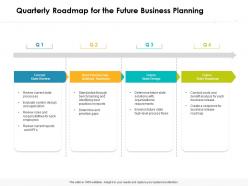
Hoja de ruta trimestral para la planificación empresarial del futuro
Try Before you Buy Download Free Sample Product
Audience
Editable
of Time
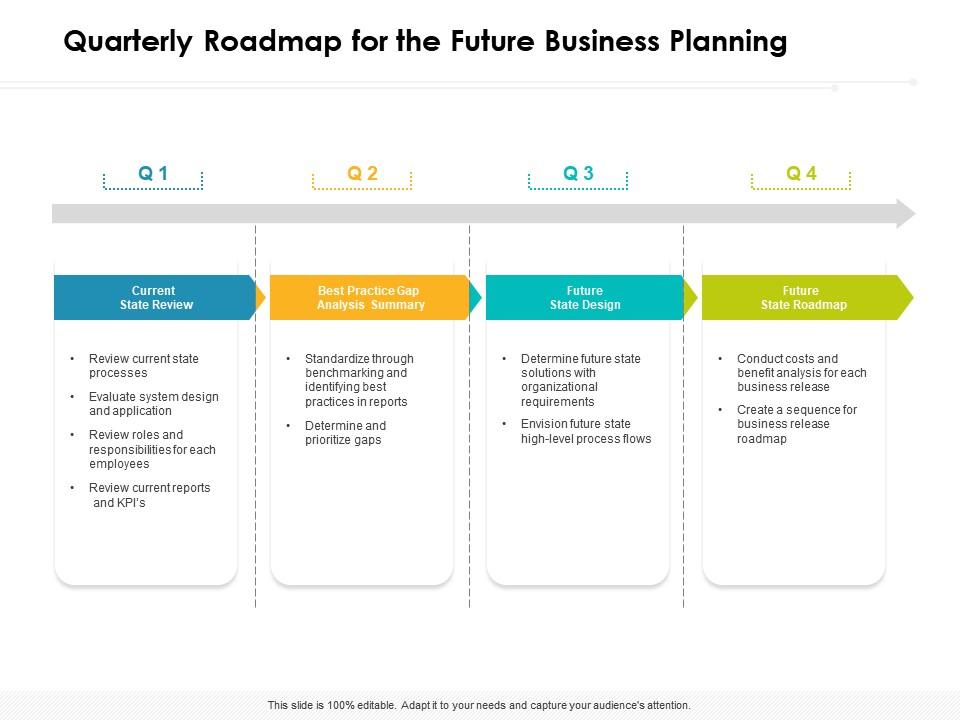
La tasa de éxito de los planes de negocios depende en gran medida del plan de acción, y esta hoja de ruta trimestral editable para la planificación empresarial del futuro cumple correctamente el propósito. Encapsule toda la información relacionada con el proyecto de manera bien estructurada para obtener la máxima eficiencia al incorporar nuestro impresionante tema de PowerPoint. Indique el entregable crítico, los pasos involucrados, el marco de tiempo, la asignación de la fuerza laboral y mucho más de una manera fácil de entender utilizando este diseño de PowerPoint de hoja de ruta prediseñado. También puede priorizar sus tareas y discutir las áreas problemáticas con sus colegas incorporando este diseño PPT personalizado. Potencie su plan de trabajo empleando este tema de PPT diseñado profesionalmente. Los empresarios pueden descargar la hoja de ruta trimestral para la planificación empresarial futura como una herramienta de comunicación beneficiosa que facilita la colaboración con diferentes tareas y el logro de objetivos.
Características de estas diapositivas de presentación de PowerPoint:
Presentación de la hoja de ruta trimestral para la diapositiva de PowerPoint de planificación empresarial futura. Esta diapositiva PPT está disponible en relaciones de aspecto de 4,3 y 16,9. Puede descargar este tema PPT en varios formatos como PDF, PNG y JPG. Esta plantilla de PowerPoint es completamente editable y puede modificar el tamaño de fuente, el tipo de fuente y las formas según sus requisitos. Nuestro diseño PPT es compatible con Google Slides.
People who downloaded this PowerPoint presentation also viewed the following :
Hoja de ruta trimestral para la planificación empresarial futura con las 2 diapositivas:
Ofrezca a su audiencia una experiencia satisfactoria. Encontrarán que nuestra hoja de ruta trimestral para la planificación empresarial del futuro es estimulante.
FAQs for Quarterly roadmap for the
Key components of an effective quarterly business roadmap include strategic objectives, measurable milestones, resource allocation plans, timeline frameworks, and performance indicators. These elements work together by aligning team priorities, streamlining project execution, and enabling real-time progress tracking, with many organizations finding that comprehensive roadmaps deliver enhanced operational efficiency and competitive advantage.
Aligning quarterly business roadmaps with company objectives involves cascading strategic goals into measurable quarterly milestones, establishing clear KPIs that directly support annual targets, and ensuring cross-departmental coordination through regular alignment reviews. This strategic approach enables organizations to maintain focus on priority initiatives, track meaningful progress toward long-term vision, and adapt tactical execution while preserving strategic direction, ultimately delivering consistent advancement toward overarching business goals.
Quarterly roadmap success metrics include revenue growth, customer acquisition rates, operational efficiency improvements, project completion percentages, and strategic milestone achievements. These measurements enable organizations to track progress across financial, operational, and strategic dimensions, with many companies finding that combining leading indicators like customer satisfaction scores with lagging indicators like profit margins delivers comprehensive performance visibility and competitive advantage.
Quarterly business roadmaps should be reviewed monthly and updated as needed, with formal revisions occurring mid-quarter and at quarter-end to ensure alignment with changing market conditions. Many organizations find that monthly check-ins enable teams to adjust priorities, reallocate resources, and respond to new opportunities, ultimately maintaining strategic momentum while delivering measurable results.
Stakeholder input ensures quarterly roadmaps align with diverse organizational priorities, customer needs, market requirements, and operational constraints through collaborative feedback sessions. By incorporating perspectives from sales teams, customer service representatives, product managers, and executive leadership, companies develop more comprehensive strategies that balance competing demands, ultimately delivering roadmaps with broader buy-in and higher execution success rates.
Technology streamlines quarterly roadmap creation through automated data integration, real-time collaboration platforms, interactive visualization tools, and dynamic updating capabilities. Cloud-based project management systems enable teams to collaboratively build roadmaps with live data feeds, while dashboard technologies provide stakeholders instant access to progress tracking and milestone updates, ultimately delivering enhanced transparency and faster strategic alignment across organizations.
Common pitfalls include setting unrealistic timelines, lacking stakeholder input, failing to prioritize initiatives, ignoring resource constraints, and creating overly rigid plans without flexibility. These challenges can derail strategic execution by creating bottlenecks, misaligned expectations, and missed opportunities, with many organizations finding that balancing ambition with practical implementation ultimately delivers sustainable growth and competitive advantage.
A quarterly roadmap facilitates collaboration by establishing shared priorities, clear timelines, and defined ownership across departments, while providing transparent visibility into dependencies and milestones. Through regular checkpoint reviews and progress tracking, teams maintain alignment on strategic objectives, identify bottlenecks early, and adjust resources accordingly, ultimately delivering enhanced cross-functional coordination and measurable accountability.
Market trends influence quarterly roadmaps by reshaping customer demands, competitive landscapes, and strategic priorities, requiring businesses to adjust product development, resource allocation, and go-to-market strategies. Organizations across retail, technology, and financial services increasingly adapt their quarterly objectives based on emerging trends, with many finding that trend-responsive roadmaps deliver enhanced market positioning and competitive advantage.
Balancing short-term goals with long-term vision requires strategic alignment where quarterly objectives directly contribute to broader organizational milestones, regular progress assessment, and flexible resource allocation. Many companies find that breaking long-term initiatives into measurable quarterly deliverables, while maintaining buffer capacity for emerging opportunities, enables sustainable growth and competitive positioning without sacrificing immediate operational needs.
Visual elements that enhance quarterly business roadmap communication include timeline charts, milestone markers, progress indicators, color-coded priorities, and departmental swim lanes. These components streamline complex strategic information by creating clear visual hierarchies, enabling stakeholders to quickly identify dependencies and critical paths, while ultimately delivering improved alignment and faster decision-making across organizations.
Risk assessment within quarterly roadmaps involves identifying potential operational, financial, market, and execution risks through stakeholder input, data analysis, and scenario planning. Organizations mitigate these risks by developing contingency plans, establishing buffer timelines, diversifying resource allocation, and implementing regular checkpoint reviews, with many finding that proactive risk management enhances project success rates and maintains strategic momentum.
**INPUT**: What tools or software are recommended for creating a professional-looking quarterly roadmap? **OUTPUT**: Professional quarterly roadmap tools include Microsoft Project, Asana, Roadmunk, ProductPlan, and Aha!, each offering timeline visualization, milestone tracking, and collaborative features. These platforms streamline strategic planning by enabling cross-functional alignment, automated progress updates, and stakeholder communication, with many organizations finding that integrated dashboards ultimately deliver enhanced transparency and faster decision-making across departments.
Ensuring quarterly roadmap flexibility requires building in buffer time for adjustments, establishing regular review checkpoints, and maintaining contingency plans for critical initiatives. Strategic roadmap management involves creating modular project structures, prioritizing initiatives by impact and urgency, and fostering cross-functional communication channels, with many organizations finding that this adaptive approach delivers sustained competitive advantage while minimizing disruption during unexpected market shifts.
Incorporating feedback loops into quarterly planning enables continuous improvement by capturing insights from customers, employees, and market performance, allowing teams to adjust strategies based on real-world data. This iterative approach helps organizations identify gaps early, optimize resource allocation, and maintain alignment with evolving business objectives, ultimately delivering more responsive strategies and competitive advantage in dynamic markets.
No Reviews