Ransomware In Digital Age RACI Matrix For Ransomware Attacks Prevention Strategy
Try Before you Buy Download Free Sample Product
Audience
Editable
of Time
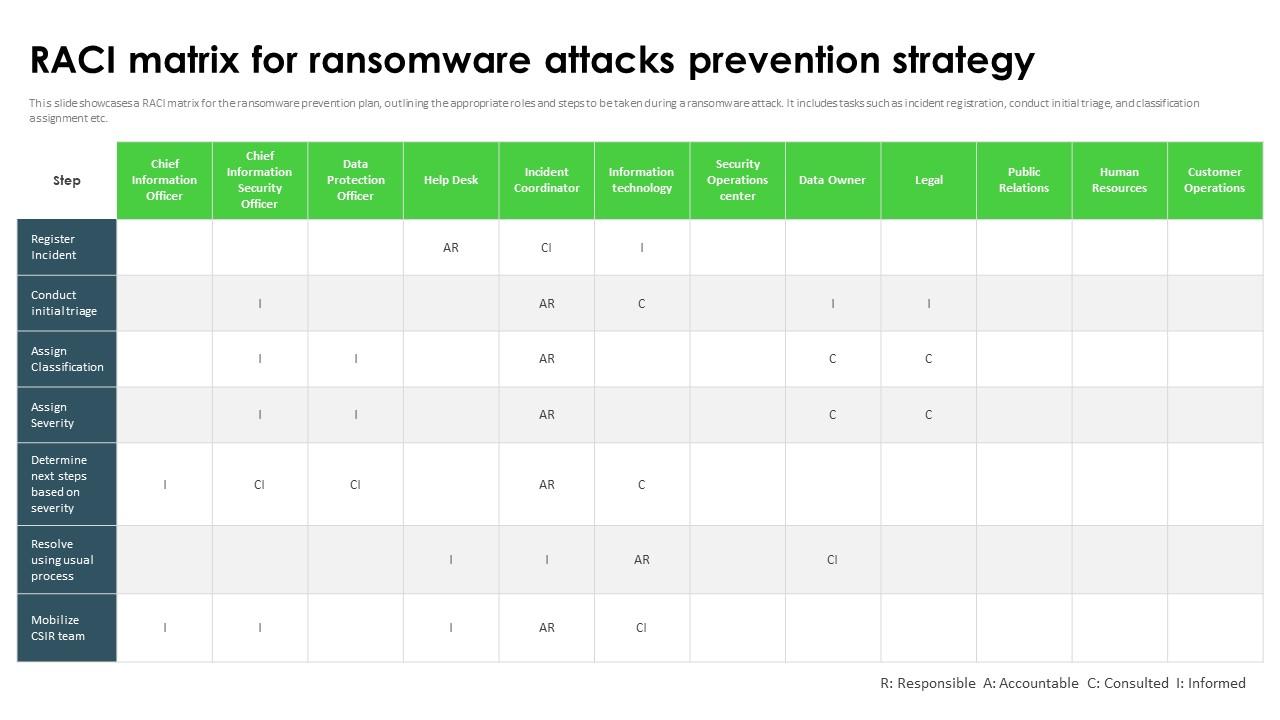
This slide showcases a RACI matrix for the ransomware prevention plan, outlining the appropriate roles and steps to be taken during a ransomware attack. It includes tasks such as incident registration, conduct initial triage, and classification assignment etc.
People who downloaded this PowerPoint presentation also viewed the following :
Ransomware In Digital Age RACI Matrix For Ransomware Attacks Prevention Strategy with all 9 slides:
Use our Ransomware In Digital Age RACI Matrix For Ransomware Attacks Prevention Strategy to effectively help you save your valuable time. They are readymade to fit into any presentation structure.
FAQs for Ransomware In Digital Age RACI Matrix For Ransomware
Key components include robust backup systems, endpoint protection, network segmentation, employee training, and incident response planning. These security measures work together by creating multiple defense layers, ensuring data recovery capabilities, and minimizing attack surfaces, with many organizations finding that combining proactive monitoring with regular security assessments ultimately delivers enhanced resilience and faster threat response.
Organizations can assess ransomware vulnerability through comprehensive security audits, penetration testing, employee phishing simulations, network segmentation reviews, and backup system evaluations. These assessments identify weak points across IT infrastructure, employee training gaps, and recovery capabilities, with many financial institutions and healthcare systems finding that regular vulnerability assessments significantly enhance their defensive posture and incident response preparedness.
Employee training serves as a critical first line of defense against ransomware by teaching staff to recognize phishing emails, suspicious links, malicious attachments, and social engineering tactics that cybercriminals commonly exploit. Through comprehensive security awareness programs, organizations significantly reduce human error vulnerabilities, enhance incident response capabilities, and create a security-conscious culture, with many companies finding that well-trained employees prevent up to 90% of potential ransomware attacks.
Regular data backup is critical because it provides an independent recovery path when ransomware encrypts primary systems, eliminates leverage attackers hold over organizations, and ensures business continuity during incidents. Through automated, immutable backup solutions, companies in healthcare, finance, and manufacturing can restore operations within hours rather than paying ransoms, ultimately maintaining competitive advantage while reducing downtime costs.
Cybersecurity frameworks help organizations protect against ransomware by providing structured risk assessment protocols, incident response procedures, and comprehensive security controls across all systems. Through frameworks like NIST or ISO 27001, companies establish robust backup strategies, employee training programs, and network segmentation practices, ultimately delivering proactive threat detection and faster recovery capabilities that minimize operational disruption.
Effective ransomware detection technologies include AI-powered behavioral analysis, endpoint detection and response (EDR) systems, network traffic monitoring, email security gateways, and backup encryption solutions. These technologies work by identifying suspicious file encryption patterns, monitoring unusual network activity, and blocking malicious attachments, with many organizations finding that layered security approaches deliver significantly better protection than single-point solutions.
Organizations should update their software and systems immediately when security patches become available, typically implementing automated updates for critical security fixes within 24-48 hours. Many financial institutions and healthcare organizations find that establishing monthly comprehensive update cycles, combined with emergency patching protocols, significantly reduces vulnerability windows while maintaining operational stability and competitive security positioning.
Weak passwords significantly increase ransomware vulnerability by enabling brute-force attacks, credential stuffing, and lateral network movement once systems are compromised. These security gaps allow cybercriminals to escalate privileges and deploy ransomware across organizational networks, with many financial institutions and healthcare systems finding that password vulnerabilities serve as primary attack vectors, ultimately compromising sensitive data and operational continuity.
Organizations should immediately isolate infected systems, activate incident response protocols, assess backup integrity, and engage cybersecurity experts while avoiding ransom payments. Through swift containment measures, comprehensive damage assessment, and strategic recovery planning, companies can minimize operational disruption, preserve critical data, and restore services systematically, ultimately strengthening their security posture for future threats.
Endpoint ransomware protection requires implementing advanced threat detection, regular automated backups, employee security training, network segmentation, and timely software updates. These security measures work by isolating potential threats, ensuring rapid recovery capabilities, and minimizing attack surfaces, with many organizations finding that this layered approach significantly reduces ransomware risks while maintaining operational continuity.
Network segmentation prevents ransomware by isolating critical systems, limiting lateral movement, and containing potential breaches within specific network zones. Through strategic network isolation, organizations can protect essential databases, minimize attack surfaces, and maintain operational continuity during incidents, with many financial institutions and healthcare systems finding that segmented architectures significantly reduce recovery costs.
Organizations must consider data breach notification laws, regulatory reporting requirements, incident disclosure obligations, and potential sanctions for inadequate cybersecurity measures. Financial institutions, healthcare providers, and government contractors face particularly stringent compliance frameworks, with many finding that proactive legal consultation and documented incident response procedures help minimize regulatory exposure while ensuring faster recovery and maintained stakeholder trust.
Threat intelligence enhances ransomware prevention by identifying emerging attack vectors, tracking threat actor tactics, and providing early warning indicators of potential campaigns. Through real-time intelligence feeds, organizations can proactively update security controls, patch vulnerabilities, and strengthen endpoint defenses, with many enterprises finding that intelligence-driven strategies significantly reduce breach likelihood and response times.
Organizations can secure their supply chain against ransomware through vendor risk assessments, multi-factor authentication requirements, network segmentation, regular security audits, and incident response protocols. These measures work by isolating critical systems, verifying third-party security standards, and monitoring data flows, with many companies finding that strategic vendor partnerships and continuous monitoring ultimately deliver enhanced resilience and operational continuity.
Incident response plans can be tailored for ransomware by incorporating immediate isolation protocols, backup verification procedures, specialized forensic analysis, and coordinated communication strategies with law enforcement and cybersecurity experts. These customized approaches enable organizations to minimize system downtime, preserve critical evidence, and restore operations more effectively, with many financial institutions and healthcare systems finding that ransomware-specific protocols reduce recovery time by 40-60% compared to generic incident responses.
-
Good research work and creative work done on every template.
-
Love how there are no boring templates here! The design is fresh and creative, just the way I like it. Can't wait to edit and use them for my extended projects!Â