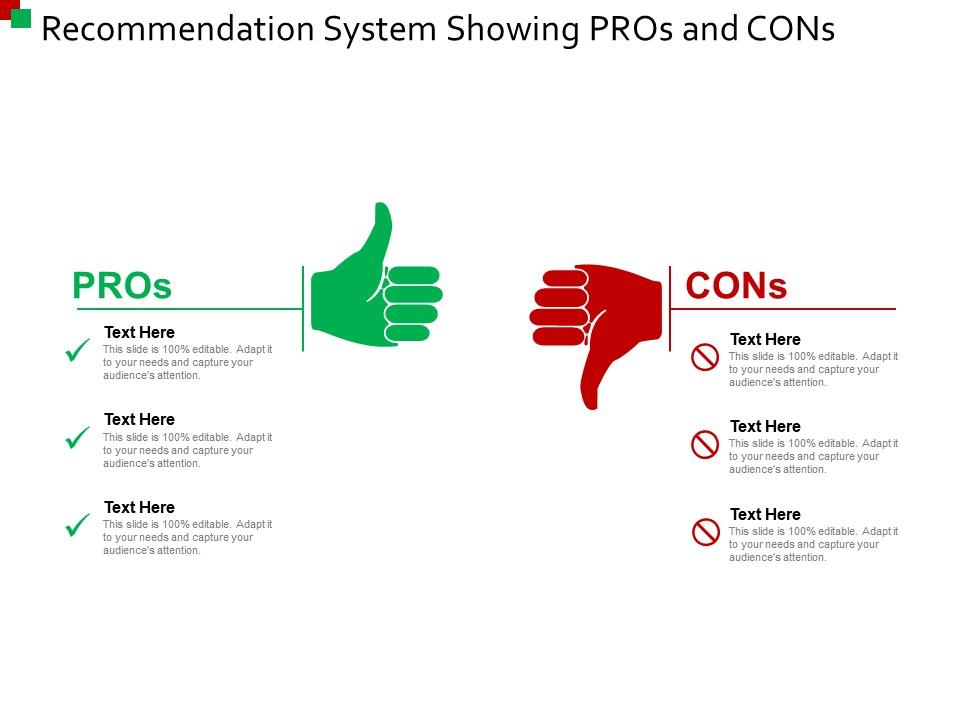
Recommendation system showing pros and cons
Try Before you Buy Download Free Sample Product
Audience
Editable
of Time
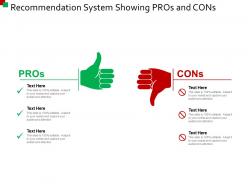
Do you want to represent pros and cons of processes, projects, system and more? Use our professionally drafted recommendation system showing pros and cons PPT diagram to do it efficiently. With this wonderful recommendation systems PPT, you can easily define the strong and weak points of several topics. This PPT design is also useful while you explain key elements of a business, that are helpful in achieving business objectives and barriers coming on the way for the firm from achieving business goals. You can use this amazing recommendation PowerPoint template to give a categorical view of recommender systems showing pros and cons of business. PPT diagram can be used by business managers, students, researchers to show collaborative recommendation of any system such as pros and cons of online shopping or social media. This pros and cons PowerPoint template is very useful now a day to analyze growth factors and barriers for any business. Download by clicking on download button and display important pros and cons of any system in an impressive way. Keep your eyes on the chart with our Recommendation System Showing Pros And Cons. Ensure folks follow the correct course.
People who downloaded this PowerPoint presentation also viewed the following :
Recommendation system showing pros and cons with all 5 slides:
Handle the case efficiently with our Recommendation System Showing Pros And Cons. Don't allow energies to get dissipated.
FAQs for Recommendation system showing
So there's basically three types to think about. **Collaborative filtering** checks out what people similar to you liked and suggests stuff based on that. Then you've got **content-based filtering** - this one looks at the actual features of items and matches them to what you're into, like suggesting more jazz after you binned Miles Davis on repeat. Most big platforms actually use **hybrid systems** now since they mix both methods and honestly just work way better. Collaborative's awesome when you have loads of user data to work with. Content-based though? Better for new stuff that doesn't have much interaction yet. I'd say figure out what your data situation looks like first - that'll point you toward the right direction.
So collaborative filtering is pretty smart - it finds users with similar tastes to you and recommends stuff they liked that you haven't seen yet. Think of it like your friend who has great movie taste, but powered by algorithms. The system gets smarter as more people use it, which is honestly kind of cool. What's great is how it creates those random discovery moments where you find something amazing you never would've searched for. Way more personal than just looking at your own history. That's what keeps people actually engaged instead of just scrolling endlessly.
So basically, content filtering looks at stuff your users already liked and finds similar things to recommend. Like if someone's into high-rated sci-fi movies, it'll suggest more of those. You build profiles for each item using whatever data you have - genre, director, keywords, all that. Then match those against what users historically prefer. Start by figuring out which features actually matter to your audience (this part's honestly more art than science). The whole thing's pretty simple once you wrap your head around it. Oh and don't overthink the metadata extraction - sometimes the obvious stuff works best.
So basically ML is what makes recommendation engines not suck. It digs through tons of user data to find weird patterns - like people buying running shoes on Tuesdays also love protein bars (random but whatever). The cool part? It keeps learning from new user behavior, so recommendations actually improve over time instead of being stuck with those crappy "other customers bought" suggestions. Honestly, collaborative filtering is your best starting point if you're building one - it's pretty straightforward to set up and you'll see decent results fast. Way better than doing it manually, trust me.
Yeah, privacy stuff is a real pain for recommendation systems. GDPR and similar laws mean you can't just hoover up whatever data you want anymore. Getting proper consent is annoying but necessary. Your recommendations will probably be less accurate since you're working with anonymized or limited data - honestly, it sucks but that's reality now. I'd focus more on collaborative filtering instead of tracking every click someone makes. Oh, and definitely figure out what data you actually *need* versus what would just be cool to have. Build those privacy controls in early or you'll hate yourself later.
Honestly, it depends what you're trying to achieve, but I'd go with precision@k, recall@k, and click-through rate as your main ones. Precision shows how many of your top recommendations were actually good. Recall tells you what percentage of relevant stuff you caught. CTR is huge - doesn't matter how smart your algorithm is if people aren't clicking, right? NDCG works well too if ranking order is important for you. Oh, and conversion rate is obviously key but maybe tackle that after you get the basics down. Start simple, then build from there.
So basically you've got a few options here. New users? Hit them with popular stuff or demographic matches until they rate some things. New items are trickier - you'll want to use their actual features like genre or price to find similar stuff. Honestly, the onboarding part is huge though. Ask people to rate a bunch of things upfront or just straight-up ask what they like. Hybrid systems work pretty well too since they mix different approaches. Oh, and knowledge-based ones are solid because they don't need any history at all. Start broad, then get personal as data comes in.
Honestly, cold start is gonna be your biggest headache - like recommending stuff to complete strangers. Data sparsity sucks too, plus once you scale up things get messy fast. You'll spend forever balancing exploration vs exploitation, and don't get me started on filter bubbles. Oh, and feedback loops where your recs actually change what people do next? That's a whole thing. Start with basic collaborative filtering, then add content-based stuff later. Focus hard on implicit feedback data early since nobody leaves ratings anymore. Trust me on that one - explicit ratings are basically dead.
Get both explicit feedback (ratings, thumbs up/down) and implicit stuff like how long people actually spend looking at recommendations. Explicit feedback is way more valuable since users are directly telling you their preferences. Set up your system so this data keeps retraining your models - either real-time updates or scheduled batches work. Pay extra attention to negative feedback because people complain way more than they praise, which is honestly pretty typical human behavior. Start simple with basic ratings and track how more feedback improves your accuracy. Click-through rates and purchase data also give you tons of insight.
Dude, personalization is seriously worth it. You'll see 20-40% bumps in clicks and how long people stay on your site. Makes total sense though - when your recommendations don't suck, users actually engage more and keep coming back. The tricky part? You want to nail their preferences but also throw in some surprises they didn't know they'd love. Track your engagement metrics before you start implementing this stuff, then compare after. That's honestly the only way to know if it's actually working or just looks good on paper.
So basically, each industry optimizes for totally different things. E-commerce sites? They just want you to buy stuff, so they track your browsing and push products. Netflix though - they're obsessed with keeping you glued to your screen for hours. Social media's the worst honestly, their whole game is friend networks and interaction data to make you scroll forever. The data's different too. Shopping sites deal with purchase history while streaming focuses on what you actually watch and rate. Oh, and if you're building one yourself - figure out your main business goal first before anything else.
So there's a bunch of ways to handle this. Start by figuring out what kind of bias you're dealing with - demographic stuff, popularity bias, whatever. Then diversify your training data and check it regularly for gaps. Fairness-aware algorithms are pretty solid since they factor in protected attributes during training. You can also do post-processing to adjust recommendations for different user groups. A/B testing is clutch here - seriously, the results can be wild. Adding explanation features helps too so people actually get why they're seeing certain recs. Pick techniques that match your specific bias problem rather than throwing everything at it.
So hybrid recommendation systems mix different methods together - like collaborative filtering, content-based stuff, and knowledge-based approaches. It's kinda like asking multiple friends for advice instead of just one person. You can combine them by averaging the results, switching between methods depending on the situation, or stacking them so one feeds into the next. Honestly, the layered approach works really well in my experience. Each method covers what the others miss, which is pretty neat. Figure out what combination makes sense for your specific situation and whatever data you've got to work with.
Dude, explainable AI is everywhere right now - users want to know why Netflix suggested that weird documentary, you know? Real-time personalization is getting insane too, adapting instantly to what you're doing. Oh, and conversational recs through chatbots are blowing up. Privacy stuff like federated learning is finally catching on (thank god, considering how sketchy data collection has gotten). Cross-domain recommendations are wild now - your Spotify habits actually influence Amazon book suggestions. Graph neural networks make everything way more sophisticated by mapping complex relationships. Honestly? Start with explainable features first. People are done with black box algorithms.
Look, recommendation systems work because they actually get your customers. Instead of showing random crap, they learn - like if someone's always buying hiking boots but never touches dress shirts, the system stops pushing formal wear. Smart, right? People stick around when shopping feels easy and personal. Plus they end up buying more since they discover stuff they didn't even know they wanted. The trick is good data tracking - what they buy, what they browse, what they completely ignore. Build solid profiles from that and you'll see way more repeat customers coming back.
No Reviews