category-banner

Reinforcement And Supply Chain Reinforcement Learning Guide To Transforming Industries AI SS

Rating:
90%
Reinforcement And Supply Chain Reinforcement Learning Guide To Transforming Industries AI SS
Slide 1 of 9
Favourites Favourites

Try Before you Buy Download Free Sample Product

Audience Impress Your
Audience
Editable 100%
Editable
Time Save Hours
of Time
The Biggest Sale is ending soon in
0
0
:
0
0
:
0
0
Rating:
90%
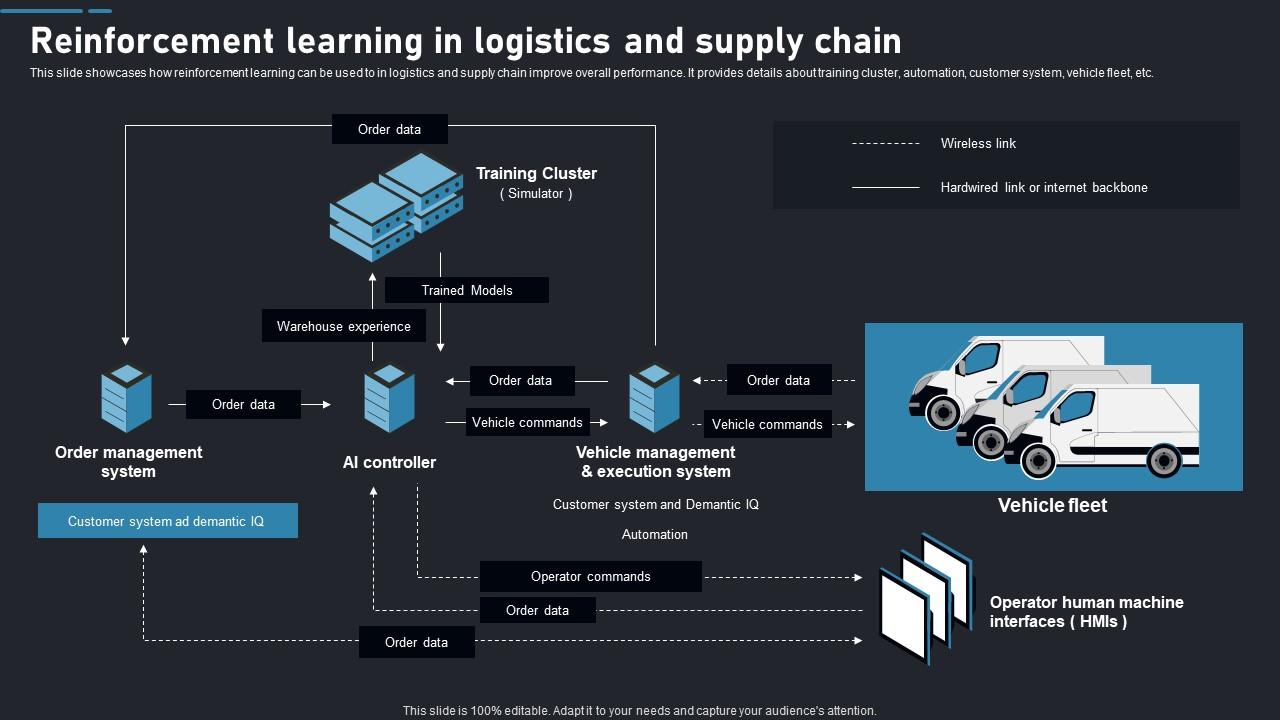
This slide showcases how reinforcement learning can be used to in logistics and supply chain improve overall performance. It provides details about training cluster, automation, customer system, vehicle fleet, etc. Present the topic in a bit more detail with this Reinforcement And Supply Chain Reinforcement Learning Guide To Transforming Industries AI SS. Use it as a tool for discussion and navigation on Reinforcement, Vehicle Management, Execution System. This template is free to edit as deemed fit for your organization. Therefore download it now.

People who downloaded this PowerPoint presentation also viewed the following :

FAQs for Reinforcement And Supply Chain Reinforcement Learning Guide To Transforming

Reinforcement learning operates on trial-and-error interaction with environments, reward-based feedback systems, and sequential decision-making processes, unlike supervised learning's labeled datasets or unsupervised learning's pattern discovery approaches. Through agent-environment interactions, organizations in gaming, robotics, and financial trading leverage RL's ability to optimize long-term outcomes, adapt strategies dynamically, and learn optimal behaviors without explicit instruction, ultimately delivering competitive advantages in complex decision scenarios.

Exploration and exploitation balance in reinforcement learning involves agents strategically choosing between testing new actions to discover better strategies and leveraging known successful actions for immediate rewards. This trade-off proves crucial because pure exploitation leads to suboptimal solutions while excessive exploration wastes resources, with many AI systems in finance, gaming, and robotics finding that dynamic balancing strategies like epsilon-greedy ultimately deliver superior long-term performance.

The reward function serves as the primary mechanism for guiding an agent's decision-making by providing feedback signals that indicate the desirability of specific actions in given states. Through these numerical rewards, agents learn to optimize their behavior by maximizing cumulative returns, with applications in finance using portfolio optimization rewards and manufacturing employing efficiency-based scoring, ultimately enabling systems to develop strategic behaviors that align with business objectives.

Model-free reinforcement learning learns directly from experience without building environment models, using methods like Q-learning and policy gradients, while model-based approaches first construct predictive models of the environment before optimizing policies. Model-free methods excel in complex, unpredictable domains like gaming and robotics, whereas model-based approaches deliver faster learning in structured environments, with many organizations finding strategic combinations optimize both sample efficiency and computational performance.

Deep reinforcement learning combines neural networks with traditional RL algorithms by using deep neural networks as function approximators to handle high-dimensional state spaces, replacing lookup tables with learned representations that can generalize across similar situations. This integration enables autonomous systems to master complex tasks like robotics control, game strategies, and financial trading, while significantly reducing computational requirements and improving decision-making accuracy in dynamic environments.

Common reinforcement learning algorithms include Q-learning, policy gradients, actor-critic methods, deep Q-networks, and temporal difference learning. Q-learning focuses on value estimation through trial-and-error exploration, while policy gradients directly optimize decision-making strategies, with financial services and gaming companies finding that combining these approaches delivers enhanced automated trading systems and personalized recommendations.

Reinforcement learning enables robots to master complex tasks through trial-and-error learning, powers game AI that adapts to player strategies, and trains autonomous vehicles to navigate safely by learning from driving scenarios. These applications streamline operations by reducing manual programming, enhancing decision-making accuracy, and delivering adaptive solutions, with many industries finding that RL-driven systems ultimately provide competitive advantages through continuous learning and optimization.

Researchers face computational complexity, sample inefficiency, reward design difficulties, exploration-exploitation trade-offs, and stability issues when scaling reinforcement learning algorithms. These challenges become amplified in complex environments like autonomous vehicle networks, financial trading systems, and industrial automation, where researchers increasingly focus on distributed computing approaches, transfer learning, and hierarchical methods to achieve scalable solutions.

Temporal difference learning enhances reinforcement learning efficiency by combining Monte Carlo and dynamic programming methods, enabling agents to learn from incomplete episodes without waiting for final outcomes. This approach allows real-time value function updates using bootstrapping, significantly accelerating learning in complex environments like robotics and game playing, ultimately delivering faster convergence and more adaptive decision-making capabilities.

Safety precautions for reinforcement learning in critical applications include robust testing protocols, fail-safe mechanisms, human oversight integration, reward function validation, and comprehensive monitoring systems. These safeguards enable organizations in healthcare, autonomous vehicles, and financial services to deploy RL while minimizing risks, ultimately delivering reliable performance and regulatory compliance in high-stakes environments.

Multi-agent environments significantly complicate reinforcement learning by introducing non-stationary dynamics, where agents must adapt to other learning agents' evolving strategies simultaneously. Collaborative approaches like multi-agent deep deterministic policy gradient and cooperative game theory enable agents to share experiences, coordinate actions, and optimize collective rewards, with applications in autonomous vehicle fleets, trading systems, and manufacturing networks ultimately delivering enhanced system-wide performance and strategic coordination advantages.

Common reinforcement learning evaluation metrics include cumulative reward, average reward per episode, convergence speed, sample efficiency, and policy stability measures. These metrics enable organizations to assess agent performance across training phases, with applications in autonomous systems, financial trading algorithms, and industrial automation finding that comprehensive evaluation ultimately delivers more reliable AI implementations and competitive advantages.

Transfer learning enhances reinforcement learning efficiency by enabling pre-trained models to adapt quickly to new environments, reducing training time through knowledge transfer, leveraging shared representations across similar tasks, and utilizing domain adaptation techniques. Organizations in gaming, robotics, and autonomous systems find that transfer learning accelerates deployment cycles, minimizes computational costs, and delivers faster convergence, ultimately providing competitive advantages in dynamic markets.

Hardware advances, particularly GPUs and TPUs, dramatically accelerate reinforcement learning by enabling parallel processing of complex simulations, faster neural network training, and real-time decision-making across multiple environments simultaneously. These improvements allow organizations in gaming, robotics, and financial services to deploy more sophisticated RL algorithms that previously required weeks of computation, ultimately delivering faster model iterations and more responsive AI systems.

**INPUT**: What ethical considerations arise from the development and deployment of reinforcement learning systems? **OUTPUT**: Ethical considerations include algorithmic bias, transparency in decision-making, accountability for autonomous actions, data privacy concerns, and potential job displacement impacts. These challenges present both risks and opportunities for organizations, with many companies finding that proactive ethical frameworks, diverse training datasets, and human oversight mechanisms ultimately deliver responsible AI deployment while maintaining competitive advantage in increasingly regulated markets. **Word count: 58 words**

Ratings and Reviews

90% of 100
Write a review
Most Relevant Reviews
  1. 100%

    by Byrne Cruz

    Attractive design and informative presentation.
  2. 80%

    by Douglass Riley

    The Designed Graphic are very professional and classic.

2 Item(s)

per page: