Responsibility assignment matrix raci ppt powerpoint presentation outline
Try Before you Buy Download Free Sample Product
Audience
Editable
of Time
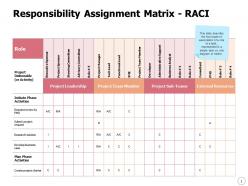
Explain different insignia with our Responsibility Assignment Matrix RACI Ppt Powerpoint Presentation Outline. Elaborate on the authority each denotes.
People who downloaded this PowerPoint presentation also viewed the following :
Responsibility assignment matrix raci ppt powerpoint presentation outline with all 5 slides:
Elaborate on the authority each insignia denotes with our Responsibility Assignment Matrix RACI Ppt Powerpoint Presentation Outline. Explain all the different implications.
FAQs for Responsibility assignment matrix raci ppt
RACI breaks down like this: Responsible does the work, Accountable signs off (and takes the heat when stuff goes wrong), Consulted gives input beforehand, and Informed just gets updates. Pretty straightforward once you get it. Set it up like a grid - tasks down the left side, team members across the top. Then drop R, A, C, or I in each box depending on what role they play for that specific task. Oh, and make sure each task has exactly one person who's Accountable, otherwise you'll get that "not my job" thing happening. Trust me on that one.
So a RACI matrix is basically your project's way of avoiding those awkward "wait, who was supposed to do this?" moments. It maps out who's Responsible, Accountable, Consulted, and Informed for every task. The accountability part is honestly my favorite - there's always one person who owns the final outcome, no excuses. Really helps when you've got multiple people involved and responsibilities start getting fuzzy. Each team member knows exactly what they're handling vs. what they just need to give input on. I'd start by listing your main tasks first, then assign the RACI roles. Trust me, it saves so much confusion later.
Don't put multiple people as "Responsible" - that's just asking for confusion. One person owns it, period. Also avoid making someone "Accountable" for literally everything because they'll become your worst bottleneck. Keep the matrix high-level too - nobody wants to scroll through 50 micro-tasks, trust me on that one. The biggest mistake though? Rolling it out without checking with your team first. People get seriously annoyed when they suddenly discover new responsibilities they never signed up for. Make sure everyone knows what the letters actually mean before you start using it.
RACI's honestly pretty versatile - works in basically any industry where people need clear roles. IT teams love it for deployments and system upgrades, figuring out who codes versus who approves. Healthcare uses it too, like making sure doctors handle diagnoses while nurses manage meds and families stay in the loop. Construction's probably where it shines most though - so many people involved! Architects design, contractors build, inspectors sign off, clients give input. I've seen teams waste hours arguing about whose job something was, so having it mapped out upfront saves major headaches. Just gotta adapt it to whatever industry rules you're working with.
Honestly, RACI matrices are a lifesaver for messy projects. They spell out exactly who's responsible, who approves stuff, who contributes, and who just gets informed. You won't have those weird situations where nobody knows whose job something is - or worse, when three people all think they're supposed to do the same task. Communication gets so much smoother because everyone knows who to bug with questions and who needs to sign off on decisions. I've seen too many projects go sideways because of unclear roles. Just map it out with your team before you start anything big.
Get everyone in the room BEFORE you start mapping out the RACI - trust me on this one. First figure out who all the key players are, then run a workshop where people can hash out roles together. Way better than surprising someone later with "oh by the way, you're accountable for this whole thing." Ask pointed questions about who actually makes decisions vs. who just needs updates. I learned this the hard way on a project last year. Write everything down as you go and make sure each person explicitly agrees to their role. Send a summary afterward so there's no confusion about what everyone signed up for.
Oh, RACI actually *is* a type of RAM! RAM is just the umbrella term for any matrix that shows who's doing what. RACI's the most common one with those four roles - Responsible, Accountable, Consulted, Informed. There's also RASCI and CAIRO but honestly, who uses those? Most people say "RACI matrix" even when they're talking about RAMs in general. The difference is other RAMs might have totally different role categories, but RACI's four-letter thing has pretty much taken over. I'd just go with RACI unless your company has some weird preference for something else.
Yeah totally, RACI works fine with Agile stuff. Just don't go crazy with it upfront - I've watched teams waste hours mapping out every tiny detail. Bad move. Focus on the actual confusing parts first, like when you're not sure who's supposed to approve something or handle cross-team work. Build it out for specific stories or sprint work as needed. Keep the thing flexible since roles shift around anyway. Short version: use it when people are genuinely confused about responsibilities, not because some process says you should. Start small and don't let it turn into another doc nobody updates.
So basically, RACI matrices are clutch for risk stuff because nobody knows who's supposed to handle what otherwise. You assign one person as Responsible for each risk, someone Accountable for the outcome, then figure out who needs to be Consulted or just kept Informed. Honestly, I've seen too many projects where risks blow up because everyone thought someone else was watching for it. The matrix stops that "wait, wasn't that your job?" panic when things go sideways. Just set it up early and update it when people join or leave the team.
Honestly, just use whatever project management tool your team's already on - Monday.com, Asana, whatever. They'll automatically update the matrix when roles change, which is huge because nobody remembers to manually update spreadsheets (been there). You get notifications too so people actually know when their stuff shifts. Spreadsheets technically work but they're a pain for collaboration - like, good luck getting everyone to check the same Google sheet regularly. The automation is really what makes it worth it. Don't overthink introducing some fancy new platform though.
You'll know RACI is working when people stop asking "who's handling this?" in every meeting. Decisions happen faster because everyone knows who's accountable vs. who just needs a heads up. Those cringe moments where someone goes "wait, I thought you were doing that" basically vanish. People aren't duplicating work or stepping on each other anymore either. The real win though? When your team starts checking the RACI matrix on their own without you having to remind them. I mean, that's when you know it's actually stuck. Focus on tracking these little behavior shifts - way better than any formal metrics honestly.
Every 2-4 weeks works well, or whenever you hit a major milestone. So many teams make this thing once and then never look at it again - huge mistake! Team changes are the big one where you'll need updates. Also when scope shifts or you realize someone's drowning while another person has no clue they're supposed to help. Quick check-ins during regular meetings work great, like 15 minutes max. Way better than waiting until everything's on fire and nobody knows whose job it actually is.
Honestly, stick to 10-15 activities max and maybe 5-8 roles. Trust me on this one - I once made this insane 30x12 matrix that literally nobody used. It was embarrassing lol. You want the whole thing to fit on one screen so people can actually look at it during meetings without scrolling forever. Focus on the big stuff - key decisions and major deliverables, not every little task. If you're going over those limits, just split it up by phases or create separate ones for different parts of the project. Way easier to manage that way.
Oh man, RACI matrices get weird fast when you're working across cultures. Like, in some places people won't push back on whoever's "Accountable" even if they're supposed to be doing the actual work. And don't get me started on "Consulted" - some folks think it's just being polite while others expect real input. Then you've got cultures where being "Informed" feels like you're getting sidelined, which is awkward. Power dynamics are tricky too. What looks like normal delegation might come across as totally controlling. Honestly, just run through some examples with your international teammates first - saves so much confusion later.
Honestly, get everyone to actually sign off on the RACI at kickoff - sounds formal but people won't blow off stuff they've committed to in writing. Then bring it up constantly in meetings and decisions. I can't tell you how many times I've seen these things just sit in folders doing nothing! Check in regularly about who's really handling what vs what the document says. Call people out right away when they drift from their roles - don't wait. The whole point is making it drive actual behavior, not just being another planning doc that collects dust.
No Reviews