


Role Of Ai Technology In Recruitment Process





Try Before you Buy Download Free Sample Product
 Impress Your
 Audience
 100%
100% Editable
 Save Hours
 of Time


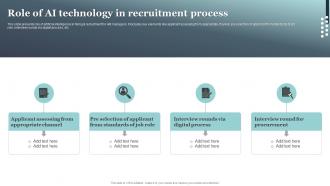
This slide presents role of artificial intelligence in hiring recruitment for HR managers. It includes key elements like applicant assessing from appropriate channel, pre selection of applicant from standards of job role, interview rounds via digital process, etc.
People who downloaded this PowerPoint presentation also viewed the following :
Role Of Ai Technology In Recruitment Process with all 6 slides:
Use our Role Of Ai Technology In Recruitment Process to effectively help you save your valuable time. They are readymade to fit into any presentation structure.





FAQs for Role Of Ai Technology
AI in recruitment delivers enhanced candidate screening, automated resume parsing, predictive analytics for job fit, bias reduction, and significantly faster time-to-hire processes. These technologies streamline hiring by processing thousands of applications efficiently, identifying top talent through data-driven insights, and enabling recruiters to focus on strategic candidate engagement, ultimately delivering cost reduction and improved hiring quality.
AI enhances candidate screening by automating resume parsing, analyzing skills compatibility, assessing cultural fit through behavioral analytics, and ranking candidates based on predefined criteria. Through machine learning algorithms, recruiters can process thousands of applications within hours rather than weeks, while reducing unconscious bias and improving match quality, ultimately delivering faster hiring cycles and better candidate experiences.
Companies should consider bias mitigation, transparency in decision-making, data privacy protection, candidate consent, and algorithmic fairness when implementing AI recruitment tools. While these technologies streamline hiring processes and enhance efficiency, organizations must ensure diverse training data, clear communication about AI usage, and human oversight in final decisions, ultimately delivering equitable opportunities and maintaining candidate trust in an increasingly automated landscape.
AI can reduce unconscious bias in hiring by standardizing candidate screening processes, removing identifying information during initial evaluations, analyzing job descriptions for biased language, and focusing assessments on skills rather than demographics. These technologies enable organizations to evaluate candidates more objectively through data-driven insights, with many companies finding that AI-powered recruitment tools enhance diversity while streamlining hiring processes and improving candidate quality.
NLP revolutionizes job description creation by automatically analyzing existing descriptions, suggesting relevant keywords, standardizing language for consistency, and ensuring inclusive terminology while reducing unconscious bias. Through intelligent text analysis, organizations streamline their hiring processes, attract more diverse candidates, and create clearer role expectations, with many companies finding that NLP-enhanced descriptions generate significantly higher-quality applicant pools.
AI significantly enhances candidate experience by streamlining application processes, providing instant feedback, personalizing job recommendations, and reducing response times through automated communications. These technologies enable faster application reviews, transparent status updates, and 24/7 chatbot support, with many organizations finding that candidates appreciate the efficiency and consistent communication throughout their journey.
Predictive analytics in AI informs talent acquisition by analyzing historical hiring data, candidate performance patterns, and market trends to forecast recruitment needs and success probability. Through machine learning algorithms, organizations can identify high-potential candidates earlier, optimize sourcing channels, and reduce time-to-hire, with many companies finding significantly improved hiring quality and strategic workforce planning capabilities.
AI enhances diversity and inclusion by removing human bias from initial screening, anonymizing candidate data, and standardizing evaluation criteria across all applicants. These technologies enable organizations to focus on skills and qualifications rather than demographic factors, with companies in finance and healthcare finding significantly more diverse candidate pools and fairer hiring outcomes.
Recruiters can balance automation with human interaction by using AI for initial screening, resume parsing, and candidate matching, while reserving personal interviews, cultural assessments, and final decisions for human judgment. This strategic combination enables faster candidate processing and reduced administrative tasks, while maintaining the personal connections essential for evaluating soft skills, ultimately delivering improved hiring efficiency without sacrificing relationship-building quality.
Organizations face integration challenges including data quality inconsistencies, legacy system compatibility issues, employee resistance to new technologies, bias in algorithmic decision-making, and compliance with evolving regulations. While these hurdles require strategic planning and investment, many companies find that phased implementation approaches, comprehensive staff training, and robust data governance frameworks enable successful transitions, ultimately delivering streamlined hiring processes and enhanced candidate experiences.
AI streamlines onboarding by automating paperwork processing, personalizing training schedules, delivering customized content modules, and tracking completion progress in real-time. Through intelligent chatbots and adaptive learning platforms, organizations accelerate integration timelines, reduce administrative overhead, and enhance new hire experiences, with many companies finding that AI-powered onboarding improves retention rates significantly.
Key metrics include time-to-hire reduction, cost-per-hire optimization, candidate quality scores, diversity and inclusion improvements, and recruiter productivity gains. These measurements enable organizations to assess how AI streamlines screening processes, enhances candidate matching accuracy, and reduces administrative burden, with many companies finding that strategic AI implementation delivers faster placements and improved hiring outcomes.
Machine learning algorithms improve job requirement understanding through comprehensive training on historical hiring data, successful candidate profiles, performance metrics, and detailed job descriptions across various industries. These systems analyze patterns in skills matching, candidate success rates, and role specifications, enabling recruiters to identify optimal fits more accurately while reducing bias, ultimately delivering faster hiring processes and better talent acquisition outcomes.
Companies like Unilever use AI-powered video interviews and personality assessments to screen thousands of candidates, while IBM Watson analyzes resumes and predicts candidate success rates for specific roles. These implementations streamline hiring processes by reducing time-to-hire, minimizing unconscious bias, and improving candidate matching accuracy, with many organizations finding that AI-driven recruitment delivers faster placements and enhanced talent quality.
AI enhances employer branding by personalizing candidate communications, optimizing job descriptions for wider reach, and creating engaging chatbot interactions that reflect company culture. Through predictive analytics and automated social media management, organizations streamline their brand messaging while delivering consistent, responsive candidate experiences, ultimately attracting top talent in competitive markets.
-
“As you have innovative ideas and they are all customizable, this saves a huge chunk of your time to prepare well-read presentations.”
-
Amazing product with appealing content and design.