Root Cause Analysis Process For Employee Turnover
Try Before you Buy Download Free Sample Product
Audience
Editable
of Time
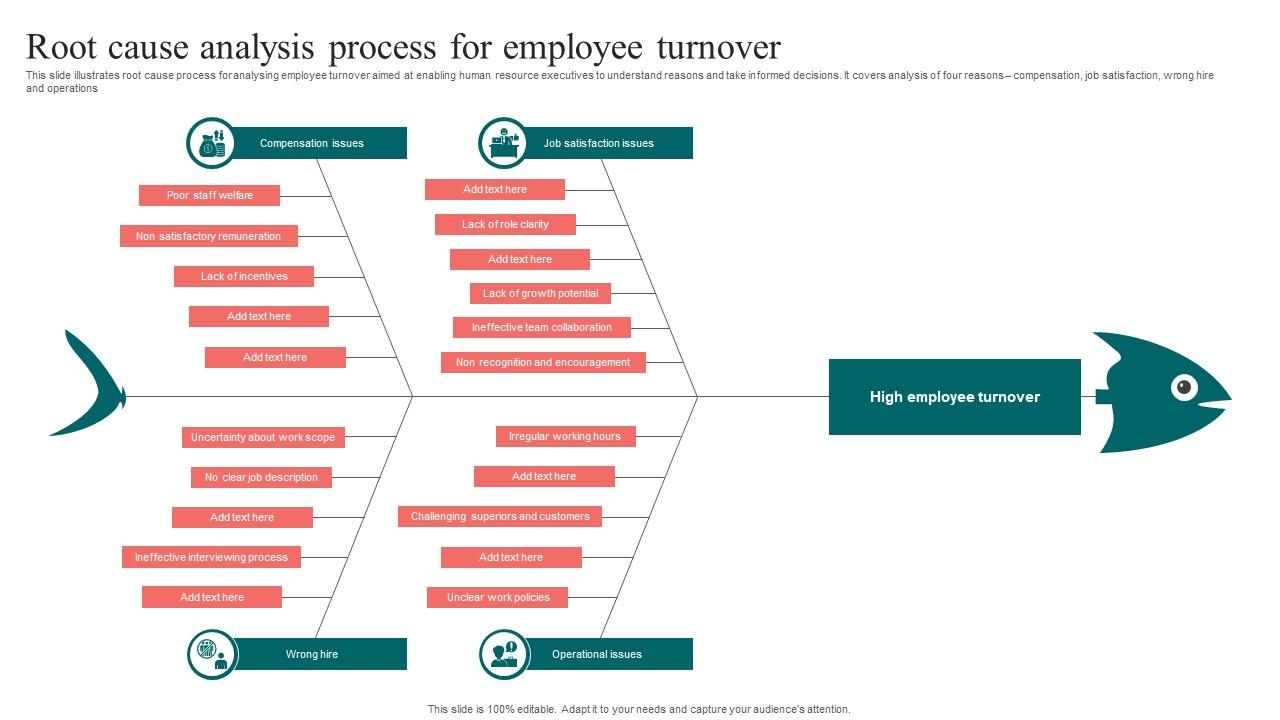
This slide illustrates root cause process for analysing employee turnover aimed at enabling human resource executives to understand reasons and take informed decisions. It covers analysis of four reasons compensation, job satisfaction, wrong hire and operations
People who downloaded this PowerPoint presentation also viewed the following :
Root Cause Analysis Process For Employee Turnover with all 6 slides:
Use our Root Cause Analysis Process For Employee Turnover to effectively help you save your valuable time. They are readymade to fit into any presentation structure.
FAQs for Root Cause Analysis Process
Primary causes of employee turnover include inadequate compensation, limited career advancement opportunities, poor management relationships, work-life balance issues, and insufficient recognition programs. These factors vary significantly across sectors, with healthcare experiencing burnout-related departures, retail facing scheduling conflicts, and technology companies losing talent to competitive offers, ultimately impacting organizational productivity and recruitment costs.
Data analysis techniques predict employee turnover through machine learning algorithms, predictive modeling, statistical analysis, sentiment analysis, and pattern recognition systems. These methods identify risk factors like engagement scores, performance metrics, and tenure patterns, enabling HR teams to implement targeted retention strategies, reduce recruitment costs, and maintain organizational continuity, with many companies finding significant improvements in workforce stability.
Company culture significantly influences employee retention by shaping workplace satisfaction, career development opportunities, work-life balance, and organizational values alignment. A positive culture fosters engagement through clear communication, recognition programs, and growth pathways, with many organizations finding that strong cultural foundations reduce turnover by 30-50%, ultimately delivering competitive advantage and reduced recruitment costs.
External economic factors significantly impact employee turnover through job market conditions, wage competition, cost of living changes, and industry growth patterns. During economic expansion, turnover typically increases as employees find better opportunities, while recessions often reduce voluntary departures, with organizations in sectors like technology and healthcare experiencing more pronounced fluctuations based on economic cycles.
Organizations should track turnover rate, time-to-fill positions, exit interview feedback, retention rates by department and role, cost-per-hire, and employee tenure patterns. These metrics enable companies to identify problematic areas, understand departure reasons, and measure recruitment efficiency, with many finding that comprehensive analysis ultimately delivers improved retention strategies and reduced hiring costs.
Exit interviews should include structured questions about management effectiveness, career development opportunities, workplace culture, compensation satisfaction, and specific improvement suggestions. These conversations, when conducted by neutral HR professionals or third-party facilitators, enable organizations to identify recurring patterns, address systemic issues, and implement targeted retention strategies, ultimately reducing future turnover costs and enhancing employee experiences.
High employee turnover creates significant financial implications including recruitment costs, training expenses, lost productivity, decreased morale, and knowledge drain. These costs often reach 50-200% of an employee's annual salary, with sectors like retail and hospitality finding that strategic retention initiatives, competitive compensation, and enhanced workplace culture ultimately deliver substantial cost savings and improved operational efficiency.
**INPUT**: How do different demographics (age, gender, tenure) affect turnover rates? **OUTPUT**: Different demographics significantly influence turnover patterns, with younger employees typically showing higher turnover rates, women often leaving due to work-life balance factors, and employees with shorter tenure being more likely to exit within their first year. These demographic insights enable organizations to develop targeted retention strategies, customize benefits packages, and improve workforce planning, with many companies finding that tailored approaches reduce turnover costs while enhancing employee satisfaction. [Word count: 60]
Effective turnover reduction strategies include enhanced onboarding programs, competitive compensation packages, flexible work arrangements, career development opportunities, and regular performance feedback sessions. These approaches streamline employee engagement by addressing job satisfaction concerns, providing clear advancement pathways, and creating supportive work environments, with many organizations finding that strategic retention initiatives ultimately deliver reduced recruitment costs and improved operational efficiency.
Employee engagement surveys inform turnover analysis by identifying satisfaction gaps, measuring commitment levels, pinpointing retention risks, and revealing organizational culture issues before departures occur. Through predictive analytics, companies across healthcare, retail, and financial services can address concerns proactively, enhance workplace satisfaction, and reduce costly turnover while building stronger retention strategies.
Employee turnover significantly impacts organizational performance through increased recruitment costs, reduced productivity, and loss of institutional knowledge, while also creating opportunities for fresh perspectives and innovation. Companies experiencing high turnover often face disrupted workflows and decreased customer satisfaction, though strategic turnover can eliminate underperformers and bring new talent, ultimately requiring balanced retention strategies for sustained competitive advantage.
Effective onboarding significantly reduces early employee turnover by establishing clear expectations, building connections with colleagues and managers, and providing comprehensive role training during critical first months. Organizations with structured onboarding programs experience 50% lower early turnover rates, with new hires feeling more engaged and confident, ultimately delivering better retention and reduced recruitment costs.
**INPUT**: What are the best practices for conducting turnover analysis effectively? **OUTPUT**: Best practices for conducting turnover analysis include tracking exit interview data, analyzing departure patterns by department and tenure, examining compensation benchmarks, measuring engagement scores, and identifying management effectiveness indicators. These methodologies streamline retention strategies by revealing underlying causes, enabling targeted interventions, and delivering actionable insights, with many organizations finding that systematic analysis reduces turnover costs while enhancing workforce stability. [Word count: 60 words]
Predictive analytics tools enhance turnover forecasting by analyzing historical data patterns, employee engagement metrics, performance indicators, and behavioral signals to identify at-risk employees. Through machine learning algorithms, organizations streamline retention strategies, optimize resource allocation, and proactively address workforce challenges, ultimately reducing recruitment costs and maintaining operational continuity.
Leadership significantly influences employee retention through clear communication, career development opportunities, recognition programs, flexible work arrangements, and fostering inclusive workplace cultures. Strong leaders who prioritize mentorship, provide regular feedback, and create growth pathways see substantially lower turnover rates, with many organizations finding that investment in leadership development ultimately delivers improved employee satisfaction, reduced recruitment costs, and enhanced organizational stability.
-
Wonderful templates design to use in business meetings.
-
The service is fast, and I could access any presentation after buying the subscription. I don’t think I’ll ever have to worry about a presentation in my life.