RPA In Logistics Supply Chain Management

Rating:
80%
RPA In Logistics Supply Chain Management
Slide 1 of 6

or

Favourites Favourites

Try Before you Buy Download Free Sample Product

Audience Impress Your
Audience
Editable 100%
Editable
Time Save Hours
of Time
The Biggest Sale is ending soon in
0
0
:
0
0
:
0
0
Rating:
80%
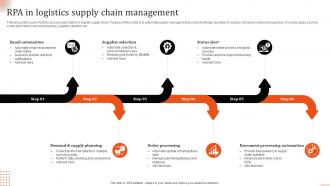
Following slide covers Robotic process automation in logistic supply chain. Purpose of this slide is to automate supply management process that helps business to reduce cost and increase transparency. It include steps such as email automation, demand planning, supplier selection etc. Presenting our set of slides with RPA In Logistics Supply Chain Management. This exhibits information on six stages of the process. This is an easy to edit and innovatively designed PowerPoint template. So download immediately and highlight information on Email Automation, Supplier Selection, Order Processing.

FAQs for RPA In Logistics

Key benefits of implementing RPA in logistics include enhanced inventory management, streamlined order processing, automated shipment tracking, reduced operational costs, and improved delivery accuracy. These technologies revolutionize supply chain operations by minimizing manual errors, accelerating fulfillment cycles, and optimizing resource allocation, with many logistics companies finding significantly faster processing times and enhanced customer satisfaction.

RPA improves supply chain efficiency by automating order processing, inventory tracking, shipment scheduling, and vendor communications, significantly reducing manual errors and processing times. Through intelligent automation, logistics companies streamline warehouse operations, enhance demand forecasting, and accelerate invoice processing, with many organizations finding that RPA delivers faster fulfillment cycles and improved customer satisfaction.

Companies face challenges including legacy system compatibility, complex process mapping, employee resistance to change, initial implementation costs, and ensuring data accuracy across platforms. While these hurdles require strategic planning, many logistics organizations find that phased rollouts, comprehensive staff training, and partnering with experienced vendors ultimately streamline operations and deliver significant cost reductions.

Yes, RPA significantly enhances inventory management by automating stock level monitoring, purchase order generation, demand forecasting, and supplier communications across multiple systems simultaneously. Through intelligent automation, retailers and manufacturers streamline replenishment cycles, minimize stockouts and overstock situations, and improve accuracy in warehouse operations, ultimately delivering cost reductions and enhanced customer satisfaction.

Data analytics plays a crucial role in optimizing RPA within logistics by identifying process inefficiencies, predicting demand patterns, monitoring bot performance, and enabling continuous improvement through real-time insights. Through advanced analytics, logistics companies streamline warehouse operations, optimize delivery routes, and enhance inventory management, with many organizations finding that data-driven RPA delivers significantly faster processing times and reduced operational costs.

RPA enhances compliance in logistics by automating documentation, standardizing regulatory reporting, and maintaining detailed audit trails across all operations. Through automated systems, logistics companies streamline customs declarations, safety certifications, and shipping documentation while reducing human errors, ultimately delivering consistent regulatory adherence and faster compliance verification processes.

Successful RPA implementations in logistics include Amazon's warehouse automation, DHL's shipment tracking systems, FedEx's invoice processing, Maersk's container management, and UPS's route optimization. These technologies streamline operations by reducing manual data entry, accelerating package sorting, and enhancing delivery accuracy, with many logistics companies finding that automated processes deliver faster customer service and significantly lower operational costs.

RPA improves last-mile delivery by automating route optimization, real-time tracking updates, delivery scheduling, and customer communication workflows. These automated processes enable logistics companies to reduce delivery times, minimize fuel costs, and enhance customer satisfaction through proactive notifications, with many e-commerce and courier services finding that RPA ultimately delivers 30% faster delivery times.

RPA implementation in logistics typically shifts workforce focus from repetitive tasks to strategic roles, requiring upskilling in technology management, data analysis, and customer relationship functions. While automation handles order processing and inventory tracking, employees increasingly focus on exception handling, vendor negotiations, and process optimization, with many organizations finding that strategic workforce development ultimately delivers enhanced operational efficiency and competitive advantage.

Organizations should track delivery time reduction, order processing speed, inventory accuracy rates, cost per transaction, and error reduction percentages to measure RPA effectiveness in logistics. These metrics enable supply chain managers to quantify operational improvements, with many logistics companies finding that automated processes deliver 40-60% faster order fulfillment and significantly enhanced customer satisfaction.

RPA integrates with existing logistics software through APIs, screen scraping, and database connections, seamlessly connecting with WMS, TMS, and ERP systems without requiring major infrastructure changes. This strategic combination enables automated data synchronization across platforms, streamlined order processing, and enhanced inventory tracking, with many logistics companies finding significantly improved operational efficiency and reduced manual errors.

Staff need training in RPA interface navigation, process monitoring, exception handling, basic troubleshooting, and workflow optimization to effectively collaborate with automated systems. These competencies enable logistics teams to oversee bot performance, manage escalations, and continuously improve processes, with many distribution centers finding that cross-functional training enhances both operational efficiency and employee adaptability.

RPA reduces operational costs in logistics by automating repetitive tasks like order processing, inventory tracking, shipment scheduling, and invoice management, eliminating manual errors and accelerating workflows. Through automated systems, logistics companies streamline warehouse operations, optimize route planning, and enhance supply chain visibility, ultimately delivering faster processing times and significantly lower labor costs while maintaining accuracy.

Future trends for RPA in logistics include autonomous warehouse operations, predictive maintenance systems, dynamic route optimization, AI-powered demand forecasting, and blockchain-integrated supply chains. These technologies streamline operations by reducing manual oversight, minimizing equipment downtime, and enhancing delivery precision, with many logistics companies finding that strategic automation delivers faster fulfillment and significant competitive advantage.

RPA enhances logistics customer service by automating order tracking updates, processing delivery inquiries, and managing return requests through intelligent chatbots and automated communication systems. These technologies streamline response times, provide real-time shipment visibility, and enable 24/7 customer support, with many logistics companies finding significantly improved customer satisfaction and reduced operational costs.

Ratings and Reviews

80% of 100
Review Form
Write a review
Most Relevant Reviews
  1. 80%

    by Chris Watson

    Professional and unique presentations.
  2. 80%

    by O'Brien Parker

    One-stop solution for all presentation needs. Great products with easy customization. 

2 Item(s)

per page: