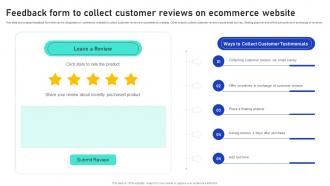
Sales Growth Strategies Feedback Form To Collect Customer Reviews On Ecommerce Website
Try Before you Buy Download Free Sample Product
Audience
Editable
of Time
This slide showcases feedback form that can be integrated on commerce website to collect customer reviews on ecommerce website. Other ways to collect customer review include email survey, floating popover and offering incentives in exchange of reviews.
People who downloaded this PowerPoint presentation also viewed the following :
Sales Growth Strategies Feedback Form To Collect Customer Reviews On Ecommerce Website with all 9 slides:
Use our Sales Growth Strategies Feedback Form To Collect Customer Reviews On Ecommerce Website to effectively help you save your valuable time. They are readymade to fit into any presentation structure.
FAQs for Sales Growth Strategies Feedback Form To Collect Customer Reviews
Effective sales growth strategies for competitive startup markets include customer segmentation, value-based selling, strategic partnerships, digital marketing automation, and referral programs. These approaches streamline customer acquisition by targeting specific market niches, demonstrating clear ROI to prospects, and leveraging existing networks, with many startups finding that combining inbound marketing with personalized outreach delivers faster revenue growth and sustainable competitive advantage.
Leveraging customer feedback enhances sales growth by identifying product improvements, refining service delivery, and uncovering new market opportunities that directly address customer needs. Through systematic feedback analysis, established businesses streamline their offerings, enhance customer satisfaction, and develop targeted solutions, with many retail and financial services companies finding that customer-driven improvements ultimately deliver higher conversion rates and increased loyalty.
Digital marketing accelerates e-commerce sales growth through targeted advertising, search engine optimization, social media engagement, email campaigns, and conversion rate optimization. These strategies enable platforms to reach broader audiences, personalize customer experiences, and track performance metrics in real-time, with many retailers finding that integrated digital approaches deliver significantly higher conversion rates and customer lifetime value.
Sales teams utilize data analytics to identify growth opportunities by analyzing customer behavior patterns, market trends, sales performance metrics, conversion rates, and revenue forecasting models. Through predictive analytics and customer segmentation, organizations streamline lead prioritization, enhance targeting strategies, and optimize resource allocation, with many companies finding that data-driven approaches deliver significantly higher conversion rates and sustainable competitive advantage.
B2B sales growth strategies focus on relationship building, longer sales cycles, account-based marketing, and consultative selling approaches targeting decision-making committees. B2C strategies emphasize emotional triggers, shorter conversion paths, mass marketing campaigns, and direct consumer engagement through digital channels. While B2B companies invest heavily in lead nurturing and personalized demonstrations, B2C businesses prioritize brand awareness and seamless purchase experiences, ultimately delivering different competitive advantages.
Personal branding significantly enhances sales professionals' credibility, trust-building capabilities, and market differentiation, ultimately driving stronger client relationships and revenue growth. Through consistent thought leadership, industry expertise demonstration, and authentic relationship cultivation, sales professionals with strong personal brands achieve higher conversion rates, expanded networks, and premium positioning, with many finding that clients increasingly seek out recognized industry authorities for strategic partnerships.
Sales growth strategies for digitally transforming businesses include CRM automation, data-driven lead scoring, omnichannel customer engagement, AI-powered sales forecasting, and digital pipeline management systems. These approaches streamline prospecting, enhance customer touchpoint tracking, and enable real-time sales performance optimization, with many organizations finding that integrated digital sales platforms ultimately deliver faster conversion cycles and improved revenue predictability.
Relationship management contributes to sustainable sales growth by building trust, ensuring customer retention, and generating referrals through personalized engagement and consistent value delivery. Strong relationships enable sales teams to understand client needs deeply, cross-sell effectively, and maintain long-term partnerships, with many organizations finding that loyal customers deliver 67% more revenue than new acquisitions.
Sales leaders can implement goal-setting with clear incentives, regular coaching sessions, peer recognition programs, data-driven performance tracking, and skills development workshops. These techniques enhance team engagement by creating accountability, fostering competitive collaboration, and providing growth opportunities, with many organizations finding that combining monetary rewards with professional development ultimately delivers higher conversion rates and sustained productivity gains.
Upselling and cross-selling strategies enhance sales performance by increasing average transaction values, maximizing customer lifetime value, and improving revenue per client relationship. These approaches enable businesses to leverage existing customer trust and purchase intent, with retail and financial services companies finding that strategic product recommendations can boost sales by 10-30% while strengthening customer loyalty.
Social media engagement significantly impacts sales growth by building brand awareness, fostering customer relationships, and driving direct conversions through targeted content and interactions. Through strategic social media presence, businesses enhance customer trust, generate qualified leads, and create community-driven advocacy, with many companies finding that consistent engagement delivers measurable revenue increases and competitive market positioning.
Businesses should approach territory management through data-driven analysis, strategic resource allocation, clear boundary definitions, performance tracking systems, and regular optimization reviews. This systematic approach enables sales teams to focus efforts on high-potential accounts, minimize travel costs, and reduce territory overlap, with many organizations finding that well-structured territories increase revenue per representative by 15-20%.
Converting leads into loyal customers requires nurturing relationships through personalized communication, delivering exceptional customer experiences, implementing targeted follow-up campaigns, and providing consistent value post-purchase. These strategies work by building trust, addressing specific customer needs, and creating emotional connections, with many retail and service organizations finding that combining loyalty programs with proactive customer support ultimately delivers higher retention rates and increased lifetime value.
Businesses can measure sales growth strategy success through revenue growth rates, customer acquisition costs, conversion rates, customer lifetime value, and sales cycle lengths. These metrics enable organizations to identify high-performing channels, optimize resource allocation, and adjust tactics in real-time, with many companies finding that comprehensive measurement ultimately delivers competitive advantage and sustainable growth.
Best practices for aligning marketing and sales efforts include shared revenue goals, integrated CRM systems, collaborative lead scoring, unified messaging, and regular cross-team communication. These strategies streamline customer journeys by eliminating handoff friction, improving lead quality, and ensuring consistent brand experiences, with many organizations finding that aligned teams generate 36% higher customer retention and significantly faster sales cycles.
-
Wide collection of templates available. SlideTeam has made it easier to create presentations in just a few minutes.Â
-
Great quality product.