Sales Territory Management Plan Process
Try Before you Buy Download Free Sample Product
Audience
Editable
of Time
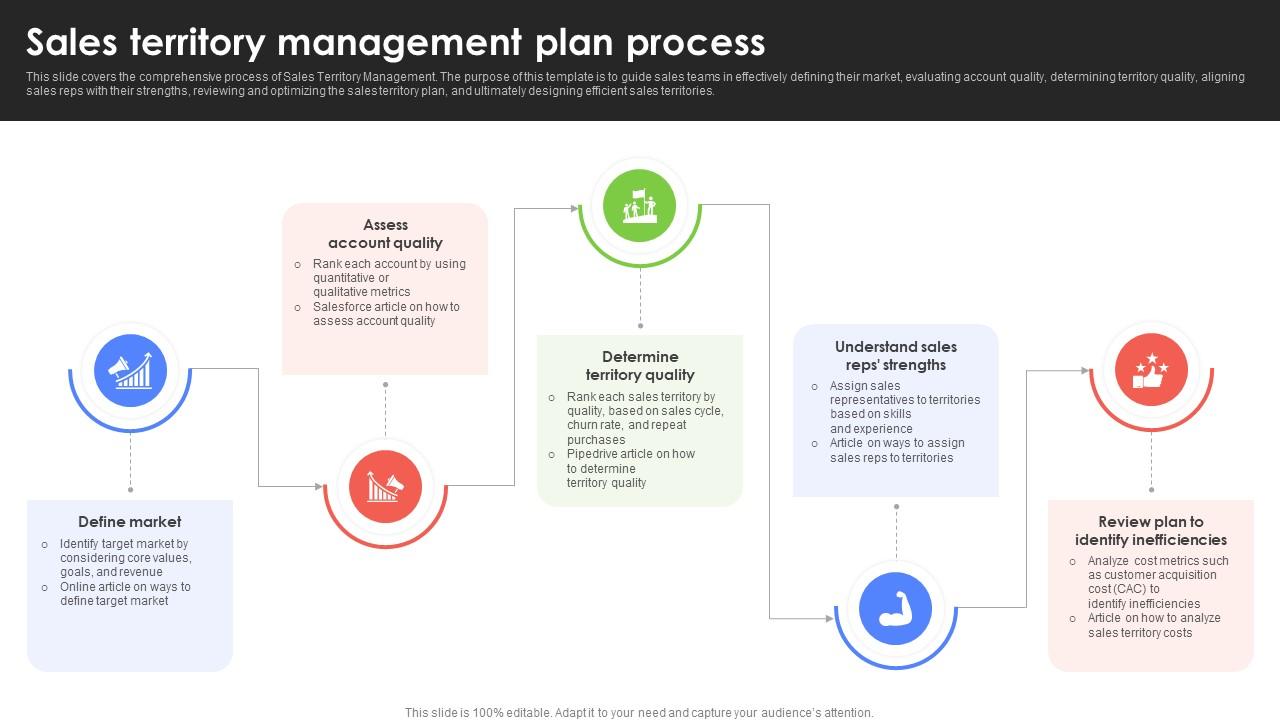
This slide covers the comprehensive process of Sales Territory Management. The purpose of this template is to guide sales teams in effectively defining their market, evaluating account quality, determining territory quality, aligning sales reps with their strengths, reviewing and optimizing the sales territory plan, and ultimately designing efficient sales territories.
People who downloaded this PowerPoint presentation also viewed the following :
Sales Territory Management Plan Process with all 9 slides:
Use our Sales Territory Management Plan Process to effectively help you save your valuable time. They are readymade to fit into any presentation structure.
FAQs for Sales Territory
Key factors include geographic boundaries, market potential, customer density, sales rep capacity, and competitive landscape. These elements work together to create balanced territories that maximize coverage while minimizing travel costs, with many organizations finding that strategic territory alignment enhances sales productivity, improves customer relationships, and ultimately delivers stronger revenue performance across regions.
Sales territory management improves overall sales performance by optimizing resource allocation, reducing travel costs, and ensuring balanced coverage across market segments. Through strategic territory design, sales teams can focus efforts on high-potential prospects, minimize account overlap, and maximize customer relationship development, ultimately delivering increased revenue per representative and enhanced competitive positioning.
Technology revolutionizes modern sales territory management through CRM systems, GPS mapping, data analytics, mobile applications, and AI-powered forecasting tools. These solutions streamline territory planning, automate lead distribution, and optimize route planning, with many sales organizations finding that integrated platforms deliver enhanced productivity, improved customer coverage, and ultimately stronger revenue performance across territories.
Demographic factors influence territory allocation by determining market potential, customer density, purchasing power, and resource requirements across different regions. Companies analyze population size, income levels, age distributions, and industry concentrations to optimize sales coverage, with many organizations finding that demographic-based territories deliver more balanced workloads and higher conversion rates.
Territory mapping tools include Salesforce Maps, HubSpot Sales Hub, MapAnything, Badger Maps, and Microsoft Dynamics 365, which streamline geographic visualization and customer distribution analysis. These platforms enhance sales efficiency by optimizing route planning, identifying coverage gaps, and enabling data-driven territory adjustments, with many organizations finding that integrated mapping solutions ultimately deliver faster customer acquisition and improved resource allocation.
Businesses balance workload by analyzing territory potential, geographic coverage, customer complexity, and historical performance data when making assignments. Strategic redistribution based on market opportunities, account values, and travel requirements ensures equitable distribution, while regular performance reviews and territory adjustments help maintain optimal resource allocation and maximize overall team productivity.
Common sales territory management challenges include uneven territory distribution, inadequate market data, conflicting customer assignments, resource allocation imbalances, and difficulty tracking performance metrics across regions. These issues often result in reduced sales efficiency, team conflicts, and missed revenue opportunities, with many organizations finding that strategic territory realignment and data-driven boundary setting ultimately delivers improved quota attainment and enhanced sales team productivity.
Sales leaders can evaluate territory effectiveness through performance metrics analysis, revenue tracking per territory, customer acquisition rates, and sales cycle length comparisons. By examining quota attainment ratios, market penetration levels, and resource allocation efficiency, organizations can identify high-performing territories and optimization opportunities, ultimately enabling strategic realignments that drive competitive advantage and sustainable growth.
Key metrics for assessing territory performance include revenue growth, market penetration rates, customer acquisition costs, sales cycle length, and quota attainment percentages. These indicators enable sales managers to identify high-performing strategies, optimize resource allocation across regions, and enhance overall team productivity, with many organizations finding that consistent metric tracking ultimately delivers improved forecasting accuracy and competitive advantage.
Customer segmentation enhances territory management by enabling sales teams to allocate resources based on customer value, buying behavior, geographic clustering, and growth potential. Through detailed segmentation analysis, organizations can optimize territory boundaries, assign specialized representatives to high-value accounts, and tailor strategies for different customer types, ultimately delivering improved conversion rates and maximized revenue per territory.
Seasonality significantly impacts sales territory planning by requiring adjustments to resource allocation, quota distribution, and coverage strategies based on regional demand fluctuations throughout the year. Retail territories may need additional support during holiday seasons, while agricultural markets require intensive coverage during planting periods, with many organizations finding that flexible territory structures and seasonal staffing models ultimately deliver more consistent revenue performance and improved customer satisfaction.
Sales teams can adapt by conducting thorough market research, analyzing local competition, understanding cultural preferences, and identifying key decision-makers within target organizations. This strategic approach enables teams to customize their messaging, adjust pricing strategies, and build relationships with regional partners, ultimately delivering faster market penetration and sustainable revenue growth in unfamiliar territories.
Best practices for onboarding sales reps in newly assigned territories include comprehensive market analysis, customer relationship mapping, territory-specific training programs, mentor pairing, and gradual responsibility transfer. These approaches streamline integration by providing deep local insights, established contact frameworks, and hands-on guidance, with many organizations finding that structured 90-day onboarding plans ultimately deliver faster quota attainment and stronger customer relationships.
Collaboration between marketing and sales optimizes territory management by aligning lead qualification criteria, sharing customer insights, and coordinating campaign timing across regions. Marketing provides sales teams with territory-specific content, demographic analytics, and lead scoring data, while sales offers feedback on prospect quality and market conditions, ultimately enabling more strategic resource allocation and higher conversion rates.
Data analytics enhances territory management decision-making by providing customer behavior insights, sales performance metrics, market opportunity identification, and resource allocation optimization. Through predictive analytics and real-time dashboards, sales organizations can adjust territory boundaries, prioritize high-value prospects, and forecast revenue more accurately, ultimately delivering improved quota attainment and strategic competitive advantage.
-
“The presentation template I got from you was a very useful one.My presentation went very well and the comments were positive.Thank you for the support. Kudos to the team!”
-
Wow! The design and quality of templates on SlideTeam are simply the best.