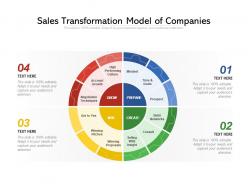
Sales transformation model of companies
Try Before you Buy Download Free Sample Product
Audience
Editable
of Time
Our Sales Transformation Model Of Companies enable you to begin with a bang. Your entrance will be explosive.
People who downloaded this PowerPoint presentation also viewed the following :
Sales transformation model of companies with all 5 slides:
Acquire all the aces with our Sales Transformation Model Of Companies. You will have the best cards in your hand.
FAQs for Sales transformation
Successful sales transformation initiatives are driven by comprehensive data analytics, technology integration, process standardization, team training, and leadership alignment. These strategic components work together by streamlining workflows, enhancing customer interactions, and improving forecasting accuracy, with many organizations finding that this combination ultimately delivers faster deal closures and sustainable revenue growth.
Organizations can assess their current sales processes through comprehensive audits examining lead generation efficiency, conversion rates, sales cycle duration, customer acquisition costs, and technology utilization gaps. By analyzing performance metrics, conducting sales team interviews, and mapping customer journey touchpoints, companies identify bottlenecks and opportunities, ultimately enabling data-driven transformation strategies that enhance productivity and competitive positioning.
Technology serves as the foundation for sales transformation by automating routine tasks, providing real-time analytics, enabling personalized customer interactions, and streamlining lead management processes. Through CRM systems, AI-driven insights, and mobile platforms, organizations enhance productivity, accelerate deal cycles, and deliver superior customer experiences, ultimately achieving measurable revenue growth and competitive advantage.
Sales teams can effectively adapt by developing consultative skills, investing in product knowledge training, implementing CRM systems for better customer insights, and adopting value-based messaging frameworks. This transformation requires sales professionals to become trusted advisors rather than transactional sellers, with many organizations finding that solution-based approaches increase deal sizes, improve customer retention, and ultimately deliver stronger competitive positioning in increasingly complex markets.
**INPUT**: What metrics should businesses track to measure the success of their sales transformation efforts? **OUTPUT**: Sales transformation success metrics include revenue growth rates, sales cycle length, conversion rates, customer acquisition costs, and sales rep productivity measures. These indicators streamline performance evaluation by tracking deal velocity, pipeline quality, and customer lifetime value, with many organizations finding that combining leading and lagging metrics ultimately delivers comprehensive visibility into transformation ROI and competitive advantage.
Organizations foster continuous improvement cultures by implementing regular performance reviews, providing ongoing training opportunities, encouraging knowledge sharing sessions, and establishing clear feedback mechanisms. Through data-driven coaching and collaborative goal-setting, sales teams develop adaptive strategies that enhance customer relationships, streamline processes, and ultimately deliver higher conversion rates and sustained revenue growth.
Best practices for training sales staff in transformed environments include digital-first skill development, data analytics proficiency, customer experience focus, continuous learning programs, and technology integration training. These approaches streamline onboarding by emphasizing CRM mastery, social selling techniques, and consultative methodologies, with many organizations finding that blended learning formats and mentorship programs accelerate performance while enhancing retention.
Customer insights drive sales transformation by revealing purchasing behaviors, preference patterns, decision-making processes, and engagement preferences that guide strategic planning and tactical execution. Through advanced analytics and customer data platforms, organizations streamline lead qualification, enhance personalization approaches, and optimize sales funnel efficiency, with many retail and technology companies finding that insight-driven transformations deliver significantly improved conversion rates and accelerated revenue growth.
Sales transformation challenges include resistance to change, inadequate technology integration, insufficient training, misaligned incentives, and poor communication across teams. Organizations can overcome these by implementing comprehensive change management programs, investing in robust CRM systems, providing ongoing skill development, and establishing clear performance metrics, with many companies finding that phased rollouts and executive sponsorship ultimately deliver higher adoption rates and sustainable revenue growth.
Sales leaders ensure alignment by establishing clear KPIs that directly connect to revenue targets, customer acquisition costs, and market expansion goals, while implementing regular cross-departmental reviews with executives, marketing teams, and operations. This strategic coordination enables organizations to synchronize transformation initiatives with broader business priorities, ultimately delivering measurable outcomes like accelerated deal cycles, improved customer retention, and enhanced competitive positioning in increasingly dynamic markets.
Sales transformation significantly strengthens customer relationships by enabling personalized experiences, faster response times, improved service quality, and data-driven insights into customer needs and preferences. Through advanced CRM systems and analytics, organizations deliver more targeted solutions, proactive support, and consistent communication across touchpoints, with many companies finding that enhanced customer experiences directly translate into higher retention rates and increased lifetime value.
Collaboration between marketing and sales teams enhances transformation by aligning messaging strategies, sharing customer insights, and coordinating lead nurturing processes throughout the buyer journey. This strategic partnership streamlines data flow, eliminates communication gaps, and creates consistent customer experiences, with many organizations finding that integrated teams accelerate pipeline velocity and ultimately deliver higher conversion rates.
Data analytics fundamentally transforms sales decision-making by providing real-time insights, predictive forecasting, customer behavior analysis, and performance optimization capabilities. These technologies enable sales leaders to make evidence-based strategic choices, identify high-value opportunities, and streamline resource allocation, with many organizations finding that analytics-driven transformation delivers faster deal closures and significantly improved conversion rates.
Organizations leverage feedback loops for ongoing improvement by implementing customer feedback systems, sales performance analytics, regular team retrospectives, and continuous training programs based on real-world results. Through these mechanisms, companies can identify bottlenecks in their sales processes, refine messaging strategies, and enhance team performance, with many finding that systematic feedback integration delivers higher conversion rates and sustained revenue growth.
Common pitfalls include inadequate change management, insufficient stakeholder buy-in, rushing implementation timelines, neglecting data quality, and underestimating training requirements. These challenges can derail transformation efforts by creating resistance, poor adoption rates, and inconsistent execution, with many organizations finding that comprehensive planning, phased rollouts, and continuous support ultimately deliver sustainable results and competitive advantage.
No Reviews