Sample Two Year Strategic Plan Strategic Management Guide For Leaders Strategic Management Guide

Rating:
90%
Sample Two Year Strategic Plan Strategic Management Guide For Leaders Strategic Management Guide
Slide 1 of 6
Favourites Favourites

Try Before you Buy Download Free Sample Product

Audience Impress Your
Audience
Editable 100%
Editable
Time Save Hours
of Time
The Biggest Sale is ending soon in
0
0
:
0
0
:
0
0
Rating:
90%
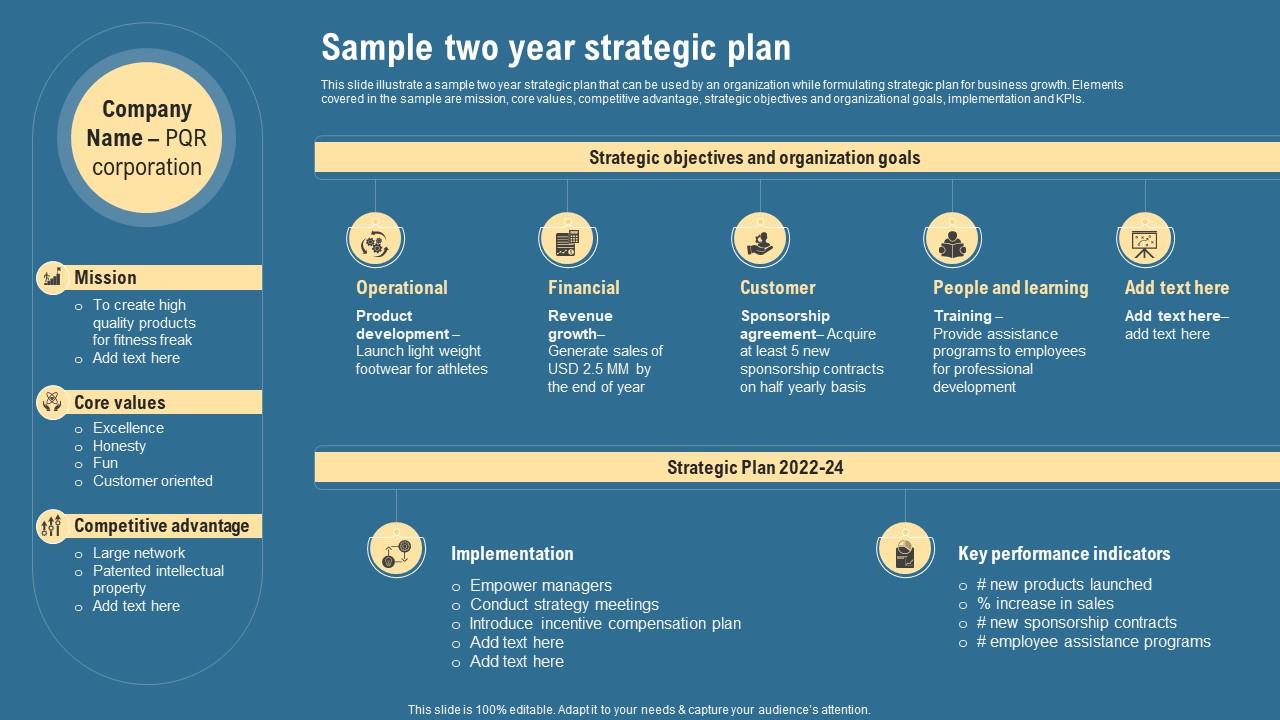
This slide illustrate a sample two year strategic plan that can be used by an organization while formulating strategic plan for business growth. Elements covered in the sample are mission, core values, competitive advantage, strategic objectives and organizational goals, implementation and KPIs. Introducing Sample Two Year Strategic Plan Strategic Management Guide For Leaders Strategic Management Guide to increase your presentation threshold. Encompassed with five stages, this template is a great option to educate and entice your audience. Dispence information on Mission, Core Values, Competitive Advantage, using this template. Grab it now to reap its full benefits.

FAQs for Sample Two Year Strategic Plan Strategic Management Guide For Leaders

Key components of a strategic management plan include vision and mission statements, environmental analysis, strategic objectives, action plans, resource allocation frameworks, and performance measurement systems. These elements work together by establishing clear direction, assessing market opportunities and threats, and creating accountability structures, with many organizations finding that integrated planning ultimately delivers enhanced operational efficiency and sustained competitive advantage.

SWOT analysis enhances strategic decision-making by systematically evaluating internal strengths and weaknesses alongside external opportunities and threats, enabling leaders to identify strategic gaps, leverage competitive advantages, and mitigate potential risks. This comprehensive assessment streamlines resource allocation and strategic planning, with many organizations finding that regular SWOT evaluations improve alignment between capabilities and market opportunities, ultimately delivering more informed decisions and sustainable competitive positioning.

Vision and mission provide strategic direction by defining organizational purpose, values, and long-term aspirations that guide decision-making across all business levels. These foundational elements enable companies to align resources, prioritize initiatives, and maintain focus during market changes, with many organizations finding that clear vision-mission alignment ultimately delivers improved employee engagement, stakeholder confidence, and sustainable competitive advantage.

Organizations effectively align resources with strategic goals through strategic resource allocation, performance measurement systems, cross-functional collaboration, and regular portfolio reviews. This alignment enables companies to streamline operations, minimize waste, and accelerate goal achievement, with many businesses finding that integrated planning processes deliver enhanced operational efficiency, faster strategic execution, and sustained competitive advantage.

Common strategic planning pitfalls include lack of stakeholder involvement, unrealistic goal setting, insufficient market analysis, poor resource allocation, and inadequate implementation tracking. These challenges often arise when organizations focus too heavily on theoretical frameworks while neglecting practical execution, with many companies finding that successful strategic planning requires balanced top-down vision and bottom-up operational insights.

External factors significantly influence strategic management by shaping organizational direction, resource allocation, and competitive positioning through market analysis, competitor assessment, and trend forecasting. Companies in retail, healthcare, and financial services increasingly adapt their strategies based on consumer behavior shifts, regulatory changes, and technological disruptions, ultimately enabling sustained competitive advantage and market responsiveness.

Key metrics for strategic plan effectiveness include financial performance indicators, customer satisfaction scores, market share growth, operational efficiency measures, and employee engagement levels. These metrics enable organizations to track progress across departments, identify areas needing adjustment, and demonstrate tangible outcomes, with many companies finding that balanced scorecards ultimately deliver comprehensive visibility into strategic success.

Scenario planning enables strategic management by developing multiple plausible future scenarios, identifying potential risks and opportunities, and creating flexible response strategies that adapt to changing conditions. Through systematic analysis of different possibilities, organizations can stress-test their strategic plans, enhance decision-making resilience, and build competitive advantage by preparing for various market developments and uncertainties.

Stakeholder analysis enables organizations to identify key stakeholders, assess their influence and interests, map their relationships, and develop targeted engagement strategies that align with strategic objectives. Through systematic stakeholder mapping, companies can anticipate potential resistance, secure critical support, and ensure strategic initiatives gain necessary buy-in, ultimately delivering smoother implementation and sustainable competitive advantage.

Organizations foster innovation culture by encouraging experimentation, providing dedicated resources for creative projects, establishing cross-functional collaboration platforms, implementing idea-sharing systems, and rewarding calculated risk-taking. Through strategic innovation frameworks, companies like 3M and Google enable employees to pursue breakthrough initiatives, streamline product development cycles, and adapt quickly to market changes, ultimately delivering competitive advantage and sustained growth.

Businesses can adapt to changing market conditions through diversification strategies, agile operational models, digital transformation initiatives, strategic partnerships, and continuous market research. These approaches enable organizations to pivot quickly when needed, reduce risk exposure, and capitalize on emerging opportunities, with many companies finding that combining multiple strategies delivers enhanced resilience and competitive advantage.

Strategic management in small businesses emphasizes agility, resource optimization, and direct market responsiveness, while large corporations focus on complex organizational alignment, diversified portfolio management, and systematic long-term planning processes. Small businesses typically streamline decision-making through fewer hierarchical layers and personal relationships, whereas corporations leverage extensive data analytics, cross-functional teams, and structured governance frameworks, with many organizations finding that scalability ultimately determines their strategic approach and competitive positioning.

Technology revolutionizes strategic management by enabling real-time data analytics, predictive modeling, automated decision-making processes, and enhanced collaboration across organizational levels. Through AI-driven insights and cloud-based platforms, companies streamline strategic planning, accelerate market responsiveness, and optimize resource allocation, with many organizations finding that digital transformation ultimately delivers competitive advantage and operational efficiency.

Effective communication enhances strategic plan execution by ensuring alignment across all organizational levels, clarifying roles and responsibilities, and maintaining consistent messaging throughout implementation phases. Through regular updates, feedback mechanisms, and transparent progress reporting, organizations streamline decision-making processes, minimize resistance to change, and accelerate goal achievement, ultimately delivering improved coordination and measurable business outcomes.

Netflix's evolution from DVD rentals to streaming giant, Apple's transformation from computers to mobile devices and services, Amazon's expansion from bookstore to e-commerce and cloud computing leader, and Microsoft's shift from software licensing to cloud-based services exemplify strategic pivots. These companies successfully recognized market shifts, leveraged existing capabilities while building new ones, and ultimately delivered enhanced customer experiences and sustained competitive advantage in rapidly evolving industries.

Ratings and Reviews

90% of 100
Review Form
Write a review
Most Relevant Reviews
  1. 100%

    by Eddy Guerrero

    Based on my personal experience, I would recommend other people to subscribe to SlideTeam. No one can be disappointed here!
  2. 80%

    by Edwin Valdez

    Informative design.

2 Item(s)

per page: