


Segmentation Markets And Evaluation Powerpoint Presentation Slides





Try Before you Buy Download Free Sample Product
 Impress Your
 Audience
 100%
100% Editable
 Save Hours
 of Time


Segment products specifically for target markets using ready-made Segmentation Markets And Evaluation PowerPoint Presentation Slides. Add segmentation markets and evaluation PPT presentation templates, segment products based on benefits people see, usage rates or brand loyalty. This content-ready product segmentation PowerPoint presentation deck comprises of templates such as market segmentation consumer markets, business markets, international markets, segment size and growth potential, company’s core competencies, competency framework, understand the customer needs, customer segmentation layout, segmentation map, performance evaluation, and more. Influence consumer buying decisions and carry out a successful marketing campaign accordingly with segmentation markets and evaluation PPT presentation templates. Usage of product segmentation will help you focus on customer needs which you can meet cost effectively having a competitive advantage. Get access to segmentation markets and evaluation PowerPoint presentation complete deck to reach out to the larger number of audiences. Continue to build on the initial advantage with our Segmentation Markets And Evaluation Powerpoint Presentation Slides. You will inch ahead consistently.
People who downloaded this PowerPoint presentation also viewed the following :
Content of this Powerpoint Presentation
Slide 1: This slide introduces Segmentation, Markets & Evaluation. State Your Company Name and begin.
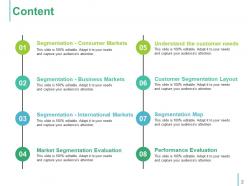
Slide 2: This slide presents Content with these of the points we have listed- Segmentation - Consumer Markets, Segmentation - Business Markets, Segmentation - International Markets, Market Segmentation Evaluation, Understand the customer needs, Customer Segmentation Layout, Segmentation Map, Performance Evaluation.
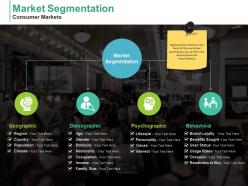
Slide 3: This slide showcases Market Segmentation Consumer Markets. Segmentation is done on the basis of the mentioned parameters, you can fill in the details as per the requirements
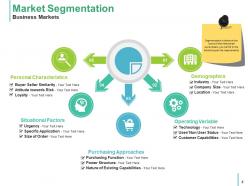
Slide 4: This slide presents Market Segmentation Business Markets. Segmentation is done on the basis of the mentioned parameters, you can fill in the details as per the requirements
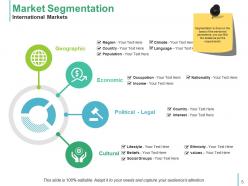
Slide 5: This slide shows Market Segmentation International Markets. Segmentation is done on the basis of the mentioned parameters, you can fill in the details as per the requirements
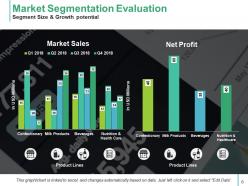
Slide 6: This slide displays Market Segmentation Evaluation Segment Size & Growth potential.
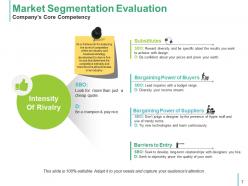
Slide 7: This slide showcases Market Segmentation Evaluation Company’s Core Competency. Its a framework for analyzing the level of competition within an industry and business strategy development to derive five forces that determine the competitive intensity and therefore the attractiveness of an industry
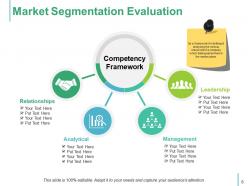
Slide 8: This slide presents Market Segmentation Evaluation. Its a framework for defining & analyzing the various resources of a company which distinguishes them in the market place.
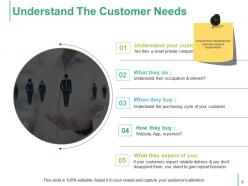
Slide 9: This slide shows Understand The Customer Needs. Analyse and understand the customer needs & requirements
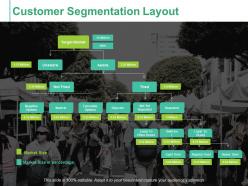
Slide 10: This slide presents Customer Segmentation Layout.
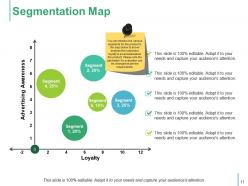
Slide 11: This slide showcases Segmentation Map. You can mention the various segments for the product in the map below to show/ analyse the customers loyalty & awareness about the product. Please note the parameter for evaluation can be changed as per the requirements.
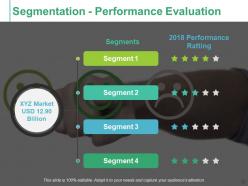
Slide 12: This slide shows Segmentation - Performance Evaluation.
Slide 13: This slide presentsSegmentation, Markets & Evaluation Icon Slide.
Slide 14: This slide is a Coffee Break image for a halt.
Slide 15: This slide forwards to Charts & Graphs.
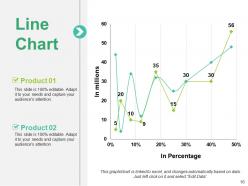
Slide 16: This slide shows a Line Chart for two product comparison.
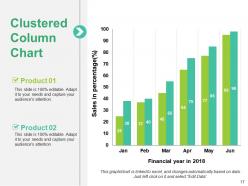
Slide 17: This slide presents Clustered Column Chart.
Slide 18: This slide is titled Additional Slides.
Slide 19: This slide represents Our Mission. State your mission, goals etc
Slide 20: This slide showcases Our Team with Name and Designation to fill.
Slide 21: This slide shows Target image with text boxes.
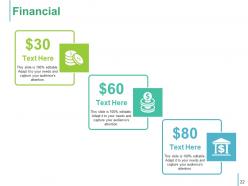
Slide 22: This slide displays Financial Projections And Key Metrics for customers and employees.
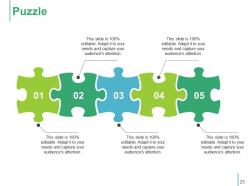
Slide 23: This slide presents a PUZZLE slide with the following subheadings- Integrity and Judgment, Critical and Decision Making, Leadership, Agility.
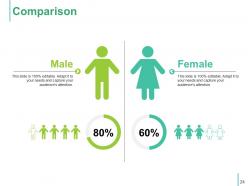
Slide 24: This slide shows Comparison of Positive Factors v/s Negative Factors with thumbsup and thumb down imagery.
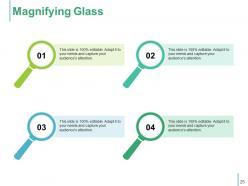
Slide 25: This slide shows a Magnifying glass with text boxes.
Slide 26: This is a Bulb/idea image slide to show information, ideas, innovation specific stuff etc.
Slide 27: This is a Thank You slide with Address# street number, city, state, Contact Numbers, Email Address.
Segmentation Markets And Evaluation Powerpoint Presentation Slides with all 27 slides:
Formulate effective guidelines for the future with our Segmentation Markets And Evaluation Powerpoint Presentation Slides. Elaborate on important instances.


FAQs for Segmentation Markets And Evaluation
Key factors influencing market segmentation include data analytics capabilities, consumer behavior tracking, digital touchpoint mapping, personalization technologies, and cross-channel integration tools. These technologies enable businesses to streamline customer targeting, enhance engagement precision, and deliver personalized experiences across multiple platforms, with many organizations finding that strategic segmentation ultimately drives higher conversion rates and competitive advantage.
Businesses effectively use demographic segmentation by analyzing age, income, education, occupation, and geographic location to create targeted marketing campaigns, personalized product offerings, and tailored messaging strategies. Through demographic insights, companies in sectors like retail, financial services, and healthcare can optimize advertising spend, enhance customer experiences, and improve conversion rates, ultimately delivering higher ROI and stronger market positioning.
Behavioral segmentation has revolutionized marketing by enabling personalized campaigns based on purchase history, browsing patterns, engagement frequency, and brand loyalty indicators. Through advanced analytics and real-time data tracking, companies like Netflix, Amazon, and Spotify deliver highly targeted content recommendations and product suggestions, ultimately increasing conversion rates and customer lifetime value while significantly reducing acquisition costs.
Psychographic segmentation enables the creation of detailed customer personas by analyzing lifestyle preferences, values, attitudes, interests, and behavioral motivations beyond basic demographics. This approach helps organizations develop more nuanced personas that capture emotional drivers and decision-making patterns, with retail brands and financial services finding that psychographic insights enhance targeted marketing strategies and ultimately deliver more personalized customer experiences.
Companies leverage geographic segmentation by analyzing regional demographics, local preferences, cultural nuances, climate variations, and economic conditions to tailor messaging and product positioning. Through location-based targeting, businesses can customize promotional offers, adjust pricing strategies, and select appropriate distribution channels, with retailers and hospitality brands finding that localized campaigns significantly enhance customer engagement and conversion rates.
Common pitfalls in market segmentation include over-segmentation creating unviable customer groups, relying on outdated demographic data, assuming segments remain static over time, and creating segments too broad to be actionable. These challenges often result in misallocated marketing resources and ineffective targeting strategies, with many organizations finding that regular segment validation and data-driven refinement ultimately delivers more precise customer insights and improved ROI.
Technology enhances market segmentation effectiveness by enabling real-time data analysis, predictive modeling, automated customer clustering, and personalized targeting at scale. Through AI and machine learning platforms, companies streamline audience identification, optimize resource allocation, and deliver more precise messaging, with retail and financial services organizations finding significantly improved conversion rates and customer engagement.
Businesses should track conversion rates, customer lifetime value, engagement metrics, retention rates, and revenue per segment to evaluate segmentation success. These metrics enable organizations to measure targeting effectiveness, optimize resource allocation, and identify high-performing segments, with many companies finding that well-segmented campaigns deliver significantly higher ROI and enhanced customer experiences.
Market segmentation varies significantly across industries based on unique customer behaviors, regulatory requirements, distribution channels, and competitive dynamics. In healthcare, segmentation focuses on patient demographics and treatment pathways, while financial services emphasize risk profiles and investment capacity, and retail segments by purchasing behavior and lifestyle preferences, ultimately enabling companies to develop targeted strategies that resonate with specific audiences and deliver superior customer experiences.
**INPUT**: What are some best practices for combining multiple segmentation strategies? **OUTPUT**: Best practices include aligning demographic, behavioral, and psychographic data for comprehensive customer profiles, ensuring consistent messaging across segments, and using technology platforms that integrate multiple data sources seamlessly. Through strategic combination of segmentation approaches, organizations in retail, financial services, and healthcare deliver more personalized experiences, improve targeting accuracy, and achieve higher conversion rates, ultimately enhancing competitive advantage. [Word count: 60]
Businesses ensure inclusive segmentation by conducting comprehensive demographic research, utilizing diverse data sources, and regularly updating consumer profiles to reflect evolving populations. Through multicultural market research, accessibility considerations, and socioeconomic analysis, organizations create more representative segments that capture underserved communities, ultimately expanding market reach and delivering personalized experiences across all consumer groups.
Market segmentation significantly influences product development by enabling companies to create targeted solutions that address specific customer needs, preferences, and pain points within distinct market segments. This strategic approach drives innovation by revealing unmet demands, allowing businesses to develop specialized features, customize user experiences, and differentiate offerings, ultimately delivering enhanced customer satisfaction and competitive advantage.
AI and machine learning enhance market segmentation by analyzing vast datasets, identifying complex behavioral patterns, enabling real-time personalization, automating customer clustering, and predicting future preferences with remarkable accuracy. These technologies streamline segmentation processes by processing unstructured data, discovering hidden correlations, and continuously refining segments, with many retail and financial services companies finding significantly improved targeting precision and campaign effectiveness.
Changes in consumer behavior significantly elevates market segmentation importance by requiring continuous adaptation to shifting preferences, purchasing patterns, digital habits, and demographic trends. As consumer expectations evolve rapidly across sectors like retail, healthcare, and financial services, organizations must regularly refine their segmentation strategies to maintain relevance, ultimately delivering personalized experiences and competitive advantage in an increasingly dynamic marketplace.
Nike's demographic and psychographic segmentation targeting athletes and fitness enthusiasts, McDonald's geographic segmentation adapting menus to local tastes, and Coca-Cola's behavioral segmentation with personalized campaigns demonstrate effective approaches. These strategies streamline marketing efforts, enhance customer engagement, and deliver improved ROI, with many companies finding that targeted segmentation ultimately increases market share and customer loyalty significantly.
-
Enough space for editing and adding your own content.
-
Much better than the original! Thanks for the quick turnaround.