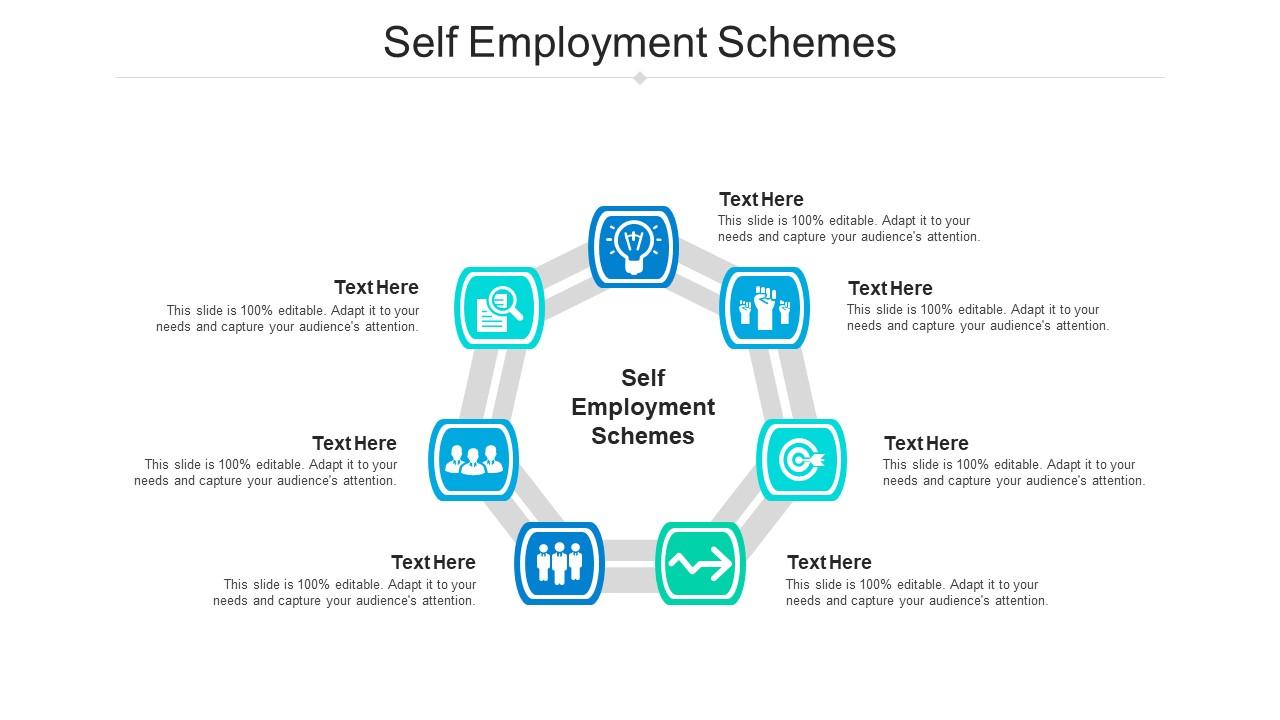
Self employment schemes ppt powerpoint presentation styles information cpb
Try Before you Buy Download Free Sample Product
Audience
Editable
of Time
Our Self Employment Schemes Ppt Powerpoint Presentation Styles Information Cpb are topically designed to provide an attractive backdrop to any subject. Use them to look like a presentation pro.
People who downloaded this PowerPoint presentation also viewed the following :
Self employment schemes ppt powerpoint presentation styles information cpb with all 6 slides:
Use our Self Employment Schemes Ppt Powerpoint Presentation Styles Information Cpb to effectively help you save your valuable time. They are readymade to fit into any presentation structure.
FAQs for Self employment schemes ppt powerpoint presentation
Successful self-employment schemes include accessible funding mechanisms, comprehensive mentorship programs, simplified regulatory frameworks, targeted skills training, and ongoing business support services. Countries like Germany, Canada, and Australia have found that combining financial assistance with structured guidance, streamlined registration processes, and sector-specific resources enables entrepreneurs to launch sustainable ventures while reducing administrative barriers, ultimately delivering higher success rates and economic growth.
Government policies significantly impact self-employment scheme effectiveness through funding allocation, regulatory frameworks, tax incentives, and administrative support structures. These policy decisions determine accessibility, sustainability, and success rates, with many emerging economies finding that streamlined registration processes, reduced bureaucratic barriers, and targeted financial assistance ultimately deliver higher entrepreneurship rates and improved economic outcomes for participants.
Training and skill development programs play a crucial role in self-employment success by enhancing technical competencies, building business management capabilities, and developing market-relevant expertise. These programs enable aspiring entrepreneurs to acquire essential skills like financial planning, digital marketing, and industry-specific knowledge, with many participants finding that structured learning significantly increases their venture's sustainability and competitive advantage in increasingly dynamic markets.
Self-employment schemes commonly support retail, food services, technology startups, healthcare, professional services, and creative industries. These sectors offer lower barriers to entry, with many programs finding that small-scale retail businesses, consulting services, and digital ventures deliver faster market entry and sustainable income generation, ultimately enabling economic independence.
Technology enhances self-employment initiatives by providing digital platforms for market access, automated financial management tools, and online training resources that reduce operational barriers. Through e-commerce integration, mobile banking solutions, and virtual networking platforms, entrepreneurs can reach broader customer bases, streamline business processes, and access mentorship opportunities, ultimately delivering greater scalability and sustainable income generation across diverse industries.
Common challenges include limited access to initial funding, lack of business management skills, market competition, irregular income streams, and insufficient mentorship support. Many entrepreneurs find that navigating regulatory requirements, building customer bases, and managing cash flow present significant hurdles, while successful schemes increasingly offer comprehensive training and ongoing guidance to address these operational challenges.
Self-employment schemes contribute to local economic development by creating jobs, fostering entrepreneurship, and stimulating regional commerce through increased business activity. These programs enable communities to retain talent, generate tax revenue, and build diverse economic foundations, with many rural areas and developing regions finding that micro-enterprise initiatives ultimately deliver sustainable growth and reduced unemployment rates.
Success metrics for self-employment schemes include participant retention rates, business survival rates, income generation levels, job creation numbers, and skill development assessments. These indicators streamline evaluation by measuring financial sustainability, market viability, and social impact, with many organizations finding that combining quantitative outcomes with qualitative feedback ultimately delivers comprehensive program insights and strategic improvements.
Cultural attitudes significantly influence self-employment scheme uptake by shaping perceptions of risk, success, and business ownership across different communities and regions. Societies that celebrate entrepreneurial achievement and view business failure as learning experiences see higher participation rates, while cultures prioritizing job security and traditional employment paths often show lower engagement, ultimately affecting economic diversification and innovation potential.
Self-employment programs typically offer microloans, grants, seed funding, equipment financing, and working capital assistance. These financial mechanisms streamline business launch by reducing initial investment barriers, providing flexible repayment terms, and enabling access to essential resources, with many entrepreneurs finding that strategic combinations of funding sources ultimately deliver sustainable growth and competitive market positioning.
Mentorship opportunities integrate into self-employment schemes through structured guidance programs, peer-to-peer networks, industry expert partnerships, and ongoing support systems that connect new entrepreneurs with experienced business leaders. These programs enhance decision-making capabilities, accelerate skill development, and provide strategic insights, with many participants finding that mentor relationships significantly improve business survival rates and long-term growth potential.
Self-employment schemes create sustainable economic growth by generating local businesses, reducing unemployment rates, fostering entrepreneurial ecosystems, and strengthening community resilience. These programs enable communities to retain talent, diversify income sources, and build social capital, with many rural areas finding that local enterprises stimulate broader economic development and community cohesion.
Self-employment programs can be tailored through targeted microfinance, culturally relevant training, flexible scheduling accommodating caregiving responsibilities, and reduced bureaucratic barriers. These adaptations enable women, minorities, and underserved communities to access capital, develop relevant skills, and navigate regulatory requirements more effectively, ultimately delivering economic inclusion and sustainable entrepreneurship opportunities.
Self-employment drives job creation by enabling entrepreneurs to establish businesses that hire additional workers, stimulate local economies, and foster innovation across sectors. While self-employed individuals initially create their own positions, they increasingly expand operations, with many small businesses in retail, consulting, and manufacturing ultimately delivering employment opportunities for others and enhancing economic growth.
Self-employment schemes adapt to changing market demands through flexible policy frameworks, digital platform integration, skill development programs, and responsive funding mechanisms. These adaptations enable entrepreneurs to pivot quickly during economic shifts, access emerging markets, and leverage new technologies, with many governments finding that agile support systems ultimately deliver greater business resilience and sustained economic growth.
-
Use of icon with content is very relateable, informative and appealing.
-
Awesomely designed templates, Easy to understand.