Seven Principles Of Software Testing For It Industry

Rating:
100%
Seven Principles Of Software Testing For It Industry
Slide 1 of 6
Favourites Favourites

Try Before you Buy Download Free Sample Product

Audience Impress Your
Audience
Editable 100%
Editable
Time Save Hours
of Time
The Biggest Sale is ending soon in
0
0
:
0
0
:
0
0
Rating:
100%
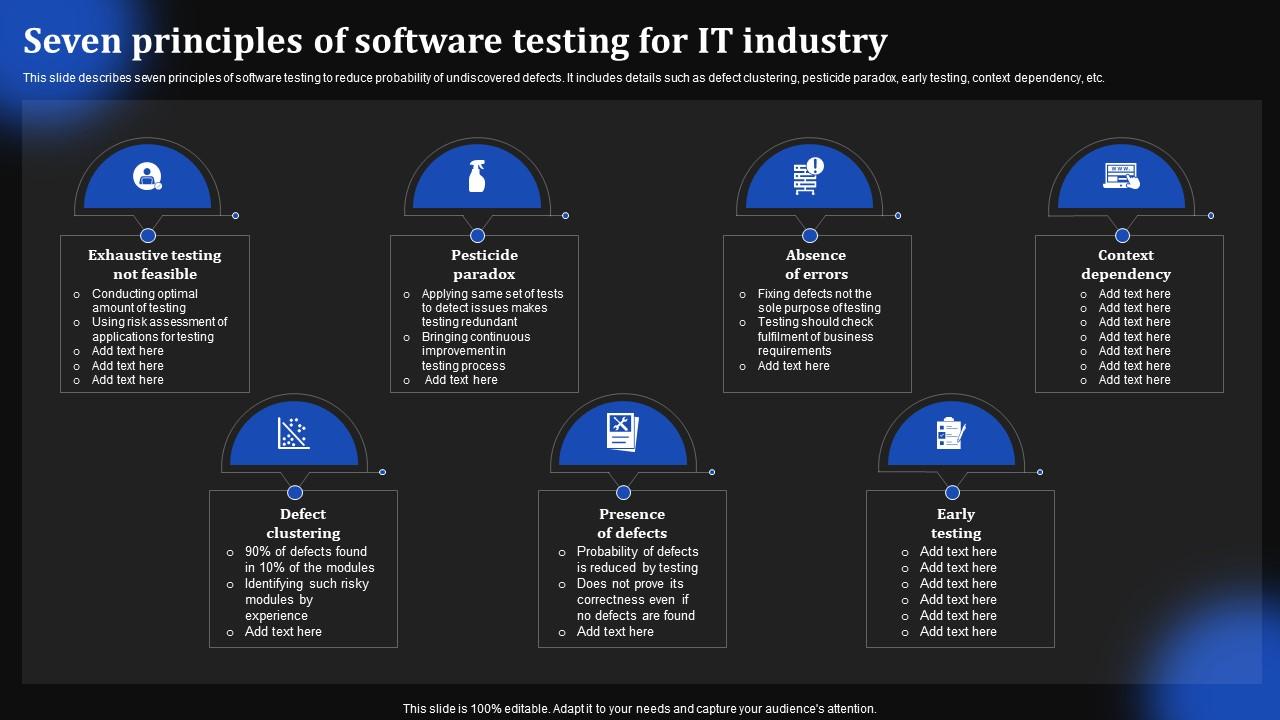
This slide describes seven principles of software testing to reduce probability of undiscovered defects. It includes details such as defect clustering, pesticide paradox, early testing, context dependency, etc. Presenting our set of slides with Seven Principles Of Software Testing For It Industry. This exhibits information on seven stages of the process. This is an easy to edit and innovatively designed PowerPoint template. So download immediately and highlight information on Pesticide Paradox, Presence Of Defects, Context Dependency.

FAQs for Seven Principles Of Software Testing

Okay so there are seven key principles you gotta know. Testing finds bugs but can't prove they're all gone - that's a big one. You literally can't test everything (impossible), so start testing early instead. Defects love hanging out together in clusters. There's this thing called the pesticide paradox where your tests get stale over time. Context matters huge for what you're testing. Oh and just because something works doesn't mean it's actually usable - learned that the hard way! The pesticide one trips people up most, so definitely wrap your head around that first.

Look, testing principles are like having good guardrails for your whole dev process. You catch bugs early when they're way cheaper to fix. Plus they help you test the right stuff at the right time - none of that "works on my machine" BS that drives everyone crazy. Projects without them? Total mess, honestly. They guide everything from requirements all the way to monitoring after you deploy. Oh, and here's the thing - you gotta bake them in from day one. Don't treat testing like some afterthought you tack on later.

Dude, test early or you'll hate your life later. Catching bugs during requirements takes like an hour to fix. Wait until production? You're looking at days or weeks of hell. Studies show early defects cost 10-100x less than post-release disasters - and honestly, those studies probably underestimate it. Get your QA people in design reviews right away. Start writing test cases the second you have requirements. Your users will actually get working software, and you won't be frantically patching things at 2am wondering where your career went wrong.

Look at your past bug reports first - you'll see patterns where problems keep popping up. Most of your testing energy should go there instead of spreading it thin everywhere. There's this whole 80/20 thing where like 80% of bugs hide in just 20% of your code. Put more testers and time on those messy areas. I mean, some parts of code are just naturally more drama-prone, right? Don't totally skip other sections, but definitely hit the trouble spots harder. Way more efficient than testing everything equally.

So basically the pesticide paradox is when your test cases get stale and stop catching new bugs - kinda like how actual bugs become immune to pesticides over time. Running the same tests repeatedly only finds the same old problems while fresh defects sneak past in areas you're not checking. You've gotta mix things up regularly. Add new test scenarios, rotate what you're focusing on, review your cases monthly. I swear some teams just get too cozy with their existing regression tests and wonder why quality drops. Keep adding fresh scenarios and switch up your approach - that's how you stay ahead of the bugs.

Here's the thing - zero bugs doesn't mean your software is perfect, it probably means your testing sucks. I've watched teams throw parties over "clean" runs while missing huge problems. The absence of errors fallacy is real. Track stuff that actually matters: test coverage, how many bugs slip into production, when you're catching critical issues. Honestly, if you're never finding defects, your tests are probably too shallow. Challenge your approach instead of assuming you built flawless code. Nobody does that.

So here's the deal - testing can only show you what's broken, not prove everything works perfectly. Finding bugs is actually good news because it means your tests are doing their job. But passing tests? That doesn't mean you're in the clear. Think of it like proofreading - spotting typos tells you they were there, but a clean read-through doesn't guarantee perfection. I've learned this the hard way honestly. Use your test results to feel more confident about your system, sure, but don't get cocky. There's probably still stuff hiding that you haven't found yet.

So basically, context-dependent testing just means you adjust your testing based on what your app actually does. Banking software? You're gonna obsess over security and data protection. Gaming apps need smooth performance above all else. Healthcare stuff has crazy compliance requirements you can't ignore. The whole point is figuring out what would absolutely destroy your business if it broke. An e-commerce checkout failing hits different than a bug in internal HR tools, you know? There's really no universal playbook here - it depends entirely on your users and what keeps you up at night. Start with your biggest risks and test around those.

TDD and BDD are game-changers for agile testing. You write tests first with TDD - yeah, it feels weird at first but keeps you laser-focused. BDD takes it further by using plain English for tests, which honestly saves so many headaches when talking to stakeholders. CI/CD pipelines automate everything, running tests at each step. I'd start with TDD if you're just getting into this stuff. Fair warning though - once you get used to it, going back to coding without tests feels like driving blindfolded. It'll totally reshape how you think about development.

Dude, stop making testing just QA's job - that's your first mistake. Get devs writing unit tests right from the start. Leadership has to actually care about quality over speed though, or you're screwed. Have your testers, devs, and product people actually talk to each other about what could break. Oh and train everyone on basic testing stuff so they're not clueless. The real trick? Don't treat bugs like disasters - celebrate catching them early. Makes such a difference when the whole team gets why testing matters instead of seeing it as someone else's problem.

Dude, get someone else to test your code who wasn't involved in writing it. You'll miss stuff because you're too close to it - happens to everyone. Fresh eyes catch things differently since they're not emotionally invested in making it work. Plus they'll actually try to break your code instead of babying it. Even just swapping with a teammate helps tons. I learned this the hard way after shipping buggy features I "tested" myself. Independence in testing is honestly a game-changer for reliability.

Honestly, automation works best for the boring stuff - regression tests, smoke tests, anything you'd have to run over and over. Load testing too, because who wants to manually click through scenarios 500 times? Focus on stable parts of your app first, especially data-heavy features or complex calculations that need consistent checking. CI pipelines love automated tests since they give quick feedback on every commit. Don't go crazy trying to automate everything though - save manual testing for the weird edge cases and exploratory work where you actually need human intuition.

Honestly, just focus on the stuff that'll actually break your app if it goes wrong. I always hit the critical user flows first - login, checkout, whatever makes you money. Then tackle the messy integrations and anything that's bitten you before. There's this whole 80/20 thing where most bugs lurk in like 20% of your code anyway. Don't waste time testing every little feature equally - you'll blow your deadline and bugs will still slip through. Rank everything by risk and impact, then work down the list. Way more effective than trying to be a perfectionist about it.

Start with simple performance tests on every commit - just basic load checks and response times, nothing crazy. Set performance budgets so your builds actually fail when things get too slow. Keep these tests under 10 minutes or your team will hate you for slowing down deployments. Save the heavy-duty stress testing for nightlies or weekly runs. Track your metrics over time in CI so you can catch slowdowns before users notice. Honestly, just pick a few critical user flows to start with. You can always add more later once you've got the basics dialed in.

Look, start with test coverage percentage and defect density - those two alone will show you if your testing actually works. Defect escape rate is critical too (how many bugs make it to production). Manual testing is such a pain, so definitely track automation coverage. I'd also watch your pass/fail ratios and whether you're keeping test cases updated when requirements shift. Honestly though? Don't go crazy with metrics. Pick maybe 3-4 that actually move the needle for your specific project. Too much data just becomes noise. Coverage and defect density are solid starting points.

Ratings and Reviews

100% of 100
Review Form
Write a review
Most Relevant Reviews
  1. 100%

    by Duane Ray

    Every time I ask for something out-of-the-box from them and they never fail in delivering that. No words for their excellence!
  2. 100%

    by Ethan Sanchez

    Requested a complete pitch deck. Delivered immediately and with high quality well researched content.

2 Item(s)

per page: