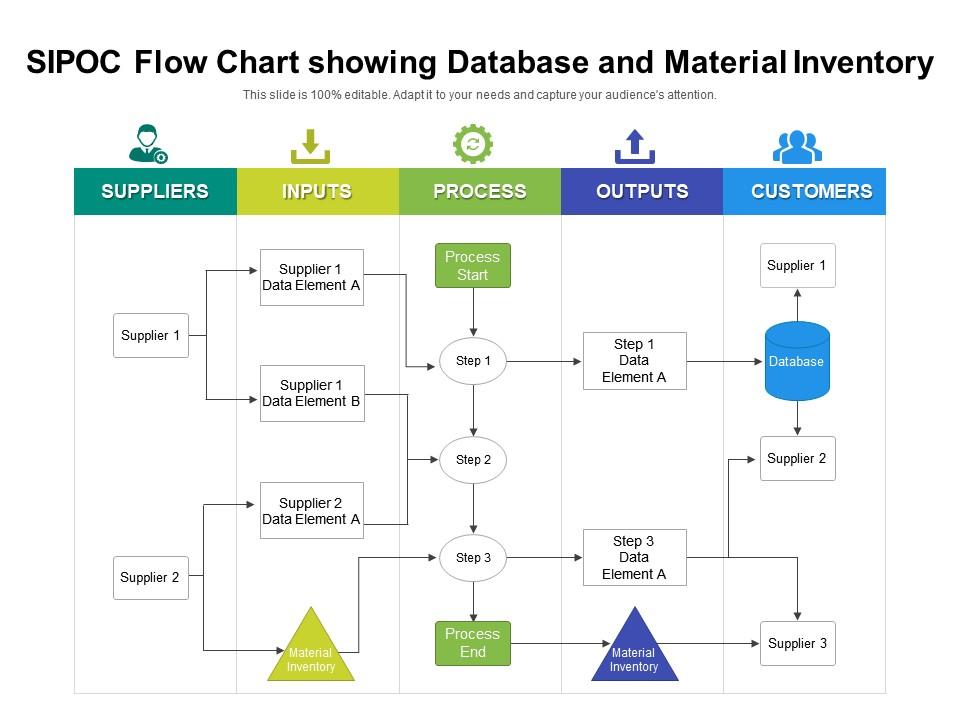
Sipoc flow chart showing database and material inventory
Try Before you Buy Download Free Sample Product
Audience
Editable
of Time
Our SIPOC Flow Chart Showing Database And Material Inventory are fully equipped to do it. They have all the facilities you could ask for.
People who downloaded this PowerPoint presentation also viewed the following :
Sipoc flow chart showing database and material inventory with all 2 slides:
Be direct and forthright with our SIPOC Flow Chart Showing Database And Material Inventory. They discourage dubious activity.
FAQs for Sipoc flow chart showing database
So SIPOC breaks down into five parts that go left to right: Suppliers give you inputs, inputs feed into your process, process creates outputs, outputs go to customers. Basic flow stuff. What's cool is it makes you zoom out and see the whole picture - not just your piece of it. I usually start with the process in the middle (that's the easiest part), then figure out what feeds into it and what comes out. The interactions are pretty straightforward once you draw it out. Your suppliers provide whatever materials or info you need, you do your thing with it, then hand off the results. Honestly feels obvious after you've done it once, but super helpful for mapping things out initially.
Honestly, SIPOC diagrams are pretty clutch for this stuff. You get that whole big picture view instead of drowning in all the tiny daily chaos. Makes it super easy to spot where things are getting stuck or which suppliers are screwing you over. Plus you can see if what you're actually delivering matches what customers want - which, let's be real, doesn't always happen. The best part? When your team sits down to map it out together, someone always goes "wait, THAT'S how accounting handles it?" Total lightbulb moments. Definitely start here before you tear apart your whole process.
Honestly, scope is your biggest enemy here. Teams always go too broad or get lost in microscopic details - there's no middle ground apparently. Finding all your suppliers and customers is trickier than it sounds too, especially the internal ones everyone conveniently forgets about. Getting people to agree on basic process steps? Good luck with that. I've seen grown adults argue over flowchart boxes for hours. Just start high-level with your main process, don't overthink it. Work outward from there to identify suppliers and customers. You can fix the details later once you've got something down on paper.
SIPOC works well pretty much anywhere you've got messy processes - manufacturing, healthcare, banks, insurance companies. Six Sigma people are obsessed with them, which honestly makes sense since they actually help. Banking uses them a ton for all those department handoffs that usually go wrong. Hospitals map patient flows with them too. The trick is picking processes that have obvious inputs and outputs. Start with whatever's giving you the biggest headache right now - that's where the visual mapping pays off most. Service industries probably get the most value since they're all about those step-by-step workflows anyway.
So SIPOC diagrams are basically the bird's eye view version of process mapping. They skip all the tiny details and just hit the main points: Suppliers, Inputs, Process, Outputs, Customers. That's it. Regular flowcharts show you every little decision and step, which honestly can be overwhelming when you're just getting started. I always use SIPOC first to map out the big picture - helps get everyone on the same page about what we're actually dealing with. Then once that's solid, you can dive into the detailed stuff. Way less confusing than jumping straight into complex process maps.
Yeah, totally! SIPOC diagrams work great for both. You can do a big picture one first - like your whole customer onboarding thing from beginning to end. Then drill down into the messy parts with detailed ones for specific steps. We actually did this on a project last year and it worked really well. Start broad to see everything, then get specific where you're having problems. The detailed versions show you exactly what inputs and outputs each little piece needs. Way more useful than trying to fix everything at once, honestly.
Honestly? Just focus on your main process first - like 5-7 steps tops or you'll overthink it. I learned that the hard way lol. Map out your suppliers and customers next, but think bigger than just internal stuff. Your team should definitely help with this part since they'll spot what you miss. Don't get caught up in every tiny detail though - stick to the inputs and outputs that actually move things along. The whole point is keeping it visual enough that some random person could look at it and get what's happening. Simple beats comprehensive every time.
Getting stakeholders involved in your SIPOC is honestly a game-changer. They know all the messy details you'll miss from the outside. Suppliers, process owners, customers - they each see different pieces of the puzzle. You'll catch weird dependencies and gaps that aren't obvious otherwise. People actually care about changes when they helped build the thing from scratch. It's basic psychology, right? Different viewpoints also reveal pain points you'd never spot working solo. I learned this the hard way on my last project - should've listened to the frontline folks earlier. Run a workshop with 3-4 key people instead of going it alone. Way better results.
Honestly, customer feedback is what makes your SIPOC actually useful instead of just a fancy diagram. Without it, you're basically shooting in the dark about what they care about. Talk to your key customers first - before you even finish mapping everything out. Figure out what they actually value, not what you think they want. Then once you make changes, circle back to see if you're still hitting their expectations. Their input helps you focus on improvements that matter to them, rather than just making internal stuff more efficient (which they don't really care about). Plus it validates whether your outputs are actually doing what they should be.
Honestly, SIPOC diagrams are pretty clutch for finding bottlenecks. Map out your whole process from suppliers to customers - sounds boring but stick with me here. You'll start seeing where inputs are arriving late, which steps drag on forever, or where outputs get stuck before reaching people. It's basically a 30,000-foot view of everything. Sometimes when you're deep in the weeds, you miss the obvious stuff. I've seen teams create one and immediately go "oh wow, THAT'S why we're always behind schedule." Just pick your messiest process first. The problem spots will practically highlight themselves once it's all laid out visually.
Honestly, any tool that makes basic tables works fine for SIPOC diagrams. Visio and Lucidchart are solid if you want templates and fancy collaboration stuff. But I've seen teams crush it using just Excel or PowerPoint - hell, even whiteboards during meetings. The whole point is simplicity anyway. You're literally just putting suppliers, inputs, processes, outputs, and customers in columns. Nothing revolutionary there. Start with whatever your team already knows how to use and can share easily. Get the content nailed down first, then make it look professional later if you need to impress someone.
SIPOC is like your roadmap before jumping into any Lean or Six Sigma work. You map out the whole process first - suppliers, inputs, process steps, outputs, customers. Makes sense to know what you're dealing with, right? Lean teams use it to spot waste and unnecessary steps. Six Sigma folks typically build it during the Define phase of DMAIC. I've watched so many projects crash because people skipped this part and had no clue about their process boundaries. My old manager used to say "you can't fix what you don't understand." Start here whether it's a quick kaizen or major project.
Think about pizza delivery - it's way easier to understand this way. Your suppliers are whoever brings you dough, toppings, plus your drivers. Inputs are all that stuff plus customer orders. Then you've got the whole process: taking orders, making pizza, checking it doesn't suck, delivering it. Outputs are hot pizza and the receipt. Honestly, I used to overthink this framework until I mapped something I actually knew. Once you see how it all connects, you can do it with any work process. Try sketching your current project - you'll probably spot ways to fix things right away.
Honestly, SIPOC diagrams are a lifesaver for project scope. You map out suppliers, inputs, process steps, outputs, and customers upfront - sounds boring but trust me on this. It prevents those awkward meetings where everyone's confused about what we're actually building. Early roadblocks become obvious, plus you'll catch stakeholders you forgot about. I'm probably obsessed with them at this point, but they're amazing for stopping scope creep before it spirals. Just grab your team for 30 minutes during kickoff and sketch one out. You'll dodge so much confusion later.
Update your SIPOC when big stuff changes - new suppliers, different outputs, customer requirements shifting around. Quarterly reviews are solid, but honestly? Best time is when your team goes "uh, this is totally wrong now." Major system overhauls or org changes are obvious triggers too. Don't let it turn into one of those useless docs nobody looks at (we've all been there). Short sentences work. Calendar reminders every few months help catch drift before it gets ridiculous. The whole point is having something accurate enough for actual process discussions, not just checking a box.
No Reviews