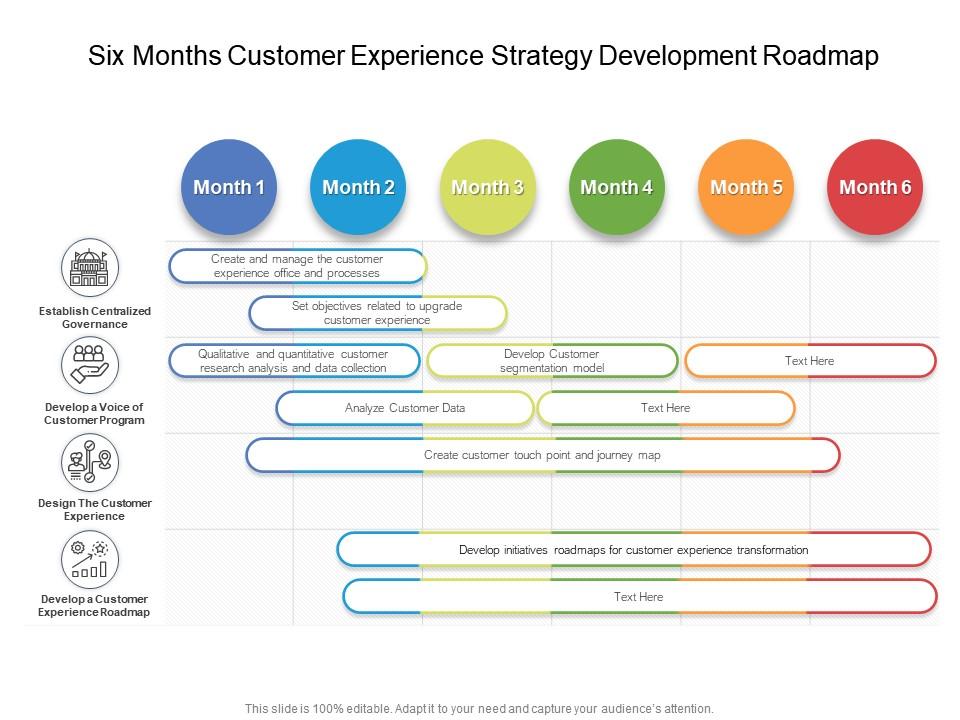
Sechsmonatiger Fahrplan für die Entwicklung der Kundenerfahrungsstrategie
Try Before you Buy Download Free Sample Product
Audience
Editable
of Time
Ein kohärenter Arbeitsplan ist unerlässlich, um das gewünschte Ziel zu erreichen. Kommunizieren Sie Ihre Vision und geben Sie Ihrem Publikum mit unserem PowerPoint-Layout einen festen Boden. Richten Sie Ihre Projektmeilensteine, Budgets, Ergebnisse, Fristen und alle erforderlichen Informationen für eine dynamische Präsentation aus, indem Sie diese erstaunlich gestaltete Entwicklungs-Roadmap für sechs Monate der Kundenerfahrungsstrategie verwenden. Maximieren Sie die Teameffizienz und rationalisieren Sie einen Arbeitsplan effizient, indem Sie unser fertiges Roadmap-PowerPoint-Design einführen. Mit diesem nützlichen Business-Tool können Sie schnell eine Koordination zwischen verschiedenen Aktivitäten im gesamten Unternehmen herstellen und Ihren Kollegen einen Einblick geben. Kennzeichnen Sie bestimmte Aufgaben farblich, priorisieren Sie sie und behalten Sie die Fristen mit Hilfe unserer auffälligen PowerPoint-Vorlage im Auge. Laden Sie unsere sechsmonatige Strategieentwicklungs-Roadmap für Kundenerlebnisse herunter, um sich im produktiven Management hervorzuheben.
Merkmale dieser PowerPoint-Präsentationsfolien:
Präsentation einer sechsmonatigen Roadmap zur Entwicklung der Kundenerfahrungsstrategie PowerPoint-Folie, die prozentual bearbeitet werden kann. Sie können Farbe, Schriftgröße, Schriftart und Formen dieses PPT-Layouts nach Ihren Wünschen ändern. Diese PPT-Vorlage ist mit Google Slides kompatibel und in den Seitenverhältnissen 4,3 und 16,9 verfügbar. Diese gebrauchsfertige PowerPoint-Präsentation kann in verschiedenen Formaten wie PDF, JPG und PNG heruntergeladen werden.
People who downloaded this PowerPoint presentation also viewed the following :
Sechsmonatige Strategieentwicklungs-Roadmap für das Kundenerlebnis mit allen 2 Folien:
Bieten Sie Ihrem Publikum ein erfüllendes Erlebnis. Sie werden unsere Strategieentwicklungs-Roadmap für sechs Monate als erbaulich empfinden.
FAQs for Six months customer experience
Key components include customer journey mapping, touchpoint optimization, personalization frameworks, feedback collection systems, and cross-functional alignment across departments. These elements work together by identifying pain points, streamlining interactions, and delivering consistent experiences, with many organizations finding that strategic integration of these components significantly enhances customer satisfaction and drives competitive advantage.
Businesses measure customer experience success through Net Promoter Score (NPS), Customer Satisfaction (CSAT) scores, customer retention rates, response times, and revenue per customer metrics. These measurements enable organizations to track satisfaction improvements, identify service gaps, and optimize touchpoints across retail, banking, and healthcare sectors, ultimately delivering enhanced loyalty and competitive advantage.
Employee engagement directly impacts customer experience through improved service quality, faster problem resolution, higher retention rates, and more personalized interactions with customers. Engaged employees in sectors like retail, hospitality, and financial services deliver significantly better customer outcomes, with many organizations finding that motivated staff create stronger emotional connections, ultimately driving customer loyalty and competitive advantage.
Technology enhances customer interactions through AI-powered chatbots, personalized recommendation engines, omnichannel communication platforms, predictive analytics, and automated customer service systems. These solutions streamline response times, deliver tailored experiences, and provide 24/7 support across multiple touchpoints, with retail and financial services organizations finding significantly improved satisfaction rates and operational efficiency.
Common pitfalls when developing a customer experience strategy include neglecting customer feedback, focusing solely on digital touchpoints, lacking cross-departmental alignment, and ignoring employee experience impacts. These oversights ultimately undermine strategic objectives by creating disconnected experiences, with many organizations finding that successful strategies require comprehensive stakeholder engagement and consistent measurement across all customer interaction points.
Customer personas influence experience design by providing detailed insights into customer needs, preferences, behaviors, and pain points, enabling businesses to create targeted touchpoints, personalized interactions, and relevant content. These research-based profiles guide product development, service delivery, and communication strategies across retail, healthcare, and financial services, with many organizations finding that persona-driven design significantly enhances customer satisfaction and loyalty.
Feedback loops can be implemented through post-interaction surveys, real-time chat analytics, social media monitoring, customer journey mapping, and behavioral data tracking. These mechanisms enable organizations to identify pain points, streamline touchpoints, and enhance service delivery continuously, with many retail and financial services companies finding that systematic feedback integration ultimately delivers improved satisfaction scores and stronger customer loyalty.
Organizations should focus on Net Promoter Score (NPS), Customer Satisfaction Score (CSAT), Customer Effort Score (CES), retention rates, and first-call resolution metrics to gauge satisfaction effectively. These measurements enable businesses to identify pain points, streamline service delivery, and enhance customer experiences, with many companies finding that combining multiple metrics delivers more comprehensive insights and competitive advantage.
A cohesive omnichannel strategy significantly enhances customer experience by ensuring seamless interactions across touchpoints, maintaining consistent messaging, and providing unified customer data access. Through integrated platforms, businesses deliver personalized service whether customers engage via mobile apps, websites, or physical stores, with many retailers finding that this consistency reduces friction, increases satisfaction, and ultimately drives higher loyalty and revenue.
Best practices for personalizing customer interactions include leveraging customer data analytics, implementing dynamic content delivery, utilizing behavioral tracking, creating segmented communication workflows, and deploying AI-powered recommendation engines. These approaches enable businesses to deliver tailored experiences across touchpoints, with retail and financial services companies finding that personalized interactions increase customer satisfaction, drive higher conversion rates, and ultimately build stronger brand loyalty.
Businesses create seamless omnichannel experiences by integrating data systems, standardizing service protocols, and implementing unified customer relationship management platforms. Through consistent branding, synchronized inventory management, and cross-channel communication tools, organizations like retailers and banks deliver personalized interactions whether customers engage online, in-store, or via mobile, ultimately enhancing satisfaction and loyalty.
Customer experience significantly impacts brand loyalty and retention by creating emotional connections, building trust through consistent interactions, and delivering value that exceeds expectations. Companies with superior customer experiences see retention rates increase by 20-30%, with sectors like retail, hospitality, and financial services finding that personalized, seamless experiences drive repeat business, reduce churn, and ultimately generate higher lifetime customer value and competitive advantage.
Storytelling can be integrated into customer experience frameworks through narrative journey mapping, emotional touchpoint design, brand story alignment across channels, and personalized content strategies that resonate with specific customer segments. Financial services and retail organizations increasingly leverage storytelling to create memorable interactions, build emotional connections, and differentiate their offerings, ultimately delivering enhanced customer loyalty and competitive advantage.
Effective strategies include immediate response protocols, empathetic communication, root cause analysis, compensation frameworks, and follow-up systems to rebuild trust. These approaches streamline resolution by acknowledging concerns quickly, investigating underlying issues, and implementing corrective measures, with many organizations finding that proactive service recovery ultimately delivers stronger customer loyalty and competitive advantage than avoiding complaints altogether.
Businesses align customer experience strategy with brand strategy by ensuring consistent messaging across all touchpoints, training employees to embody brand values, and designing interactions that reflect brand personality and promises. Through strategic integration of brand elements into service delivery, companies create cohesive experiences that reinforce brand identity, ultimately building stronger customer loyalty and competitive differentiation in increasingly crowded markets.
No Reviews