

Social Media Advertising To Enhance Brand Awareness Powerpoint Presentation Slides





Try Before you Buy Download Free Sample Product
 Impress Your
Audience
 100%
Editable
 Save Hours
of Time


Social media advertising is a type of digital marketing where paid ad campaigns are run on social media networks to reach the target audience. A Successful social media advertisement includes five main components campaign overview, target audience, campaign creatives, social media platforms, and campaign budget and success metrics. Grab our insightfully designed template on Social media advertising to enhance brand awareness. It showcases the types of social media ads, survey insights on the usage of various social media platforms for brand research, and the benefits of social media advertising for enterprises. Additionally, the deck also covers the issues faced by enterprises that need more effective social media advertising strategies and the reasons why customers unfollow our brands on social media platforms. Furthermore, our social media promotions PPT presents effective social media advertising strategies. It includes details related to user personas to identify the taste and preferences of the target audience, strategies to choose the right social media platform, and audience targeting options. Moreover, this module depicts various ad formats of different social media platforms and the cost incurred by the enterprise on Instagram, YouTube, and Facebook advertising. Lastly, it highlights details related to the team structure of the social media advertising team, impact of social media advertising on brand awareness, lead generation, customer engagement, and conversion rate. Get access to this powerful template now.
People who downloaded this PowerPoint presentation also viewed the following :
Content of this Powerpoint Presentation
Slide 1: This slide introduces Social media Advertising to enhance brand awareness. State your company name and begin.
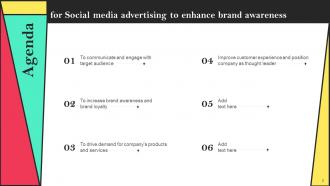
Slide 2: This slide states Agenda of the presentation.
Slide 3: This slide shows Table of Content for the presentation.
Slide 4: This slide highlights title for topics that are to be covered next in the template.
Slide 5: This slide presents Brief introduction to social media advertising.
Slide 6: This slide displays Global social media statistical indicators.
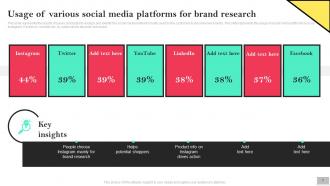
Slide 7: This slide represents Usage of various social media platforms for brand research.
Slide 8: This slide showcases Social media advertising trends for 2022.
Slide 9: This slide shows Survey insights on social media platforms used by marketers for advertising.
Slide 10: This slide presents Benefits of social media advertising for enterprises.
Slide 11: This slide highlights title for topics that are to be covered next in the template.
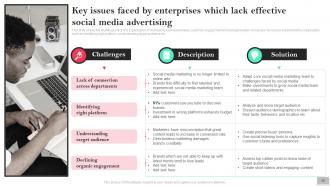
Slide 12: This slide displays Key issues faced by enterprises which lack effective social media advertising.
Slide 13: This slide represents Reasons consumers unfollowed our brand on social media.
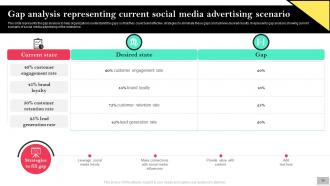
Slide 14: This slide showcases Gap analysis representing current social media advertising scenario.
Slide 15: This slide highlights title for topics that are to be covered next in the template.
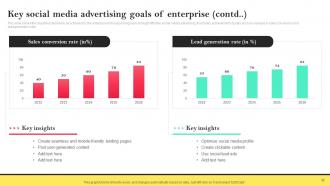
Slide 16: This slide shows Key social media advertising goals of enterprise.
Slide 17: This is another slide continuing Key social media advertising goals of enterprise.
Slide 18: This slide highlights title for topics that are to be covered next in the template.
Slide 19: This slide presents User persona to identify taste and preferences of customer.
Slide 20: This slide displays Google analytics report to identify target audience.
Slide 21: This slide highlights title for topics that are to be covered next in the template.
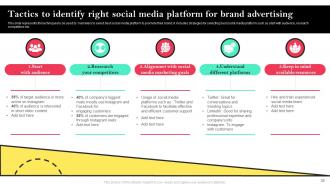
Slide 22: This slide represents Tactics to identify right social media platform for brand advertising.
Slide 23: This slide highlights title for topics that are to be covered next in the template.
Slide 24: This slide showcases Facebook audience targeting strategic map.
Slide 25: This slide highlights title for topics that are to be covered next in the template.
Slide 26: This slide shows Reasons to choose Facebook for social media advertising.
Slide 27: This slide presents Pros and Cons of advertising brands on Facebook.
Slide 28: This slide displays Various Basic Facebook advertisement formats.
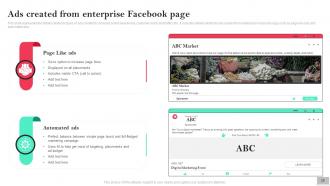
Slide 29: This slide represents Ads created from enterprise Facebook page.
Slide 30: This slide showcases Ads created from Facebook ads manager.
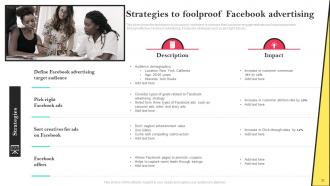
Slide 31: This slide shows Strategies to foolproof Facebook advertising.
Slide 32: This slide presents Enterprise Facebook advertisement action plan.
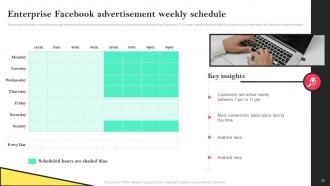
Slide 33: This slide showcases Enterprise Facebook advertisement weekly schedule.
Slide 34: This slide represents Enterprise Facebook advertisement to attract potential customers.
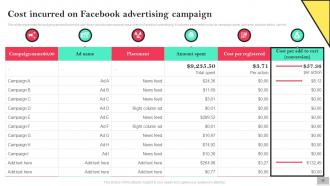
Slide 35: This slide displays Cost incurred on Facebook advertising campaign.
Slide 36: This slide highlights title for topics that are to be covered next in the template.
Slide 37: This slide presents Reasons to select Instagram for social media advertising.
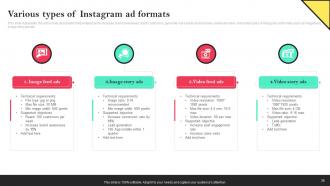
Slide 38: This slide shows Various types of Instagram ad formats.
Slide 39: This slide presents Best practices for effective Instagram advertising.
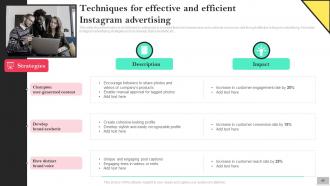
Slide 40: This slide displays Techniques for effective and efficient Instagram advertising.
Slide 41: This slide shows the report of most visited websites in 2022.
Slide 42: This slide shows the overview of usage of Instagram by audience worldwide.
Slide 43: This slide displays Comparison between trending Instagram influencers.
Slide 44: This slide presents Enterprise Instagram advertisement to attract customers.
Slide 45: This slide showcases Cost incurred by enterprise on Instagram advertising.
Slide 46: This slide shows Hashtags and average engagement per Instagram post.
Slide 47: This slide highlights title for topics that are to be covered next in the template.
Slide 48: This slide presents Key statistics to select YouTube for social media advertising.
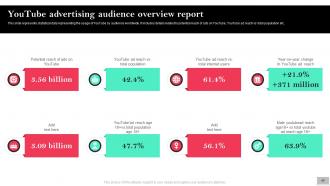
Slide 49: This slide represents YouTube advertising audience overview report.
Slide 50: This slide showcases Various types of YouTube video ad formats.
Slide 51: This slide shows Key benefits of effective YouTube advertising.
Slide 52: This slide presents Techniques for effective YouTube advertising.
Slide 53: This slide displays Enterprise audience insights for developing effective YouTube advertisement.
Slide 54: This slide represents YouTube advertising costs and expenses incurred by enterprise.
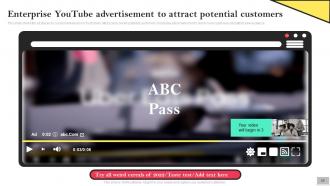
Slide 55: This slide showcases Enterprise YouTube advertisement to attract potential customers.
Slide 56: This slide highlights title for topics that are to be covered next in the template.
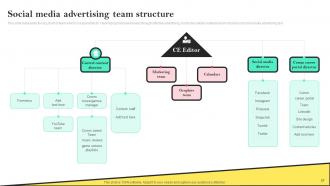
Slide 57: This slide shows Social media advertising team structure.
Slide 58: This slide highlights title for topics that are to be covered next in the template.
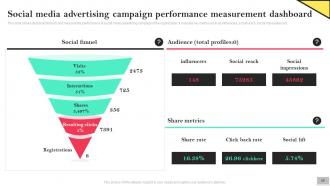
Slide 59: This slide presents Social media advertising campaign performance measurement dashboard.
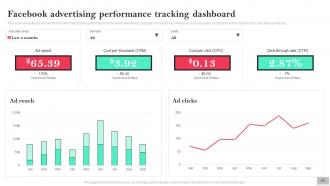
Slide 60: This slide displays Facebook advertising performance tracking dashboard.
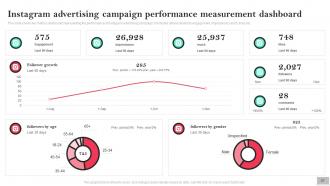
Slide 61: This slide showcases Instagram advertising campaign performance measurement dashboard.
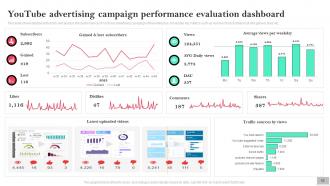
Slide 62: This slide represents YouTube advertising campaign performance evaluation dashboard.
Slide 63: This slide contains all the icons used in this presentation.
Slide 64: This slide is titled as Additional Slides for moving forward.
Slide 65: This slide presents Bar chart with two products comparison.
Slide 66: This slide presents Roadmap with additional textboxes.
Slide 67: This is Our Team slide with names and designation.
Slide 68: This is a Timeline slide. Show data related to time intervals here.
Slide 69: This slide provides 30 60 90 Days Plan with text boxes.
Slide 70: This is Our Mission slide with related imagery and text.
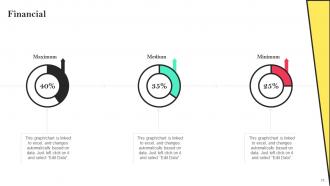
Slide 71: This is a Financial slide. Show your finance related stuff here.
Slide 72: This slide shows Post It Notes. Post your important notes here.
Slide 73: This is About Us slide to show company specifications etc.
Slide 74: This is a Thank You slide with address, contact numbers and email address.
Social Media Advertising To Enhance Brand Awareness Powerpoint Presentation Slides with all 79 slides:
Use our Social Media Advertising To Enhance Brand Awareness Powerpoint Presentation Slides to effectively help you save your valuable time. They are readymade to fit into any presentation structure.

































FAQs for Social Media Advertising To Enhance Brand Awareness
Focus on CTR, CPC, conversion rate, and ROAS first. CTR tells you if people actually care about your ad. CPC is just what you're paying per click - pretty straightforward. I used to get caught up tracking impressions but honestly they're useless without engagement. Here's the thing though - conversion rate is where the magic happens. That's clicks turning into actual sales. ROAS shows if you're making money or just burning cash, which obviously matters most. Oh, and once you get these down, audience breakdowns are super helpful too. Start simple though.
Honestly, you've gotta figure out where your people actually spend their time first. Check your current customers - what's their age range, what are they into? LinkedIn works if you're selling to other businesses, but Instagram and TikTok are where the younger crowd lives. Facebook still owns the 35+ space (my mom's on there constantly lol). But seriously, don't just assume. Ask your existing customers what platforms they use most. Look at your website analytics to see where traffic's coming from socially. Test small campaigns on 2-3 different platforms first. See what actually converts before you dump your whole budget somewhere.
Dude, segmentation is literally the difference between ads that work and ones that just eat your budget. Break your audience into groups - demographics, interests, behaviors, whatever makes sense. Show gym people fitness stuff, busy parents get meal kits, you know? Way better than throwing random ads at everyone and hoping something sticks. The more specific you get, the better your engagement and cheaper your conversions. I'd start with maybe 3-5 solid segments and test different creative for each one. It's honestly not that complicated once you get the hang of it.
Honestly, visuals make a huge difference for social media ads. People process images like 60,000 times faster than text – which sounds crazy but makes total sense when you think about it. What stops you mid-scroll? It's always the visuals, right? Good photos and videos grab attention in that first split second before someone keeps scrolling. They're perfect for conveying emotions quickly too. Visual posts get shared way more than plain text ones. I'd definitely test different formats – maybe try carousel ads or short videos first. See what your audience actually responds to. Graphics can work great too, but honestly it depends on your brand.
Yeah, video ads crush static images pretty much every time. You're looking at like 2-3x better engagement because motion just stops people mid-scroll - can't help but watch. Short videos let you actually tell a story instead of cramming everything into one image and hoping for the best. The data you get is way better too since platforms track how long people watch, when they drop off, all that stuff. CPMs run a bit higher but conversions usually make up for it. Honestly I'd just take your best static ads and turn them into 15-30 second videos first, see how they do.
So algorithms are basically the bouncers deciding who sees your ads and when. Facebook wants meaningful interactions, LinkedIn cares about professional stuff, and TikTok? That thing moves at lightning speed - blink and you're buried. Your performance, targeting, and how much you're willing to spend all factor into where you rank against other advertisers fighting for attention. Honestly, each platform has its own weird preferences, so you've got to test different creative formats and audiences to figure out what gets rewarded. It's like learning each platform's secret language.
Honestly, less is more with ad copy. You've got like 2 seconds before people scroll past, so hit them with one clear benefit right away. Lead with their biggest pain point or something they actually want - not some generic fluff about your awesome product (ugh, those make me cringe). Short sentences work. Then follow up with exactly what action you want them to take. Yeah, throw in words like "free" or "limited time" but don't go overboard and sound like a used car salesman. The real game-changer though? Test everything. What sounds good in your head might totally flop, so let the numbers show you what actually works with your audience.
Start with user-generated content for your ads - way more believable than anything you'll create yourself. Grab customer photos, reviews, videos of people using your stuff. Turn those into sponsored posts. Honestly, people think we're all liars anyway, so they'd rather hear from other customers. Just ask permission first (learned that the hard way once). UGC kills it because it doesn't feel like you're trying to sell them something. Create a hashtag, get customers posting their experiences. Then you've got endless content to pull from.
Dude, A/B testing is a game changer for social ads. Test different headlines, images, audiences - whatever. I once saw someone get 30% better clicks just by adding an emoji (crazy, right?). The thing is, you think you know what'll work, but the data usually proves you wrong. Short sentences work. Longer ones with natural flow keep people reading without sounding robotic or weird. Don't test everything at once though - pick one thing like your headline, see what wins, then throw more budget at that version. Otherwise you're just burning money and crossing your fingers.
Okay so retargeting is basically hitting up people who already checked out your stuff - visited your site, scrolled through your posts, maybe ditched their cart. Way better than throwing ads at random strangers. These people already know you exist, they just need a little push to actually buy something. My conversion rates usually jump like 2-3x compared to regular ads because honestly? The hard part's already done - they're interested. Just gotta time it right and customize what you're saying based on where they bailed. Get your Facebook Pixel running and start sorting people by what they actually did on your site.
Dude, biggest thing is being straight up about data collection - people hate feeling tricked about what info you're grabbing. Don't target people's worst moments either, like someone drowning in debt or whatever. That's just shady. Your ads need to actually look like ads too, not some sneaky "organic" post. Kids and vulnerable folks? Extra careful there obviously. Honestly though, half this stuff is just common sense - would you want some company pulling this crap on your mom? If the answer's no, then don't do it.
Ok so basically you want revenue divided by ad spend - that's your ROI right there. Set up conversion tracking in Facebook Ads Manager and LinkedIn so you can see what's actually making money, not just getting engagement. Vanity metrics are honestly worthless for this stuff. I'd focus on cost per acquisition and how much each customer's worth over time. Most platforms already have attribution windows built in, but throw some UTM codes on there too and check Google Analytics just to be safe. Oh and don't go crazy - pick like 2-3 metrics max or you'll lose your mind in all the data.
So influencer marketing? It's like having someone vouch for you instead of screaming about your product into the void. These people already have trust built up with their followers - something you can't buy with regular ads. You'll get way better engagement rates because their audience actually cares what they think. Plus there's that whole "oh if she likes it, maybe I should check it out" psychology thing. Just don't go chasing follower counts - honestly, a smaller influencer whose audience matches your target market is worth way more than some mega-celebrity whose followers couldn't care less about your stuff.
Timing is everything with seasonal campaigns - match them to holidays, weather shifts, and cultural moments your audience actually cares about. Map out your industry's big seasons first (back-to-school for retail, tax time for finance, etc). Then tweak your creative and messaging to fit what's on people's minds. Here's what works: skip the obvious holidays everyone's already spamming. Those weird smaller seasonal moments? Way less competition and honestly better engagement. Also, plan your content calendar like 2-3 months out or you'll be stressed scrambling at the last minute (been there).
Oh man, the worst part is definitely not going insane trying to manage everything at once. You've got different ad formats everywhere, plus each platform's audience acts totally different - what crushes it on TikTok will bomb hard on LinkedIn. Budget allocation becomes this whole nightmare because Facebook might be printing money while LinkedIn just... doesn't. And don't even get me started on juggling five different analytics dashboards. Honestly? Pick like 2-3 platforms tops, nail those first, then think about expanding. Trust me on this one.
-
The customer care of SlideTeam is very responsive. I was having a payment issue and they fixed it for me in no time.
-
Amazing product with appealing content and design.