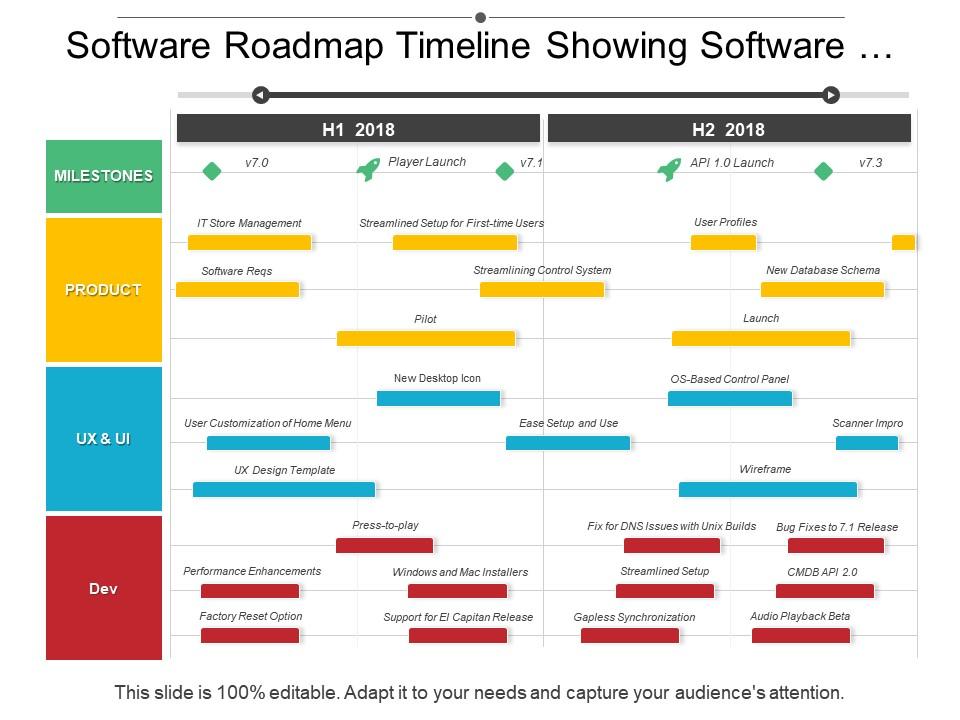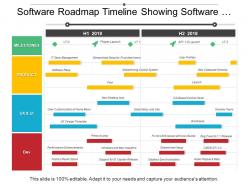
Software-Roadmap-Zeitachse mit Softwareanforderungen

Rating:
90%
Software Roadmap Timeline Showing Software Requirements
Slide 1 of 5
Favourites Favourites

Try Before you Buy Download Free Sample Product

Audience Impress Your
Audience
Editable 100%
Editable
Time Save Hours
of Time
The Biggest Sale is ending soon in
0
0
:
0
0
:
0
0
Rating:
90%

Merkmale dieser PowerPoint-Präsentationsfolien:

Präsentation der Software-Roadmap-Zeitleiste mit den Softwareanforderungen PowerPoint-Präsentationsfolie. Dieses Layout ist mit Google Slides kompatibel. Bilder verschwimmen nicht, selbst wenn sie auf einen großen Bildschirm projiziert werden. Die PPT-Vorlage kann von Vertriebs- und Marketingteams und Geschäftsführern verwendet werden. Sofort herunterladbare Folie und unterstützt Formate wie JPEG und PDF. Passen Sie Farben, Text und Schriftarten gemäß Ihren Geschäftsanforderungen an. Diese Vorlage ermöglicht Ihnen die einfache Eingabe von Details wie Firmenlogo, Marke oder Name und Schlüsselpunkten.

FAQs for Software Roadmap Timeline

Key components of an effective software roadmap include strategic objectives, feature priorities, timeline milestones, resource allocation plans, and stakeholder communication frameworks. These elements work together by aligning development teams with business goals, managing expectations across departments, and providing clear visibility into progress, with many organizations finding that well-structured roadmaps significantly enhance project delivery and strategic decision-making.

Feature prioritization in software roadmaps typically involves evaluating user impact, business value, technical feasibility, and strategic alignment through frameworks like MoSCoW or value-effort matrices. Development teams increasingly combine customer feedback, market analysis, and resource constraints to create balanced roadmaps, with many organizations finding that regular stakeholder input and agile methodologies enable more responsive prioritization, ultimately delivering features that drive user adoption and competitive advantage.

Market research provides critical insights into customer needs, competitive landscapes, feature demand, and emerging market trends that directly influence roadmap prioritization and strategic direction. Through user surveys, competitor analysis, and industry studies, development teams validate assumptions, identify high-impact opportunities, and align product evolution with market demands, ultimately ensuring resources focus on features that deliver competitive advantage and customer value.

Software roadmaps should be updated quarterly, with minor adjustments made monthly or as market conditions change, ensuring alignment with evolving business priorities, customer feedback, and technological developments. This regular cadence enables organizations to maintain strategic direction while remaining agile, with many software companies finding that frequent updates improve stakeholder communication, resource allocation, and ultimately deliver more competitive products to market.

Visual software roadmaps can be created using tools like Jira, ProductPlan, Roadmunk, Aha!, and Microsoft Visio, combined with methodologies such as Agile planning, OKR frameworks, and user story mapping. These approaches streamline product development by enhancing team alignment, improving stakeholder communication, and enabling strategic prioritization, with many development teams finding that visual roadmaps ultimately deliver faster release cycles and better resource allocation.

**INPUT**: How do you ensure alignment between stakeholders and the software roadmap? **OUTPUT**: Stakeholder alignment requires regular communication through roadmap reviews, stakeholder workshops, and transparent priority-setting sessions that involve key decision-makers from development, marketing, and executive teams. These collaborative approaches streamline consensus-building by establishing shared success metrics, maintaining open feedback channels, and conducting quarterly alignment sessions, ultimately delivering unified strategic direction and minimizing costly development pivots. [Word count: 56 words]

Key metrics for software roadmap success include feature delivery velocity, stakeholder satisfaction scores, technical debt reduction, user adoption rates, and revenue impact from new releases. These metrics enable organizations to assess both execution efficiency and business outcomes, with many development teams finding that combining quantitative performance data with qualitative stakeholder feedback delivers the most comprehensive view of roadmap effectiveness and strategic alignment.

Agile methodologies influence software roadmaps by enabling iterative planning, continuous stakeholder feedback, and adaptive prioritization based on changing market conditions. Through short sprints and regular retrospectives, development teams can pivot features, adjust timelines, and incorporate user insights more effectively, ultimately delivering products that better align with customer needs while maintaining competitive responsiveness in dynamic markets.

Common pitfalls include overcommitting to unrealistic timelines, lacking stakeholder input, ignoring technical debt, failing to prioritize features effectively, and creating overly detailed long-term plans. These challenges can be minimized by maintaining flexibility, incorporating regular feedback loops, and balancing customer demands with technical requirements, ultimately delivering more sustainable development cycles and stakeholder alignment.

A software roadmap should incorporate regular review cycles, flexible milestone structures, and continuous stakeholder feedback to accommodate evolving requirements and technological advances. Through agile frameworks and quarterly assessments, development teams can pivot priorities, integrate emerging technologies, and realign features with customer demands, ultimately delivering more relevant solutions while maintaining strategic direction and competitive positioning.

Timelines and milestones provide critical structure for software development by establishing clear expectations, enabling resource planning, and tracking progress against strategic objectives. They help development teams prioritize features, communicate progress to stakeholders, and maintain project momentum, while ensuring deliverables align with business goals and market demands, ultimately delivering predictable releases and competitive advantage.

User feedback integrates into software roadmaps through systematic collection via surveys, analytics, support tickets, and user interviews, followed by prioritization based on business impact and feasibility. Development teams increasingly use feedback management platforms to categorize requests, identify common patterns, and align user needs with strategic objectives, ultimately delivering features that enhance satisfaction while supporting competitive positioning.

Effective strategies include visual roadmaps with timelines, regular stakeholder meetings, simplified language avoiding technical jargon, milestone-based updates, and interactive dashboards showing progress. These approaches enhance transparency by translating complex development phases into business outcomes, demonstrating ROI timelines, and aligning technical priorities with strategic objectives, ultimately ensuring stakeholder buy-in and informed decision-making.

Software roadmaps in startups prioritize rapid iteration, flexibility, and market validation, often pivoting based on user feedback and funding constraints. Established companies typically focus on structured planning, stakeholder alignment, and integration with existing systems, with many large organizations finding that longer development cycles enable comprehensive testing and enterprise-wide rollouts, ultimately delivering greater stability and scalability.

Best practices for incorporating scalability projections include capacity planning analysis, performance benchmarking, infrastructure assessment, user growth modeling, and resource allocation forecasting. These strategic approaches enable development teams to anticipate system demands, optimize architecture decisions, and ensure seamless expansion, with many organizations finding that proactive scalability planning reduces technical debt while delivering cost-effective growth acceleration.

Ratings and Reviews

90% of 100
Review Form
Write a review
Most Relevant Reviews
  1. 80%

    by Robert Young

    Graphics are very appealing to eyes.
  2. 100%

    by Brown Murphy

    Editable templates with innovative design and color combination.

2 Item(s)

per page: