


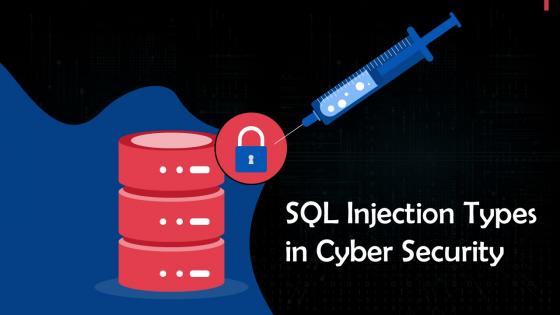
SQL Injection Types In Cyber Security Training Ppt




Try Before you Buy Download Free Sample Product
 Impress Your
 Audience
 100%
100% Editable
 Save Hours
 of Time


This set of PPT slides in depth covers the types of SQL injection, such as In-Band SQLi, Inferential or Blind SQLi, and Out-of-Band SQLi, and the strategies to prevent them.
People who downloaded this PowerPoint presentation also viewed the following :
Content of this Powerpoint Presentation
Slide 2
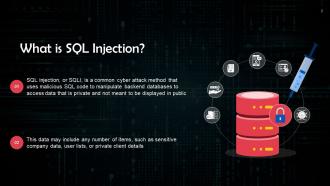
This slide talks about SQL Injection. SQL injection, or SQLI, is a common cyber attack method that uses malicious SQL code to manipulate backend databases to access data that is private and not meant to be shown in public.
Slide 3
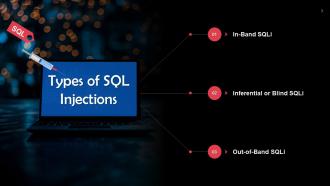
This slide lists types of SQL Injections. These include: In-Band SQLi, Inferential or Blind SQLi, and Out-of-Band SQLi.
Slide 4
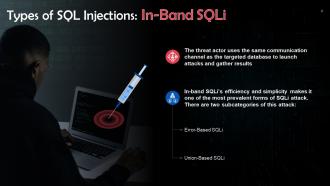
This slide discusses In-Band SQLi. The threat actor uses the same communication channel to launch attacks and gather results.
Slide 5
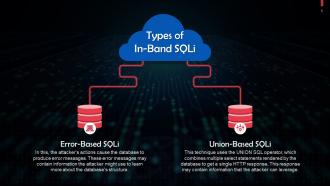
This slide highlights types of In-Band SQL injections. These are: Error-Based SQLi and Union-Based SQLi.
Slide 6
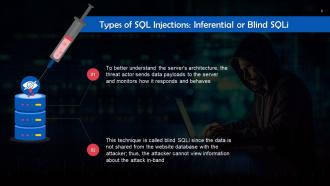
This slide talks about Inferential or Blind SQLi. To better understand the server's architecture, the threat actor sends data payloads to the server and monitors how it responds and behaves.
Slide 7
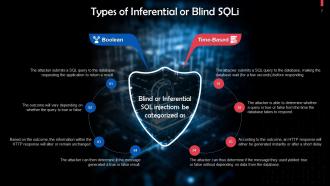
This slide highlights types of Inferential or Blind SQL injections. Blind SQL injections are either boolean or time-based.
Slide 8
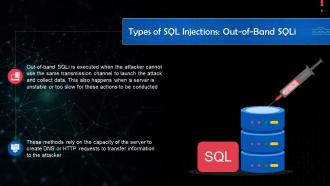
This slide discusses Out-of-Band SQLi. Out-of-band SQLi is executed when the attacker cannot use the same transmission channel to launch the attack and collect data or when a server is unstable or too slow for these actions to be conducted.
Slide 9
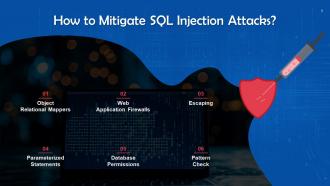
This slide highlights ways of mitigating SQL Injection attacks. These are: Object relational mappers, web application firewalls, escaping, parameterized statements, database permissions, and pattern check.
Slide 10
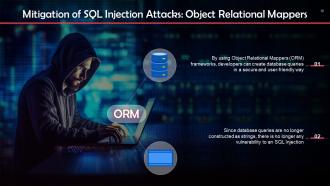
This slide discusses how Object Relational Mappers (ORM) can be used to mitigate the risk of SQL injection attacks. Developers can use ORM frameworks to create database queries in a secure and user-friendly way.
Slide 11
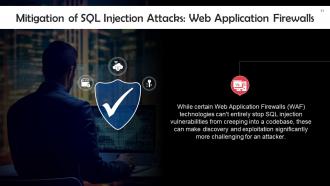
This slide talks about how Web Application Firewalls (WAFs) are used to mitigate the risk of SQL injection attacks. WAF technologies can make discovery and exploitation significantly more challenging for an attacker.
Slide 12
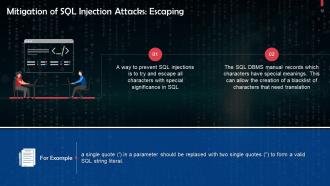
This slide discusses how Escaping mitigates the risk of SQL injection attacks. A way to prevent SQL injections is to attempt to escape all characters with special significance in SQL.
Slide 13
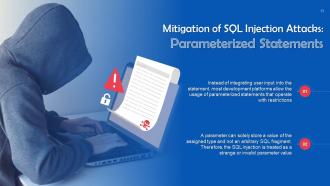
This slide discusses how Parameterized Statements mitigate the risk of SQL injection attacks. Instead of integrating user input into the statement, most development platforms allow the usage of parameterized statements that operate with restrictions.
Slide 14
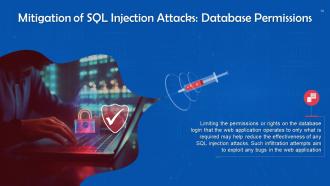
This slide discusses how Database Permissions can be used to mitigate the risk of SQL injection attacks. Limiting the permissions or rights on the database login may help reduce the effectiveness of any SQL injection attack.
Slide 15
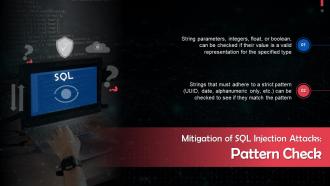
This slide discusses how Pattern Check can be used to mitigate the risk of SQL injection attacks. String parameters, integers, float, or boolean, can be checked if their value is a valid representation for the specified type.
SQL Injection Types In Cyber Security Training Ppt with all 34 slides:
Use our SQL Injection Types In Cyber Security Training Ppt to effectively help you save your valuable time. They are readymade to fit into any presentation structure.













FAQs for SQL Injection Types In Cyber
So SQL injection is basically when hackers shove malicious code into your input fields to mess with your database. Your app takes whatever users type and dumps it straight into SQL queries - which is a terrible idea, btw. Like if someone enters `'; DROP TABLE users; --` in a login box instead of their actual username. Boom, they can steal data or delete entire tables. I've seen this wreck projects before. Just use parameterized queries instead of concatenating user input directly. Also validate everything users send you - don't trust anyone on the internet.
So basically, traditional SQL injection gives you instant feedback - error messages pop up, you see database stuff, or the page changes right away. Pretty obvious when it works. Blind injection though? Total pain. The app won't tell you anything useful. You're stuck guessing if your attack worked by watching response times or testing true/false conditions. Way more tedious. Honestly, I always check for error messages first when I'm testing. If you see those, you'll know you're dealing with the easier type. Otherwise you're in for some patient detective work.
So there's basically four main types you'll run into. Union-based attacks let hackers pull data by mixing their malicious stuff with legit queries. Then there's boolean blind - honestly, these are pretty devious because they figure out info based on true/false responses without any obvious errors showing up. Time-based blind ones are similar but they use database delays to slowly extract data. Error-based attacks just trigger database errors to leak your schema info. But yeah, regardless of which type you're dealing with, parameterized queries are gonna be your best defense against all of them.
So basically you inject database functions like `SLEEP()` or `WAITFOR DELAY` that force delays, then time the responses to pull data out character by character. It's what you use when the app gives you absolutely nothing back - no results, no errors, total blackout. Honestly, it's slow as hell compared to other methods but sometimes there's no other option. The trick is letting SQLmap handle the automation because doing it manually would be torture - I tried once and wanted to throw my laptop out the window. Works though, just gotta be patient with it.
User input validation basically acts like a bouncer for your database - it checks data types, length limits, and filters out sketchy characters before they get anywhere near your queries. Can't believe how many people just skip this step entirely! But here's the catch: validation alone won't save you since attackers are pretty clever with encoding tricks and workarounds. You still need parameterized queries doing the heavy lifting. Think of it this way - validation catches the obvious stuff, but prepared statements are what actually stop SQL injection attacks. Use both together and you're golden.
Stacked queries let attackers run multiple SQL commands at once by throwing semicolons between them. Picture this - someone finds a basic injection spot that normally just leaks data. But with stacking? They'll grab your user table first, then BAM - "DROP TABLE users;" or slip in "INSERT INTO admin_users..." to mess with your actual database structure. Goes from read-only snooping to total database chaos real quick. Honestly, it's terrifying how fast things escalate. Always use parameterized queries and lock down those database permissions.
Parameterized queries are your go-to here - they keep SQL code totally separate from user input. Really can't go wrong with those. Input validation helps catch sketchy data before it hits your database. You could use stored procedures too, but honestly they're only as secure as whoever writes them. Don't give your app more database permissions than it actually needs either. Like, if it just reads and writes data, why would you give it admin access? That's just asking for trouble. Start with the parameterized queries though - they'll stop most injection attacks dead in their tracks.
So error-based SQL injections are when hackers deliberately mess up their SQL queries to make your database angry and throw detailed error messages. Those errors leak info about table names, columns, sometimes even actual data - stuff they shouldn't see. It's different from blind injections where they're basically guessing in the dark. Pretty clever attack honestly, even if it's super annoying to deal with. The fix? Configure your database to show boring generic errors to users instead of the technical details. Save the detailed errors for your logs where only you can see them.
So for SQL injection testing, SQLMap is hands down the best automated tool out there - free and crazy powerful, though honestly it can feel like drinking from a fire hose when you're starting out. OWASP ZAP is way more beginner-friendly if you want to ease into it first. Burp Suite's another solid option that does web app scanning plus SQLi detection. You can also do manual testing with browser dev tools or intercepting proxies. My take? Start with ZAP to get your feet wet, then move to SQLMap once you're not completely lost.
So basically, parameterized queries keep your SQL code completely separate from user data - that's the magic that blocks injection attacks. The database treats anything users type as literal text instead of runnable code. Even if hackers try sneaking malicious SQL in there, it just becomes harmless data. It's like having guard rails between code and input, honestly. Your database compiles the query structure first, then drops the parameters in safely after. Just use them everywhere you're dealing with user input. Trust me, you'll sleep way better knowing your database isn't getting pwned.
Dude, SQL injections will absolutely wreck your reputation. Once hackers get into customer data and financial records, people lose all trust in your platform. I've personally seen companies tank 30-40% of their users after breaches like this. The legal bills and fines hit hard too - not to mention everyone jumping ship. But honestly, most of these attacks are super preventable. Parameterized queries and proper input validation stop like 99% of SQL injection attempts. Start fixing this stuff now before you're dealing with angry customers and regulatory headaches. Trust me, prevention is way cheaper than cleanup.
Dude, there have been some massive ones. Heartland Payment Systems got wrecked in 2008 - 130 million credit cards exposed. Yahoo took a hit in 2012 with 450,000 accounts compromised. TalkTalk's 2015 breach was honestly just embarrassing for a telecom company. Equifax in 2017 was huge too, though that one was more complicated than pure SQL injection. Hackers usually go after login forms, search boxes, payment systems - basically anywhere users type stuff that isn't properly checked. The fix is pretty straightforward though. Use parameterized queries and validate all user input, even on forms that seem totally innocent.
Look for spots where user input gets jammed straight into SQL strings with concatenation - stuff like `"SELECT * FROM users WHERE id = " + userInput`. That's the classic red flag. Search your codebase for SQL keywords (SELECT, INSERT, UPDATE) mixed with string concatenation operators. Login forms and search features are usually the worst offenders. Don't forget about stored procedures either - they can hide dynamic SQL inside them. I always check CRUD operations too since they're prime targets. Basically anywhere you see variables getting mashed into SQL without proper parameterization, that's your vulnerability right there.
ORMs are pretty great at preventing SQL injection since they handle parameterized queries automatically. Like when you do `User.find(id)` or `Post.where(status: 'active')`, the framework sanitizes everything behind the scenes. You can still mess up though - mainly if you write raw SQL or do something dumb like string interpolation in query builders. Honestly, I've seen people break this by getting fancy with custom queries. Stick to the ORM's built-in methods and you'll be fine. Only drop to raw SQL if you absolutely have to, and double-check anything custom you write.
Parameterized queries are your best friend here - seriously, just use those everywhere and you'll stop most injection attacks. Don't ever concatenate user input straight into SQL strings, even when it looks innocent. Validate inputs on both ends too. Your database accounts should only have the bare minimum permissions they need. Keep everything updated obviously, and make sure your error messages aren't spilling database details to attackers. Actually, I learned that one the hard way at my last job. But yeah, start with the parameterized queries - that's like 90% of your protection right there.
-
I've been looking for a good template source for some time. I'm happy that I discovered SlideTeam. Excellent presentations must try!
-
The designs are super attractive. Me and my team love using SlideTeam’s presentations.