Standard Models For Brand Hierarchy Boosting Product Corporate And Umbrella Branding SS V
Try Before you Buy Download Free Sample Product
Audience
Editable
of Time
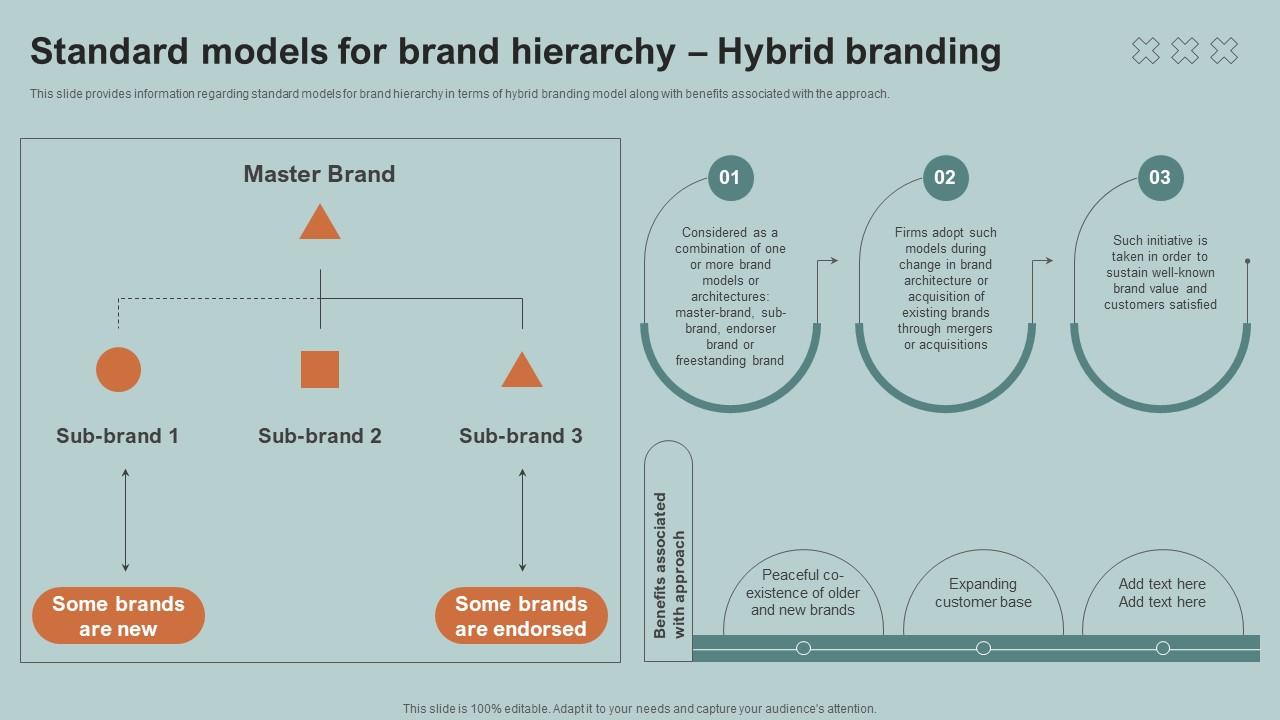
This slide provides information regarding standard models for brand hierarchy in terms of hybrid branding model along with benefits associated with the approach.
People who downloaded this PowerPoint presentation also viewed the following :
Standard Models For Brand Hierarchy Boosting Product Corporate And Umbrella Branding SS V with all 6 slides:
Use our Standard Models For Brand Hierarchy Boosting Product Corporate And Umbrella Branding SS V to effectively help you save your valuable time. They are readymade to fit into any presentation structure.
FAQs for Standard Models For Brand Hierarchy Boosting Product Corporate And Umbrella
Key components of a brand hierarchy model include corporate brand, master brand, sub-brands, product brands, and individual product lines, each defining distinct market positioning and consumer relationships. These elements work together by establishing clear brand relationships, streamlining marketing efforts, and optimizing resource allocation, with many organizations finding that strategic hierarchy management enhances brand equity while reducing operational complexity.
Brand hierarchy influences consumer perception and loyalty by creating clear relationships between parent brands and sub-brands, establishing trust pathways, and simplifying purchase decisions through familiar brand architecture. This strategic organization enables consumers to transfer positive associations across product lines, reduces marketing costs for companies launching new offerings, and ultimately builds deeper brand equity, with many retail and technology companies finding that well-structured hierarchies significantly enhance customer retention rates.
Brand hierarchy models include monolithic, endorsed, freestanding, and hybrid structures, each differing in visual connection, resource allocation, and risk management approaches. While monolithic models like FedEx create strong umbrella branding with shared equity, freestanding structures like P&G's portfolio enable targeted positioning across diverse markets, with many organizations finding that hybrid approaches deliver both operational efficiency and strategic flexibility.
Companies should evaluate their brand hierarchy choice based on resource allocation, market positioning goals, and risk management strategies across their portfolio. Organizations with strong master brands typically benefit from monolithic structures for cost efficiency, while diversified companies often choose endorsed or freestanding models to target distinct customer segments, with many finding that market research and competitive analysis ultimately guide the most strategic approach.
Brand architecture serves as the strategic framework that defines relationships between parent brands, sub-brands, and product lines, establishing clear positioning, messaging consistency, and market differentiation across portfolios. This structural foundation enables companies to optimize resource allocation, minimize brand confusion, and maximize synergies, with organizations like Procter & Gamble and Unilever leveraging comprehensive architectures to deliver stronger market presence and sustainable competitive advantage.
A brand hierarchy model helps product line extensions by providing strategic framework for leveraging parent brand equity, determining optimal brand architecture, and maintaining consistent positioning across new offerings. This enables companies to streamline market entry, minimize marketing costs, and reduce consumer confusion, while many organizations finding that structured extensions deliver faster adoption rates and stronger competitive positioning.
Common pitfalls include creating overly complex structures that confuse customers, failing to establish clear differentiation between brand levels, inconsistent messaging across the hierarchy, and inadequate resource allocation for sub-brands. These missteps can dilute brand equity, create market confusion, and weaken competitive positioning, with many organizations finding that simplified, strategically aligned hierarchies ultimately deliver stronger customer recognition and operational efficiency.
Cultural differences significantly impact brand hierarchy models through varying consumer preferences, local market dynamics, relationship-building approaches, and communication styles across global markets. Companies like Unilever and P&G adapt their hierarchies by emphasizing family brands in collectivist cultures while promoting individual product brands in individualistic markets, ultimately delivering culturally resonant messaging and stronger local market penetration.
Brand hierarchy effectiveness metrics include brand awareness levels, customer loyalty scores, market share distribution, revenue attribution by brand tier, and cross-selling rates between portfolio brands. These measurements enable organizations to assess portfolio synergies, optimize resource allocation across brand levels, and identify integration opportunities, with many companies finding that strategic hierarchy alignment ultimately delivers stronger market positioning and enhanced customer lifetime value.
Visual branding elements support brand hierarchy through consistent logos, color schemes, typography, imagery, and design systems that clearly distinguish relationship levels. These elements enable organizations to maintain brand equity while differentiating product lines, with many retail and technology companies finding that strategic visual consistency across subsidiaries enhances recognition while preserving individual market positioning.
Successful brand hierarchy implementations include Procter & Gamble's master brand strategy with Tide, Pampers, and Gillette, Unilever's portfolio approach spanning personal care and food brands, and Google's parent company Alphabet structure organizing diverse technology ventures. These strategic frameworks enable companies to leverage brand equity across multiple product lines, optimize marketing investments, and maintain clear consumer positioning while scaling operations efficiently.
Companies should adapt their brand hierarchy during mergers and acquisitions by conducting comprehensive brand audits, evaluating customer equity and market positioning, and developing integration strategies that preserve valuable brand assets while eliminating redundancies. Through strategic portfolio rationalization, organizations streamline their brand architecture, enhance operational efficiency, and strengthen market presence, with many finding that thoughtful hierarchy restructuring delivers clearer customer communication and sustainable competitive advantage.
Digital media fundamentally reshapes brand hierarchy models by enabling direct consumer engagement, real-time feedback loops, and personalized messaging across multiple touchpoints simultaneously. Through social platforms, content marketing, and digital analytics, companies can create more flexible, responsive hierarchies that adapt quickly to market changes, while consumers increasingly influence brand positioning through reviews, social sharing, and interactive experiences, ultimately delivering enhanced brand agility and deeper customer relationships.
A well-defined brand hierarchy streamlines marketing efforts by establishing clear brand relationships, enabling consistent messaging across product lines, and optimizing resource allocation for maximum impact. This strategic framework allows organizations to leverage master brand equity, reduce marketing complexity, and deliver cohesive customer experiences, while many companies finding that structured hierarchies significantly enhance campaign effectiveness and brand recognition.
Companies can communicate brand hierarchy through consistent visual identity systems, strategic product naming conventions, clear packaging design, targeted marketing campaigns, and coordinated digital presence across touchpoints. Through integrated storytelling and positioning strategies, organizations like Procter & Gamble and Unilever effectively showcase parent-subsidiary relationships while maintaining distinct brand identities, ultimately enhancing consumer understanding and brand loyalty.
-
SlideTeam’s pool of 2Million+ PPTs has really benefited my team, everyone from the IT department to HR. We are lucky to have crossed ways with them.
-
Incredibly beautiful designs that will help you get noticed! These eye-catching templates are perfect for corporate presentations that can be altered to fit any occasion or taste.