

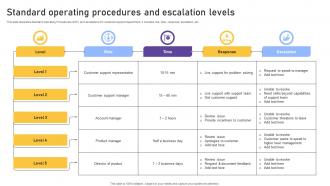
Standard Operating Procedures And Escalation Levels





Try Before you Buy Download Free Sample Product
 Impress Your
 Audience
 100%
100% Editable
 Save Hours
 of Time


This slide illustrates Standard Operating Procedures SOP and escalations for customer support department. It includes role, time, response, escalation, etc.
People who downloaded this PowerPoint presentation also viewed the following :
Standard Operating Procedures And Escalation Levels with all 6 slides:
Use our Standard Operating Procedures And Escalation Levels to effectively help you save your valuable time. They are readymade to fit into any presentation structure.





FAQs for Standard Operating Procedures
You'll want clear triggers for when to escalate - like after 2 tries or 24 hours pass. Then map out who handles what at each level and give realistic timeframes before it bumps up. Honestly, the biggest mistake I see is creating these processes and then nobody knows they exist! Set up automated alerts so stuff doesn't get missed. Start backwards from your current headaches - what's breaking down now? That'll show you exactly where you need the guardrails. Short answer though: triggers, owners, timeframes, and notifications that actually work.
Honestly, escalation SOPs are a game-changer because they give your team clear paths when shit hits the fan beyond normal fixes. No more problems sitting around getting worse while people wonder who to call. Your team won't panic and bug leadership over every little thing, but they also won't sit on major issues too long - both drive me crazy! You get predictable response times and everyone knows they're accountable. The efficiency boost is real. I'd start by looking at where your current escalation process has gaps. You'll probably find some obvious fixes pretty fast.
Honestly, communication makes or breaks your whole escalation process. Without it, issues just vanish into thin air and nobody knows what's going on. You've got to map out who gets notified and when - otherwise your team will be running around like headless chickens when something actually hits the fan. Document your channels ahead of time. Short updates work better than novels, trust me on that one. Each step needs someone responsible for passing info up the chain. It's basically like that telephone game we played as kids, except the stakes are way higher and you can't afford the message getting mangled.
Set up automated workflows that ping the right people when SOPs get violated - saves you tons of time. Real-time dashboards show what's happening across everything (I'm weirdly obsessed with checking mine). Your team can report problems through mobile apps instantly, wherever they are. Response times get tracked automatically, and it'll escalate again if people ignore the first alert. Just don't go crazy adding new systems - pick stuff that plays nice with what you've already got running.
Track your escalation volume, resolution times, and whether people are escalating the right stuff. You want to see how many issues get passed up versus handled at each level - plus how long it takes to actually fix escalated problems. Customer satisfaction scores matter too, obviously. The tricky part is measuring escalation accuracy because honestly, some people just love passing things along when they could handle it themselves. Look for patterns in your data so you can tweak your process before everything goes sideways. Short wins are finding where your SOP breaks down before it becomes a real headache.
So you gotta bake compliance checks directly into your escalation process from the start. Document everything super clearly - like, spell out exactly when someone should escalate and how. Train people on those specific triggers too. I swear, most compliance disasters happen because teams are just improvising since nobody explained the actual process. Set up automatic tracking so you can see who escalated what and when. Oh, and do random checks to catch people who aren't following protocol. Start by looking at your recent escalation cases - you'll probably spot the weak points pretty fast.
Don't wait forever to escalate - that's the biggest mistake I see people make. Figure out your triggers ahead of time, like "if it's not fixed in 30 minutes, I'm calling my manager." Also, know who to actually contact when shit hits the fan at 2 AM (because it always does). The worst thing? Escalating with zero context - just confuses everyone more. Set your criteria early, map out who calls who, and document everything when you escalate. Honestly, make a little cheat sheet so you're not panicking when everything's on fire.
Yeah, cultural stuff really throws off escalation processes. Some teams won't escalate anything because they think it makes them look incompetent or disrespectful to management. Others escalate literally everything - drives me nuts honestly. Then you've got communication styles that don't translate well. What sounds urgent in one culture sounds aggressive somewhere else. Time zones are brutal too since critical issues just sit there waiting for someone in the right region to see them. I'd set up regional contacts who get the local vibe and build that cultural awareness right into your escalation rules.
So you need to train everyone on when stuff should get escalated - like severity levels, timing, customer impact, that kind of thing. Role-playing beats reading manuals every time, trust me on that one. Make sure they know exactly who to call at different levels and document everything properly. Authority boundaries are huge too - you don't want people escalating every small thing OR letting major issues sit there for hours. Oh, and definitely do refresher training quarterly since people totally forget this stuff when they're not using it constantly.
After each escalation wraps up, do a quick post-mortem. Ask the basics: right person? Good timing? What sucked? I know everyone just wants to move on once the crisis is over, but don't skip this part. Write down what you learn and actually update your escalation rules based on it. Then every quarter, look at all your escalation data for patterns. Maybe you're always escalating too late, or maybe Karen from ops should've been in the loop earlier - stuff like that. Otherwise your SOP just sits there getting more useless over time.
Dude, not escalating SOPs properly can seriously bite you in the ass legally. You're basically creating evidence that shows you knew problems existed but ignored your own procedures - regulators eat that stuff up during investigations. Think compliance violations, lawsuits, the whole mess. Courts will point to your paper trail and be like "see? They had protocols but didn't follow them." It's honestly one of the dumbest ways to get in trouble. Just document everything - when you escalated, why you didn't, whatever. Make your escalation triggers super clear in the SOPs too.
Okay so first thing - write down exactly when people should escalate stuff. Like specific timeframes, how bad the issue is, that kind of thing. Then map out who calls who, with actual phone numbers and what you expect from each person. Most places totally bomb this by being super vague about it. Visual stuff helps a ton - flowcharts, decision trees, whatever. People just scan that faster than reading paragraphs. Oh and don't bury it in some random manual. Put it somewhere people can actually find it when things are on fire. Test it out with your team every few months too, you'll probably find holes you didn't think about.
Healthcare, manufacturing, and finance get huge benefits from good escalation processes. Patient safety and regulatory stuff - you can't mess around with delays there. Manufacturing's the same way since one bottleneck screws up the whole production line. Tech companies are finally figuring this out too, especially when their services go down and they're bleeding money every minute. Honestly, any industry where problems snowball quickly will see the biggest impact. I'd start by figuring out which delays actually hurt your bottom line, then set up triggers around those spots. Makes way more sense than having escalation everywhere.
Build risk assessment right into your escalation triggers - don't just look at severity anymore. Consider impact, how likely it'll happen again, what breaks downstream. Map your current escalation points first. Then add "what's the risk if we don't escalate?" as a standard question. High-risk stuff gets fast-tracked to senior leadership while regular issues follow normal channels. Document risk factors at each level and require mitigation plans before closing incidents. Honestly, I've watched too many teams escalate everything and completely burn out their managers - this approach actually prevents that chaos.
Check your SOP escalation stuff every 3 months or so. Most teams ignore this until everything's broken though. Look at what went wrong recently - where did escalations get stuck? Talk to the people actually using these protocols, not just whoever wrote them up. Run some fake scenarios because I guarantee half your contact info is wrong and people forget their roles. Oh and document it clearly enough that new people won't bug you every five minutes asking what step comes next. Trust me on that one.
-
“You have the structure in place that are easy to explore new opportunities.I will be recommending your services to other people.”
-
I loved the hassle-free signup process. A few minutes and, I had this giant collection of beautiful designs.