


Steps for land valuation and analysis powerpoint presentation slides




Try Before you Buy Download Free Sample Product
 Impress Your
 Audience
 100%
100% Editable
 Save Hours
 of Time


Introducing our steps for land valuation and analysis PowerPoint presentation slides. Analyze the key real estate market with the help of our land investment PowerPoint deck. This estate analysis PPT theme consists of a slide that talks about client approval and valuation report schedule. Assimilating this land finance PPT layout helps you with the market survey details of the surrounding area. This ready-to-use land inspection PowerPoint design contains a slide that talks about the basis of valuation and the factors influencing market value. Incorporating this particular plot investment PPT theme in your presentation lets you describe the features of the property available for sale. This property cost inspection PowerPoint creative set contains a slide that discusses the cost approach method with evaluation details. This land analysis PPT deck lets you make required variations to icons and colors. Choose this estate funding PowerPoint design to showcase organization and assurance. Download this PPT slide to explore true perfection.
People who downloaded this PowerPoint presentation also viewed the following :
Content of this Powerpoint Presentation
Slide 1: This is the introductory slide of the "Steps For Land Valuation And Analysis" PowerPoint presentation. Add your company name here.
Slide 2: Use this slide to share the agenda of your PPT presentation. Identify and analyze the economic value of the real estate and identify the suitable approach as per the property type.
Slide 3: This slide contains the Table of Contents. In this key slide, highlight the categories like Company Introduction and Valuation Purpose, Property Details and Documents, SWOT and Risk Analysis, etc.
Slide 4: This PPT slide introduces the first title of your Table of Contents: Company Introduction and Valuation Purpose. Introduce your company and the key takeaways of your real estate valuation in a pointer format, among others.
Slide 5: This slide shows the key takeaways related to real estate valuation, covering difficulties in the real estate valuation process, general real estate market concepts, ascertaining fair value, etc.
Slide 6: This slide shows the basic introduction related to the company, which includes valuation type, property type, property name, location, etc. It also presents client information which provides for client name, domain, location, contact person, etc.
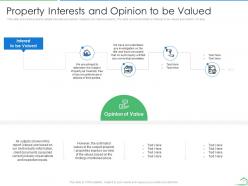
Slide 7: This slide shows the property details, interests, and opinions related to the client's property. It covers the detail on Interest to be valued and the idea of value.
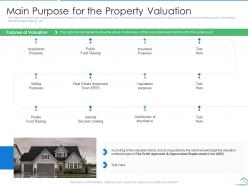
Slide 8: This slide shows the main reasons behind the client's demand for valuation of the property, which includes acquisition purposes, selling purposes, private fundraising, public fundraising, internal decision making, etc.
Slide 9: In this slide, introduce the second title of your Table of contents, Valuation Approval, and Inspection. Focus on client approval, inspection role, marketing survey, etc..
Slide 10: This slide shows the schedule related to the valuation report's timings, including client approval date, inspection date, valuation date, report date, etc.
Slide 11: This slide shows the valuation provider's inspection role process, which includes received property information, on-site team, location analysis, general building surveying, utilities and services check-up, etc.
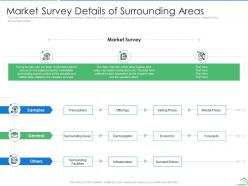
Slide 12: This slide shows the market survey details related to the surrounding areas such as transitions, offerings, selling prices, rental prices, surrounding facilities, infrastructure, demand drivers, etc..
Slide 13: This slide shows the valuation provider's inspection role process, which includes received property information, on-site team, location analysis, general building surveying, utilities and services check-up, etc.
Slide 14: Use this slide to introduce the third heading of the Table of contents: Approaches and Valuation Factors. Identify the basics, valuation approaches, and the methods used by the real estate valuation company here.
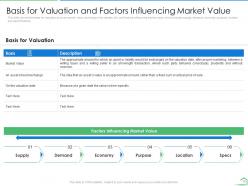
Slide 15: This slide shows the basis for valuation, such as market value, exchange of assets, etc. It also presents the factors influencing the market value, including supply, demand, economy, purpose, location, and specifications.
Slide 16: This slide shows the various valuation approaches related to real estate, including cost approach, comparable approach, income approach, etc.
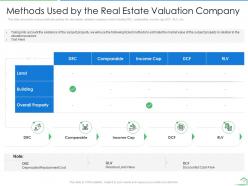
Slide 17: This slide shows the various methods used by the real estate valuation company, including Depreciated Replacement Cost (DRC), comparable, income cap, (Discounted Cash Flow) DCF, Residual Land Value (RLV), etc.
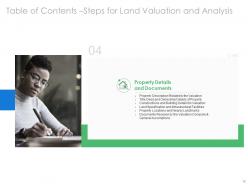
Slide 18: This slide introduces the fourth heading of the Table of contents: Property Details and Documents. In this PPT slide, highlight property description, deed, ownership, construction, and land specifications, among other details.
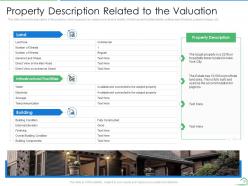
Slide 19: This slide shows the description of the property to be valued, such as the land details, infrastructural facilities details, building specifications, property images, etc.
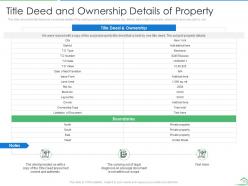
Slide 20: This slide shows the title deed and ownership details of the valuing property, including the city, district, date of the last transaction, issue from, land area, plot no. etc.
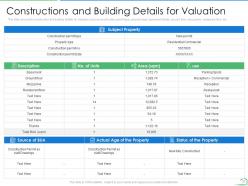
Slide 21: This slide shows the construction and building details for valuation, such as the construction permit type, property type, basement details, ground floor, mezzanine, restaurant floor, etc.
Slide 22: This slide shows the land specification details and infrastructural facilities, including the current land status, current land use, current land grading, current surrounding property, etc.
Slide 23: This slide shows the main property location and nearby landmarks such as the east side details, west side details, etc.
Slide 24: This slide shows the main documents received by the valuation company, such as the title deed copy, construction permit, master plan, layout, etc.
Slide 25: Use this slide to bring attention to the fifth title of your Table of Contents: SWOT and Risk Analysis related to the real estate valuation.
Slide 26: This slide shows the strengths, weaknesses, opportunities, and threats related to the real estate company's valuation, including the good quality finishing, high demand, etc.
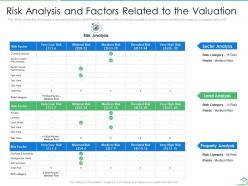
Slide 27: This slide shows the risk analysis and various valuation factors, including the overall economy, sector current performance, occupancy rates, etc.
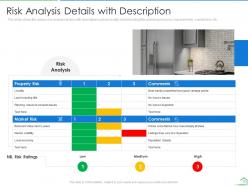
Slide 28: This slide shows the various risk analysis factors with descriptions such as the locality and land including the title, planning resource, improvements, market risks, etc.
Slide 29: Bring focus to the sixth and last title of this PPT presentation, Valuation Details and Conclusion, in this slide. It introduces the concepts of cost approach methods and income approach market rate, leasing, and contract methods.
Slide 30: This slide can be used to demonstrate the cost approach method along with the details of its evaluation. Perform the land valuation based on comparable method and construction valuation based on the depreciated cost of replacement in this slide.
Slide 31: This slide shows the cost approach of real estate valuation, including the calculations related to the area, completion rate, total costs, land value, property value details, rounded value, etc.
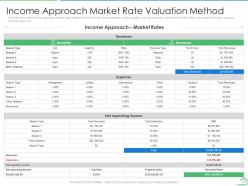
Slide 32: This slide shows the income approach market value method, including various seasons, units, quantity, rate, revenue type, total revenue, total days, net operating income, cap rate, property value, etc.
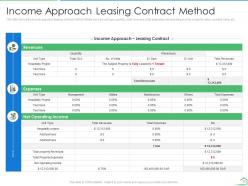
Slide 33: This slide shows the income approach leasing contract method details such as the unit type, quantity, total revenues, total expenses, net operating income, property value, rounded value, etc.
Slide 34: This slide shows the real estate calculated values in different approaches such as the income-market methodology, DRC approach, Income-contract method, etc.
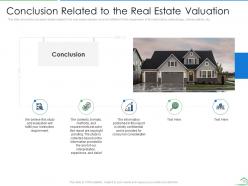
Slide 35: This slide shows the conclusion details related to the real estate valuation, such as the fulfillment of the requirement of the instructions, methodology, criteria outlined, etc.
Slide 36: This slide presents the Icons for quick accessibility and usage related to real estate valuation.
Slide 37: This slide marks the beginning of additional slides.
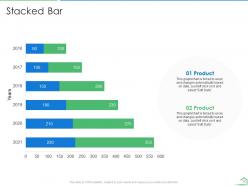
Slide 38: This slide comprises an excel-linked stacked bar to compare the value of two properties over the years.
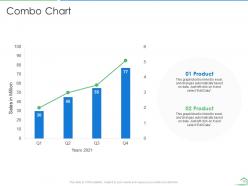
Slide 39: This slide comprises an excel-linked combo chart to compare sales of two properties over the years.
Slide 40: This slide provides the mission of the real estate company. This includes the vision, mission, and goal.
Slide 41: Share your company goals using the unique infographics of this slide.
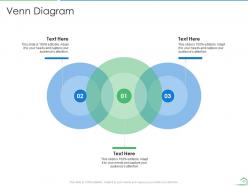
Slide 42: This slide provides a Venn diagram that can show interconnectedness and overlap between various properties, projects, etc.
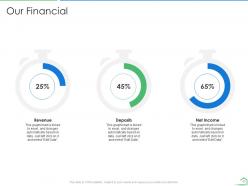
Slide 43: Demonstrate your financial performance diagrammatically with this unique infographic. Measure your company's revenue, deposits, and net income with this PPT slide.
Slide 44: This slide contains Post It Notes that can express any brief thoughts or ideas.
Slide 45: This is the comparison slide to contrast male and female clients present on the social media channels relevant to your work area.
Slide 46: This is the idea generation slide to share any additional trade tactics.
Slide 47: This is another handy additional slide to highlight the four essential aspects of your real company that complete it in a creative puzzle format.
Slide 48: This is a "Thank You for watching" slide where details such as the address, contact number, email address are added.
Steps for land valuation and analysis powerpoint presentation slides with all 48 slides:
Use our Steps For Land Valuation And Analysis Powerpoint Presentation Slides to effectively help you save your valuable time. They are readymade to fit into any presentation structure.



















FAQs for Steps for land valuation and analysis
Location's everything, honestly - I've watched crappy little plots in good neighborhoods sell for way more than massive chunks of land out in the sticks. Zoning laws mess with values big time too. Utilities and infrastructure access? Super important. Soil quality matters if you're building. Then you've got market demand, lot size and shape, environmental stuff, easements that can screw you over. Oh, and always check recent sales in the same area when you're comparing - that's your best bet for getting realistic numbers instead of just guessing.
So zoning basically controls what you can build, which totally affects property values. Commercial or multi-family zoning? That's where the money is - way more valuable than regular residential since you can actually make income from it. Industrial zoning is weird though - amazing if you need warehouse space, but pretty useless for most other stuff. Agricultural zones keep values low because you can't really develop much. Oh and definitely look into rezoning potential before you buy anything - sometimes that's where the real opportunity is hiding.
So you've got three main methods to work with. Sales comparison is your bread and butter - just find similar properties that sold recently and adjust for any differences. For investment properties, income approach works really well since you're looking at rental potential and cap rates. Cost approach is more specialized, good for weird properties where you calculate land value plus what it'd cost to rebuild. Most appraisers I know end up mixing all three methods to get a solid number. Oh, and definitely start with the sales comp data first - it's usually your most reliable starting point and gives you a good baseline.
So you'll want to find 3-5 recent sales of similar land in your area - that's your starting point. Land doesn't sell as often as houses though, which is annoying, so you might be stuck using sales from like 6-12 months ago. Start within half a mile and expand out if you need more data. Look for parcels with similar size, zoning, and location. Then you adjust those prices based on differences - maybe your lot has better road access or theirs had utilities already run. It's honestly more art than science sometimes, but it works.
Hey! So highest and best use is basically what drives the whole valuation process. You're looking for the most profitable legal use given what's happening in the market right now - not what it's currently used for. Like if there's a tiny house sitting on prime commercial land, that's obviously not maximizing anything, you know? Four things to check: can it physically work, is it legal, does the math work financially, and will it actually generate the most money. Honestly, I always figure this out first because everything else flows from there. The land's value totally depends on its best potential use.
Look, interest rates dropping usually means land values go up - people can suddenly afford more. Economic growth boosts demand and prices shoot up, while recessions do the opposite obviously. Limited supply drives everything crazy expensive too. Employment rates matter, population growth, local development stuff... honestly the whole thing's like a roller coaster sometimes! I always tell people to check recent comparable sales instead of relying on old data. Current market momentum is everything. Oh and don't forget about local development plans - those can totally change the game overnight.
Environmental assessment is basically your risk detector for property deals. You don't want to find buried tanks after signing papers - trust me on that one. Check for soil contamination, groundwater problems, wetlands, and any past industrial use. These issues can completely tank a property's value or make it impossible to sell. I've watched deals completely blow up because people skipped this step. The assessment shows you cleanup costs, development limits, and liability headaches before you commit to a price. Do this early in the process. Way cheaper than nasty surprises later.
Vacant land isn't just vacant land - that's where a lot of appraisers mess up honestly. Weird topography, crappy soil, access problems, environmental stuff - none of that shows up in your typical comps. So you've gotta dig deeper. Find specialized comparables that actually match what you're dealing with. Talk to soil engineers or surveyors who know the area. Then apply percentage adjustments based on how these quirks affect what someone can actually do with the land. Oh, and document the hell out of everything so you can defend your numbers later.
First thing - pull that title report and check what zoning actually allows. Easements can totally screw you over if there's some random utility access you didn't know about. Building codes and setbacks are annoying but you gotta factor them in. Environmental stuff is where it gets tricky though - wetlands or sketchy soil history will tank your numbers fast. Honestly? Just call the planning department. I know it's a pain but those people know all the weird local restrictions that aren't obvious from paperwork. Better than redoing your whole valuation later when you find out there's some bizarre deed restriction from 1987.
Infrastructure stuff is huge for land values - we're talking 10-30% bumps, sometimes more. Roads, transit, utilities, schools, parks... they all matter. Transportation projects hit hardest though. Like when they announce a new subway line? Values start climbing before they even break ground, which is kinda wild if you think about it. I'd dig into local development plans ASAP if I were you. Highway access can totally transform an area. Don't just look at what's there now - check what's planned too. That's where the real money gets made.
Dude, location is EVERYTHING when it comes to land value. Proximity to schools, jobs, shopping centers - that stuff makes or breaks the price. I've literally seen identical lots where one's worth 50% more just because it's on the better side of the street. Wild, right? Waterfront property or mountain views will obviously boost value, but flood zones tank it. Distance to downtown matters too - even being 10 minutes closer can mean serious money. Oh, and here's a tip: always check comparable sales by area first when you're doing assessments. Trust me, it'll save you hours of headache later.
So demographic changes totally mess with land values, but not how you'd expect. Young people flooding cities? Downtown properties go crazy. Older folks prefer suburbs near hospitals and ranch-style houses - those areas heat up instead. Here's what's wild though: it's not just population growth that matters. A bunch of tech bros moving in hits prices way differently than retirees do. I'd honestly start checking demographic reports when you're looking at comps. Sounds boring but it'll help you figure out if these price jumps are actually gonna last or not.
Dude, biggest mistakes I see? People use comps that are way too old - like 6+ months in crazy markets. Bad move. Also check zoning laws before you get excited about a property because you might not be able to build what you think. Development costs will bite you if you don't calculate them right. Oh and environmental stuff, easements, access issues - any of that can totally screw your numbers. Make sure your comps actually match too, not just "close enough." Honestly though, if it's a big investment just pay for a real appraiser. Worth it.
Honestly, tech has completely changed how we value land now. GIS mapping makes finding comparable sales so much easier, plus you get aerial imagery to check property conditions without driving around everywhere. Drones are actually pretty sweet for getting exact measurements and spotting weird stuff like drainage issues. The automated valuation models can crunch way more data than you'd ever process manually - cuts down on those random human mistakes too. AI spots market patterns I'd totally miss otherwise. My advice? Start with a solid GIS platform first. It'll make your comps analysis way better right off the bat.
So you've got three options here. Most people go with the residual method - basically you figure out what the finished project will sell for, then work backwards subtracting construction costs, permits, profit margins, all that stuff. What's left is your land value. You can also look at comparable sales of similar development sites, but good luck finding perfect matches (it's harder than it sounds). There's the investment method too if the land generates any income currently. Residual is definitely the favorite though since it actually factors in the development potential you're paying for.
-
Easily Understandable slides.
-
Enough space for editing and adding your own content.
-
Professional and unique presentations.
-
Innovative and Colorful designs.
-
Very unique and reliable designs.