Steps To Create Global Expansion Strategy Evaluating Global Market Ppt Slides

Rating:
100%
Steps To Create Global Expansion Strategy Evaluating Global Market Ppt Slides
Slide 1 of 6

or

Favourites Favourites

Try Before you Buy Download Free Sample Product

Audience Impress Your
Audience
Editable 100%
Editable
Time Save Hours
of Time
The Biggest Sale is ending soon in
0
0
:
0
0
:
0
0
Rating:
100%
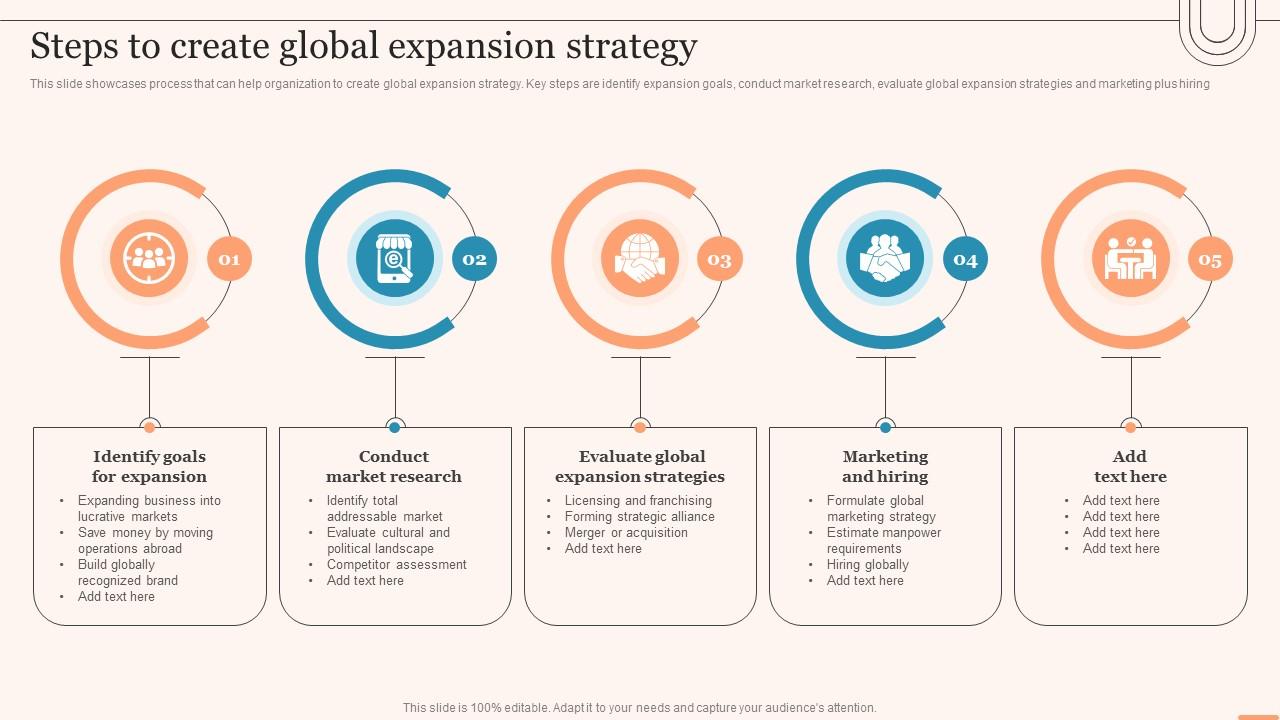
This slide showcases process that can help organization to create global expansion strategy. Key steps are identify expansion goals, conduct market research, evaluate global expansion strategies and marketing plus hiring. Introducing Steps To Create Global Expansion Strategy Evaluating Global Market Ppt Slides to increase your presentation threshold. Encompassed with five stages, this template is a great option to educate and entice your audience. Dispence information on Conduct Market Research, Evaluate Global Expansion Strategies, Marketing And Hiring, using this template. Grab it now to reap its full benefits.

FAQs for Steps To Create Global Expansion Strategy Evaluating Global

Key factors include market research and cultural analysis, regulatory compliance and legal requirements, competitive landscape assessment, distribution channels and partnerships, and financial considerations including currency risks. These elements work together to minimize entry risks while maximizing growth potential, with many organizations finding that thorough preparation in these areas ultimately delivers sustainable competitive advantage and operational success.

Businesses can effectively assess cultural barriers through comprehensive market research, cultural audits, local partnership evaluations, consumer behavior studies, and regulatory framework analysis. These assessments enable organizations to identify communication preferences, business practices, and consumer expectations across different markets, while many multinational companies find that early cultural intelligence ultimately delivers smoother market entry and enhanced customer acceptance.

Market research serves as the foundation for global expansion by identifying target demographics, analyzing competitive landscapes, assessing regulatory requirements, and evaluating cultural preferences across international markets. Through comprehensive market analysis, companies can minimize entry risks, optimize resource allocation, and tailor their offerings effectively, with many multinational organizations finding that thorough research significantly accelerates market penetration and reduces costly missteps.

Companies should evaluate entry modes by assessing market characteristics, regulatory environment, competitive landscape, resource requirements, and risk tolerance, while considering options like exporting, licensing, joint ventures, or direct investment. Financial services firms increasingly find that strategic partnerships minimize regulatory complexity and cultural barriers, while manufacturing companies often leverage local joint ventures to reduce costs and accelerate market penetration, ultimately delivering competitive advantage.

Global expansion success metrics include revenue growth in new markets, market share acquisition, customer acquisition costs, local brand recognition, and operational efficiency ratios. These measurements enable organizations to track profitability timelines, cultural adaptation effectiveness, and competitive positioning, with many multinational companies finding that combining financial indicators with market penetration data ultimately delivers comprehensive insights for strategic decision-making.

Businesses navigate regulatory challenges through comprehensive legal research, local partnership strategies, phased market entry approaches, and dedicated compliance teams with regional expertise. Many multinational corporations streamline this process by establishing local subsidiaries, leveraging government liaison services, and implementing standardized compliance frameworks, while partnering with regional law firms, ultimately reducing regulatory risks and accelerating market penetration.

Digital transformation fundamentally reshapes global expansion strategies by enabling remote operations, data-driven market analysis, cloud-based infrastructure, automated compliance management, and virtual customer engagement platforms. These technologies streamline international market entry by reducing physical presence requirements, accelerating decision-making through real-time analytics, and minimizing operational costs, with many multinational companies finding that digital-first approaches deliver faster expansion timelines and enhanced competitive positioning across diverse markets.

Geopolitical factors significantly influence global market entry decisions by affecting regulatory environments, trade policies, political stability, and economic relationships between nations. Companies assess these risks through comprehensive market analysis, diplomatic climate evaluation, and regulatory compliance frameworks, with many multinational corporations finding that strategic timing and diversified entry approaches help mitigate political uncertainties while capitalizing on emerging opportunities.

Market adaptation strategies include localization of product features, cultural customization of marketing messages, regulatory compliance adjustments, pricing modifications for local economies, and distribution channel optimization. Companies like McDonald's successfully adapt menus for regional tastes, while financial services firms modify offerings for local banking regulations, ultimately delivering enhanced customer relevance and competitive advantage in diverse markets.

Local talent acquisition is critical for international success, providing cultural expertise, market insights, regulatory knowledge, and customer understanding that external hires often lack. Companies expanding into markets like Southeast Asia, Latin America, or Europe find that local professionals enhance communication, accelerate market penetration, and build authentic relationships, ultimately delivering faster growth and sustainable competitive advantage.

Common pitfalls in global expansion include inadequate market research, cultural misunderstandings, regulatory compliance failures, overextended financial resources, and poor local talent acquisition strategies. These challenges can be mitigated through comprehensive market analysis, cultural adaptation programs, regulatory partnerships, and phased expansion approaches, with many organizations finding that strategic local partnerships and gradual scaling ultimately deliver sustainable growth and competitive advantage.

Companies can leverage partnerships and alliances in foreign markets by accessing local expertise, sharing market entry costs, navigating regulatory requirements, and building established distribution networks. Through strategic alliances with local firms, organizations streamline operations, reduce financial risks, and accelerate market penetration, while gaining cultural insights and customer relationships that would take years to develop independently, ultimately delivering competitive advantage in increasingly complex international landscapes.

Technology revolutionizes global operations by automating processes, enabling real-time communication, centralizing data management, and standardizing workflows across multiple locations. Through cloud-based platforms and integrated systems, multinational companies streamline supply chains, coordinate teams seamlessly, and maintain consistent customer experiences worldwide, ultimately reducing operational costs while accelerating market entry and competitive positioning.

Businesses achieve brand consistency while localizing offerings by establishing core brand guidelines, adapting messaging and products to cultural preferences, maintaining visual identity standards, and implementing centralized oversight with regional flexibility. Through strategic localization frameworks, companies like McDonald's and Coca-Cola successfully preserve brand recognition while customizing menu items and marketing campaigns, ultimately delivering unified global presence with meaningful local relevance.

Financial considerations for global expansion include currency exchange risks, international tax obligations, regulatory compliance costs, market entry investments, and cash flow management across borders. These factors significantly impact operational budgets and profit margins, with many multinational corporations finding that strategic financial planning, local banking partnerships, and hedging strategies ultimately deliver cost predictability and sustainable growth in international markets.

Ratings and Reviews

100% of 100
Review Form
Write a review
Most Relevant Reviews
  1. 100%

    by Colton Fisher

    Time saving slide with creative ideas. Help a lot in quick presentations..
  2. 100%

    by Chase Howard

    If you have visited their site and failed to find the products, try reaching the customer service because it will be the case that you didn't use the search bar well.

2 Item(s)

per page: