


Steps To Create Sales Territory Management Strategy Plan




Try Before you Buy Download Free Sample Product
 Impress Your
 Audience
 100%
100% Editable
 Save Hours
 of Time


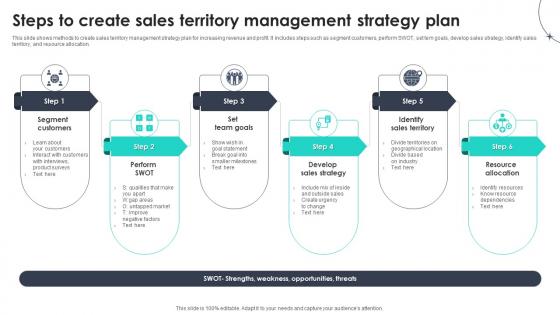
This slide shows methods to create sales territory management strategy plan for increasing revenue and profit. It includes steps such as segment customers, perform SWOT, set tem goals, develop sales strategy, identify sales territory, and resource allocation.
People who downloaded this PowerPoint presentation also viewed the following :
Steps To Create Sales Territory Management Strategy Plan with all 6 slides:
Use our Steps To Create Sales Territory Management Strategy Plan to effectively help you save your valuable time. They are readymade to fit into any presentation structure.





FAQs for Steps To Create Sales Territory
Key components include territory mapping and segmentation, account prioritization and classification, sales quota allocation, performance metrics and tracking systems, and resource distribution strategies. These elements work together by optimizing coverage efficiency, maximizing revenue potential, and ensuring balanced workloads, with many organizations finding that strategic territory alignment ultimately delivers improved sales performance and enhanced customer relationships.
Data analytics enhances sales territory planning by analyzing customer demographics, purchase patterns, geographic data, competitor presence, and sales rep performance metrics. Through predictive modeling and visualization tools, organizations can identify high-potential markets, balance workloads more effectively, and optimize travel routes, with many companies finding that data-driven territory design increases sales productivity by 15-25% while reducing operational costs.
Common sales territory management pitfalls include unequal territory distribution, inadequate market analysis, poor resource allocation, insufficient performance tracking, and misaligned sales goals with territory capacity. These challenges often result in decreased sales productivity, team frustration, and missed revenue opportunities, with many organizations finding that strategic territory redesign and data-driven boundary adjustments significantly enhance overall sales performance and competitive positioning.
Effective territory management significantly boosts sales team morale by ensuring fair opportunity distribution, realistic quotas, and balanced workloads across regions. Through strategic territory alignment, sales teams experience reduced travel time, clearer customer focus, and achievable targets, while eliminating overlap conflicts and resource competition, ultimately delivering higher performance metrics and improved job satisfaction.
Geographic mapping enables sales territory management by visualizing customer distributions, identifying market gaps, optimizing travel routes, and balancing workloads across regions. Through advanced mapping technologies, sales organizations streamline territory assignments, reduce travel costs, and enhance customer coverage, with many companies finding that visual territory analysis ultimately delivers improved sales performance and strategic resource allocation.
Companies leverage technology to streamline sales territory assignments through CRM analytics, geographic mapping software, AI-powered optimization tools, automated workload balancing systems, and real-time performance tracking platforms. These technologies enable organizations to analyze customer data, optimize geographic boundaries, and automatically redistribute accounts based on performance metrics, ultimately delivering more efficient resource allocation and improved sales outcomes.
Workload balancing strategies include geographic redistribution, account value equalization, lead rotation systems, skill-based territory assignments, and automated workload monitoring tools. These approaches streamline resource allocation by matching representative capabilities with territory demands, redistributing high-value accounts strategically, and implementing dynamic assignment algorithms, ultimately delivering improved sales performance and enhanced team productivity across organizations.
Sales territories should be reviewed quarterly for performance metrics and adjusted annually for major changes, with ongoing monitoring of market conditions, competitive landscape, and sales rep performance throughout the year. This strategic approach enables organizations to optimize resource allocation, respond to market shifts, and maintain competitive advantage, with many companies finding that regular territory assessment ultimately delivers improved sales efficiency and stronger customer relationships.
Key metrics for evaluating sales territory strategy effectiveness include revenue per territory, customer acquisition rates, sales cycle length, territory penetration rates, and rep productivity ratios. These metrics enable organizations to identify high-performing territories, optimize resource allocation, and adjust boundaries strategically, with many companies finding that balanced scorecards combining revenue and efficiency measures deliver the most actionable insights.
Customer segmentation and sales territory management intersect by enabling strategic resource allocation, targeted messaging, and optimized coverage based on customer characteristics, behaviors, and value potential. This strategic combination allows organizations to assign high-value segments to experienced representatives, customize approaches by territory demographics, and ultimately deliver enhanced customer experiences while maximizing revenue efficiency across diverse markets.
Best practices for onboarding new sales reps include comprehensive territory mapping, customer relationship transfers, product training, competitive landscape analysis, and goal-setting sessions. These approaches streamline integration by providing clear market insights, establishing existing client connections, and defining performance expectations, with many organizations finding that structured 90-day onboarding programs significantly accelerate rep productivity and territory revenue growth.
CRM systems enhance sales territory management by providing comprehensive data analytics, automated lead distribution, performance tracking capabilities, and customer interaction histories. Through centralized dashboards, sales managers can optimize territory assignments, monitor individual rep performance, and identify high-potential prospects, while ensuring balanced workloads and maximizing revenue opportunities across all geographic regions, ultimately delivering improved sales efficiency and strategic territory optimization.
Effective territory management enhances customer satisfaction by ensuring faster response times, personalized service delivery, and consistent relationship building through dedicated coverage. When sales representatives maintain focused geographic areas, customers receive more attentive support, quicker problem resolution, and deeper understanding of their specific needs, ultimately delivering improved experiences and stronger loyalty.
Businesses can ensure fair competition through clear territorial boundaries, transparent lead distribution systems, collaborative performance metrics, and shared revenue models for overlapping accounts. Many organizations implement territory mapping software and establish joint account protocols, enabling teams to focus on customer value rather than internal competition, ultimately delivering better client experiences and increased overall sales performance.
Legal and ethical considerations in sales territory management include fair territory allocation, non-discrimination compliance, transparent compensation structures, customer data protection, and adherence to antitrust regulations. These frameworks enhance organizational integrity by preventing unfair competition practices, ensuring equitable treatment of sales teams, and maintaining customer trust, ultimately delivering sustainable growth and competitive advantage.
-
Loved the collection. Editing the presentation was seamless with their templates.
-
Happy to found you SlideTeam. You guys are value for money. Amazing slides.