STP Analysis Process Framework Segmentation Targeting Positioning Analysis

Rating:
100%
STP Analysis Process Framework Segmentation Targeting Positioning Analysis STP Analysis Process Framework Segmentation Targeting Positioning Analysis
Slide 1 of 6

or

Favourites Favourites

Try Before you Buy Download Free Sample Product

Audience Impress Your
Audience
Editable 100%
Editable
Time Save Hours
of Time
The Biggest Sale is ending soon in
0
0
:
0
0
:
0
0
Rating:
100%
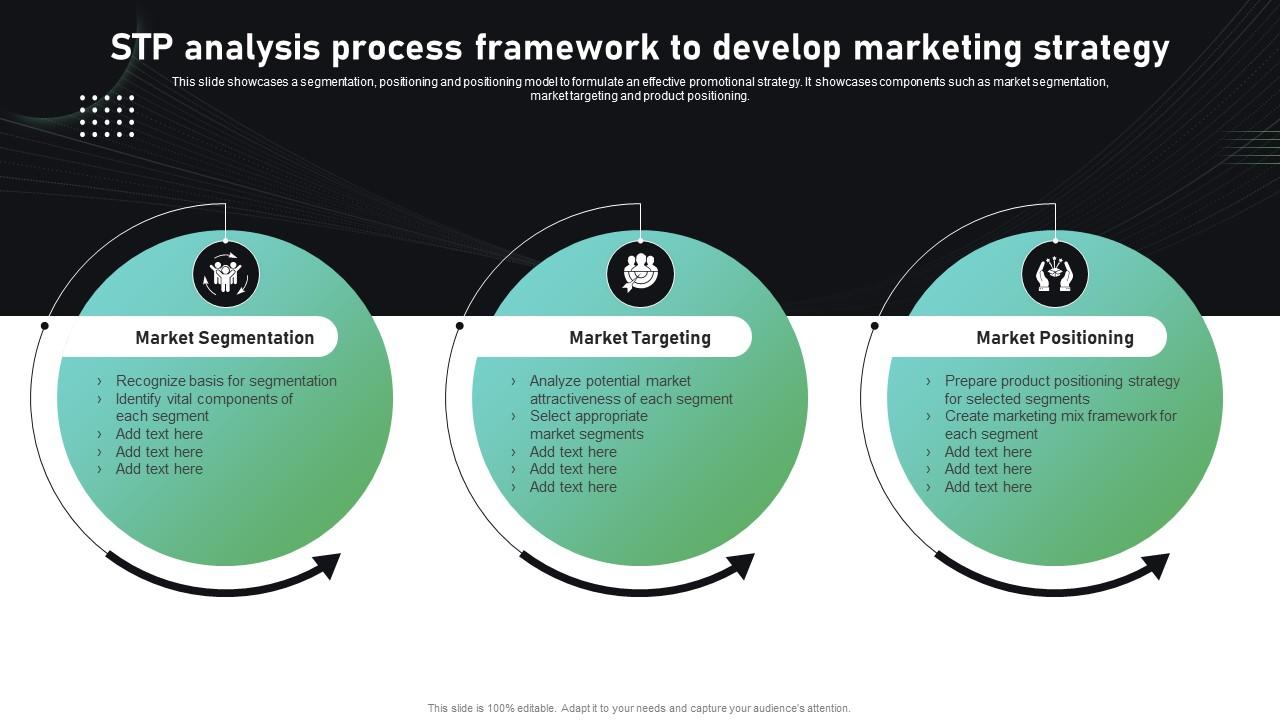
This slide showcases a segmentation, positioning and positioning model to formulate an effective promotional strategy. It showcases components such as market segmentation, market targeting and product positioning. Introducing STP Analysis Process Framework Segmentation Targeting Positioning Analysis to increase your presentation threshold. Encompassed with three stages, this template is a great option to educate and entice your audience. Dispence information on Market Segmentation, Market Targeting, Market Positioning, using this template. Grab it now to reap its full benefits.

FAQs for STP Analysis Process Framework Segmentation

STP analysis comprises three essential components: Segmentation, which divides markets into distinct customer groups based on demographics, behaviors, and preferences; Targeting, which evaluates and selects specific segments to focus marketing efforts; and Positioning, which creates unique brand identity within chosen segments. This strategic framework enables businesses to streamline marketing resources, enhance customer engagement, and deliver more personalized experiences, with many organizations finding that targeted approaches significantly improve conversion rates and competitive advantage.

Segmentation involves dividing the broader market into distinct groups based on demographics, psychographics, behavior, and geographic factors, while targeting focuses on selecting which specific segments to pursue based on attractiveness and company capabilities. Through strategic evaluation, organizations assess segment size, growth potential, and competitive landscape, ultimately choosing segments that align with their resources and objectives for maximum market impact.

Effective market segmentation methods include demographic analysis, psychographic profiling, behavioral patterns, geographic targeting, and benefit-based segmentation. These approaches enable organizations to identify distinct customer groups by analyzing purchasing habits, lifestyle preferences, and regional characteristics, with many companies finding that combining multiple segmentation methods delivers more precise targeting and enhanced competitive advantage.

Demographic segmentation enhances STP analysis by providing clear, measurable criteria like age, income, education, and occupation that enable precise market identification and targeting strategies. Through demographic insights, organizations streamline resource allocation, develop tailored messaging approaches, and deliver more personalized customer experiences, ultimately achieving higher conversion rates and competitive advantage in increasingly diverse markets.

Psychographic segmentation analyzes consumers' lifestyles, values, attitudes, interests, and personality traits, providing deeper insights beyond basic demographics like age or income. This approach enables businesses to understand purchasing motivations, brand preferences, and decision-making patterns, with retailers and financial services finding that psychographic data significantly enhances targeted marketing campaigns and product development strategies.

Businesses identify and evaluate target audiences through demographic analysis, psychographic profiling, behavioral segmentation, geographic targeting, and needs-based assessment. These methods enable companies to streamline marketing efforts, enhance customer experiences, and allocate resources strategically, with many organizations finding that comprehensive audience evaluation ultimately delivers higher conversion rates and competitive advantage.

Geographic segmentation in STP analysis enables businesses to tailor products, pricing, and marketing strategies to specific regional preferences, local regulations, climate conditions, and cultural nuances. This approach streamlines resource allocation by focusing efforts on high-potential markets, while enhancing customer relevance through location-specific messaging, ultimately delivering improved market penetration and competitive advantage.

Behavioral segmentation improves product positioning by analyzing customer purchase patterns, usage frequency, brand loyalty, and response to marketing campaigns, enabling precise targeting strategies. Through data-driven insights, companies can tailor messaging, pricing, and features to specific behavioral segments, with retail and financial services organizations finding significantly enhanced conversion rates and customer engagement.

Tools for conducting STP analysis include customer surveys, focus groups, demographic databases, psychographic research platforms, and competitive analysis software. These techniques enable businesses to identify distinct market segments through data collection, evaluate segment attractiveness using profitability metrics, and develop targeted positioning strategies, with many organizations finding that integrated approaches deliver stronger market penetration and competitive advantage.

STP analysis contributes to marketing strategy development by enabling businesses to segment their market, target the most profitable customer groups, and position their offerings strategically against competitors. Through this systematic approach, companies can allocate marketing resources more efficiently, create more personalized customer experiences, and develop compelling value propositions, ultimately delivering higher conversion rates and stronger competitive advantage in increasingly crowded markets.

Common STP analysis pitfalls include insufficient market research, overly broad segmentation, targeting segments without purchasing power, and generic positioning that lacks differentiation. These missteps often result from rushing the process or ignoring competitive landscapes, with many organizations finding that thorough validation and clear value propositions ultimately deliver stronger market penetration and sustainable competitive advantage.

Companies can measure targeting effectiveness through conversion rates, customer acquisition costs, engagement metrics, lifetime value analysis, and market share growth within targeted segments. Through advanced analytics and A/B testing, organizations streamline performance tracking across demographics, psychographics, and behavioral patterns, with many finding that segment-specific ROI measurements ultimately deliver clearer strategic insights and competitive advantage.

Digital transformation revolutionizes traditional STP methods by enabling real-time data analytics, AI-powered customer insights, dynamic segmentation algorithms, and personalized targeting at scale. Through advanced technologies, organizations can continuously refine market segments, deliver hyper-personalized experiences, and adapt positioning strategies instantly, while traditional static approaches evolve into agile, data-driven frameworks that enhance competitive advantage.

STP analysis evolves by incorporating real-time consumer data, social media insights, behavioral analytics, and emerging demographic shifts into segmentation strategies. Through dynamic market research and agile positioning adjustments, organizations continuously refine their targeting approaches, with many retail and technology companies finding that flexible STP frameworks enable faster responses to trends, ultimately delivering sustained competitive advantage.

STP analysis informs product development by identifying underserved market segments, revealing unmet customer needs, and highlighting positioning gaps that competitors haven't addressed. Through detailed segmentation research, companies can innovate targeted features, develop segment-specific products, and create differentiated value propositions, ultimately delivering solutions that resonate with specific customer groups and drive competitive advantage.

Ratings and Reviews

100% of 100
Review Form
Write a review
Most Relevant Reviews
  1. 100%

    by Evans Mitchell

    Perfect template with attractive color combination.
  2. 100%

    by Derick Meyer

    Slideteam offers pocket-friendly products. As a college student this is a really necessary thing to look at while paying for something.

2 Item(s)

per page: