Strategic Communication Plan For Agile Project

Rating:
80%
Strategic Communication Plan For Agile Project
Slide 1 of 6
Favourites Favourites

Try Before you Buy Download Free Sample Product

Audience Impress Your
Audience
Editable 100%
Editable
Time Save Hours
of Time
The Biggest Sale is ending soon in
0
0
:
0
0
:
0
0
Rating:
80%
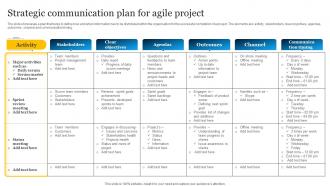
The slide showcases a plan that helps to define how and when information has to be distributed within the organisation for the successful completion of a project. The elements are activity, stakeholders, clear objectives, agendas, outcomes, channel and communication timing. Presenting our well structured Strategic Communication Plan For Agile Project. The topics discussed in this slide are Stakeholders, Agendas, Channel. This is an instantly available PowerPoint presentation that can be edited conveniently. Download it right away and captivate your audience.

People who downloaded this PowerPoint presentation also viewed the following :

FAQs for Strategic Communication Plan

Agile communication principles include transparency, frequent feedback loops, face-to-face interactions, collaborative documentation, and iterative information sharing. These strategies streamline project workflows by eliminating communication silos, accelerating decision-making processes, and enhancing team alignment, with many organizations finding that regular standups and retrospectives ultimately deliver faster project completion and improved stakeholder satisfaction.

Teams effectively implement Agile communication in remote environments by establishing daily virtual standups, utilizing collaborative platforms like Slack or Microsoft Teams, creating shared digital workspaces, and maintaining frequent video check-ins. These practices streamline information flow, enhance transparency, and foster continuous collaboration, with many organizations finding that structured remote Agile frameworks ultimately deliver faster project completion and improved team cohesion.

Tools that enhance Agile communication include Slack for real-time messaging, Jira for sprint tracking, Zoom for virtual stand-ups, Miro for collaborative planning, and Microsoft Teams for integrated workflows. These platforms streamline coordination by centralizing updates, automating progress tracking, and facilitating seamless remote participation, with many development teams finding that strategic tool integration ultimately delivers faster sprint cycles and enhanced team transparency.

Agile communication strategies prioritize frequent, informal interactions, real-time feedback loops, and cross-functional collaboration, while traditional methods rely on formal documentation, hierarchical reporting, and scheduled meetings. Through daily standups, sprint reviews, and continuous stakeholder engagement, organizations streamline decision-making, reduce project delays, and enhance team transparency, ultimately delivering faster responses to market changes.

Transparency plays a central role in Agile communication strategy by fostering trust, enabling informed decision-making, and ensuring all stakeholders have visibility into project progress, challenges, and changes. This openness streamlines collaboration across development teams, product owners, and business stakeholders, ultimately delivering faster problem resolution and enhanced project outcomes.

Feedback loops integrate into Agile communication through regular retrospectives, daily standups with impediment discussions, sprint reviews with stakeholder input, and continuous peer feedback sessions. These mechanisms enable teams to identify communication gaps, adjust messaging strategies, and enhance collaboration effectiveness, with many organizations finding that structured feedback cycles significantly improve project outcomes and team alignment.

Common Agile communication challenges include information silos, inconsistent messaging across sprints, stakeholder misalignment, and over-reliance on digital tools without face-to-face interaction. Teams overcome these obstacles by implementing daily standups, maintaining transparent project dashboards, establishing clear communication protocols, and conducting regular retrospectives, ultimately delivering enhanced collaboration, reduced project delays, and improved stakeholder satisfaction across development cycles.

Fostering open communication in Agile teams requires establishing psychological safety, implementing regular feedback mechanisms, encouraging transparent dialogue, and promoting collaborative problem-solving approaches. Through daily standups, retrospectives, and cross-functional workshops, teams streamline information sharing, minimize silos, and enhance trust-building, with many organizations finding that these practices ultimately deliver faster decision-making and improved project outcomes.

Techniques include rotating facilitation, timeboxed speaking opportunities, anonymous feedback tools, structured check-ins, and small group breakouts before larger discussions. These approaches enhance participation by creating psychological safety, minimizing dominant voices, and accommodating different communication styles, with many Agile teams finding that structured inclusivity ultimately delivers higher engagement and more innovative solutions.

Agile communication strategies support cross-functional collaboration by establishing regular touchpoints, promoting transparency through shared visibility tools, and creating feedback loops that align diverse team expertise. Through daily standups, sprint reviews, and collaborative platforms, teams from development, marketing, and operations streamline decision-making, reduce silos, and accelerate project delivery, ultimately enhancing organizational agility and competitive responsiveness.

Agile communication effectiveness metrics include team velocity trends, sprint goal achievement rates, stakeholder satisfaction scores, defect discovery timing, and cross-functional collaboration frequency. These measurements enable organizations to track information flow quality, decision-making speed, and alignment consistency, with many development teams finding that regular metric review ultimately delivers improved project outcomes and enhanced team performance.

Organizations tailor Agile communication strategies by implementing multi-channel approaches, establishing role-specific feedback loops, creating flexible meeting formats, and adapting documentation styles to different team preferences. Through strategic combination of digital tools, face-to-face interactions, and asynchronous updates, companies enhance collaboration across departments, time zones, and skill levels, ultimately delivering improved project outcomes and stronger team cohesion.

**INPUT**: What best practices should be followed to document Agile communications effectively? **OUTPUT**: Effective Agile communication documentation includes maintaining visual information radiators, recording key decisions with context, creating concise meeting summaries, and establishing shared digital repositories accessible to all stakeholders. These practices streamline knowledge transfer by reducing information silos, enabling faster onboarding, and maintaining project continuity, with many organizations finding that structured documentation enhances team collaboration while preserving Agile's adaptive flexibility. [Word count: 60 words]

Agile communication enhances stakeholder engagement through transparent progress updates, regular feedback loops, iterative demonstrations, and collaborative decision-making processes. By prioritizing frequent touchpoints and adaptive messaging, organizations streamline stakeholder alignment, reduce miscommunication risks, and accelerate project buy-in, ultimately delivering higher satisfaction rates and stronger strategic partnerships across diverse business environments.

Visual communication enhances Agile strategies by creating transparency, accelerating understanding, and reducing miscommunication through dashboards, charts, kanban boards, and infographics. These visual tools streamline complex project data, enable faster decision-making across distributed teams, and ultimately deliver improved collaboration, with many organizations finding that visual elements significantly enhance sprint planning and stakeholder alignment.

Ratings and Reviews

80% of 100
Review Form
Write a review
Most Relevant Reviews
  1. 80%

    by Darren Olson

    “You have the structure in place that are easy to explore new opportunities.I will be recommending your services to other people.”
  2. 80%

    by Rodriguez Morgan

    Thanks for all your great templates they have saved me lots of time and accelerate my presentations. Great product, keep them up!

2 Item(s)

per page: