

Strategic Control Powerpoint Ppt Template Bundles




Try Before you Buy Download Free Sample Product
 Impress Your
 Audience
 100%
100% Editable
 Save Hours
 of Time


Our Strategic Control Powerpoint Ppt Template Bundles are topically designed to provide an attractive backdrop to any subject. Use them to look like a presentation pro.
People who downloaded this PowerPoint presentation also viewed the following :
Strategic Control Powerpoint Ppt Template Bundles with all 17 slides:
Use our Strategic Control Powerpoint Ppt Template Bundles to effectively help you save your valuable time. They are readymade to fit into any presentation structure.






FAQs for Strategic Control Powerpoint
Strategic control components include performance measurement systems, feedback mechanisms, variance analysis, corrective action protocols, and strategic review processes. These systems enhance organizational effectiveness by monitoring goal achievement, identifying performance gaps, and enabling timely adjustments, with many companies finding that integrated control frameworks ultimately deliver improved decision-making and sustained competitive advantage.
Strategic control focuses on long-term organizational direction, competitive positioning, and goal achievement across multiple years, while operational control manages daily activities, short-term performance metrics, and immediate resource allocation. Strategic control evaluates whether companies are moving toward their vision and adapting to market changes, while operational control ensures efficient execution of current processes, ultimately delivering both visionary leadership and tactical excellence.
Performance measurement serves as the foundation of strategic control by establishing benchmarks, tracking progress against objectives, identifying variances, and enabling corrective action. Through balanced scorecards, KPIs, and financial metrics, organizations can monitor strategic execution across departments, assess resource allocation effectiveness, and maintain competitive advantage, with many companies finding that systematic measurement enhances decision-making and ultimately delivers sustained growth.
Organizations can effectively align strategic goals with performance indicators by establishing clear cascading objectives, implementing balanced scorecards that connect financial and operational metrics, and creating regular review cycles for measurement accuracy. Through strategic mapping and data-driven dashboards, companies streamline goal tracking, enhance accountability across departments, and ultimately deliver improved performance visibility, with many finding that integrated measurement systems significantly boost strategic execution success.
Common challenges in implementing strategic control systems include resistance to change, inadequate data systems, unclear performance metrics, insufficient leadership commitment, and poor communication across organizational levels. These obstacles often stem from cultural barriers and resource constraints, with many organizations finding that successful implementation requires comprehensive training, stakeholder buy-in, and phased rollouts to ensure sustainable adoption and measurable strategic outcomes.
Organizational culture significantly impacts strategic control by shaping employee behaviors, decision-making processes, and alignment with strategic objectives through shared values, communication patterns, and performance expectations. Strong cultures enhance control effectiveness by fostering self-regulation and accountability, while misaligned cultures can undermine strategic initiatives, with many organizations finding that cultural transformation often precedes successful strategic implementation.
Effective strategic monitoring tools include balanced scorecards, key performance indicator dashboards, strategic maps, variance analysis systems, and real-time analytics platforms. These frameworks enable organizations to track performance against objectives, identify deviations early, and make data-driven adjustments, with many companies finding that integrated monitoring systems significantly enhance decision-making speed and strategic agility.
Technology enhances strategic control processes by automating data collection, providing real-time performance dashboards, and enabling predictive analytics for early variance detection. Through AI-powered monitoring systems and integrated business intelligence platforms, organizations streamline decision-making, minimize response times, and deliver more accurate strategic adjustments, ultimately achieving competitive advantage in increasingly dynamic markets.
Organizations should follow systematic evaluation frameworks, stakeholder engagement protocols, objective performance metrics, regular timeline schedules, and independent assessment teams for effective strategic audits. These practices streamline accountability by ensuring comprehensive reviews, minimizing bias, and delivering actionable insights, with many companies finding that quarterly assessments enhance strategic alignment and competitive positioning.
Feedback mechanisms integrate into strategic control through real-time performance monitoring systems, regular stakeholder surveys, automated reporting dashboards, milestone review processes, and cross-functional communication channels. These systems enable organizations to quickly identify deviations from strategic objectives, adjust resource allocation dynamically, and maintain alignment across departments, ultimately delivering enhanced responsiveness and competitive advantage in increasingly complex business environments.
Scenario planning enables organizations to anticipate potential future challenges, identify emerging opportunities, and develop flexible strategic responses across multiple possible outcomes. This approach enhances strategic control by allowing companies to stress-test their plans against various market conditions, regulatory changes, and competitive landscapes, ultimately delivering greater resilience and adaptive capacity in increasingly unpredictable business environments.
Strategic control evolves in dynamic markets by shifting from rigid annual reviews to real-time monitoring systems, adaptive performance metrics, and continuous feedback loops. Organizations increasingly implement agile control frameworks that adjust targets quarterly, incorporate predictive analytics for early warning signals, and enable rapid strategic pivots, ultimately delivering competitive responsiveness and sustained market positioning.
Leadership establishes strategic control frameworks by setting clear performance metrics, communicating organizational priorities, and creating accountability structures throughout all management levels. Effective leaders in sectors like manufacturing and healthcare foster transparency through regular strategic reviews, empower teams with decision-making authority, and maintain alignment between operational activities and long-term objectives, ultimately delivering sustained competitive advantage.
Organizations ensure agility while maintaining strategic control by establishing clear decision-making frameworks, implementing real-time performance monitoring systems, and creating flexible resource allocation processes. Through strategic dashboards and regular review cycles, companies can quickly pivot operations while staying aligned with core objectives, with many enterprises finding that decentralized execution combined with centralized oversight delivers both responsiveness and strategic consistency.
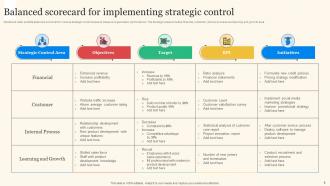
Strategic performance metrics include financial indicators like ROI and revenue growth, operational measures such as market share and customer satisfaction, innovation metrics like new product development cycles, and competitive positioning assessments. These comprehensive measurement frameworks enable organizations to track progress across multiple dimensions, with many companies finding that balanced scorecards combining financial, customer, internal process, and learning perspectives ultimately deliver clearer strategic insights and enhanced decision-making capabilities.
-
Topic best represented with attractive design.
-
Fantastic and innovative graphics with useful content. The templates are the best and latest in the industry.