Strategic HR Business Plan Overview

Rating:
100%
Strategic HR Business Plan Overview
Slide 1 of 6
Favourites Favourites

Try Before you Buy Download Free Sample Product

Audience Impress Your
Audience
Editable 100%
Editable
Time Save Hours
of Time
The Biggest Sale is ending soon in
0
0
:
0
0
:
0
0
Rating:
100%
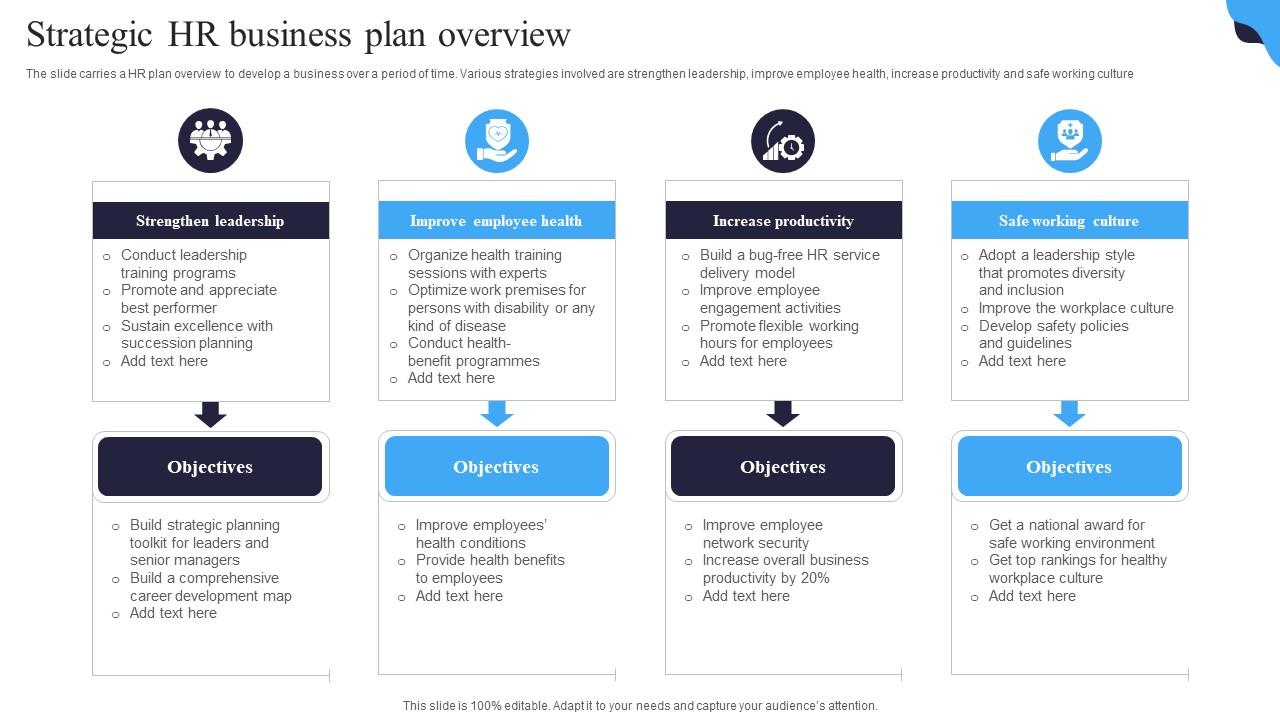
The slide carries a HR plan overview to develop a business over a period of time. Various strategies involved are strengthen leadership, improve employee health, increase productivity and safe working culture. Introducing our premium set of slides with Strategic HR Business Plan Overview. Ellicudate the Four stages and present information using this PPT slide. This is a completely adaptable PowerPoint template design that can be used to interpret topics like Strengthen Leadership, Increase Productivity, Safe Working Culture. So download instantly and tailor it with your information.

FAQs for Strategic HR

Key metrics include employee turnover rates, time-to-fill positions, employee engagement scores, productivity measurements, and training ROI. These indicators enable organizations to assess talent retention, recruitment efficiency, and workforce performance, with many companies finding that tracking these metrics simultaneously delivers improved operational outcomes, enhanced employee satisfaction, and ultimately stronger competitive positioning in talent markets.

Technology enhances strategic HR planning through predictive analytics, AI-powered talent assessment, automated workforce forecasting, cloud-based HRIS systems, and real-time performance dashboards. These tools enable HR teams to identify skill gaps, predict turnover patterns, and optimize resource allocation more effectively, while many organizations find that data-driven insights ultimately deliver faster decision-making and competitive talent strategies.

Workforce forecasting serves as the foundation for strategic HR planning by predicting future talent needs, identifying skill gaps, and anticipating demographic shifts within organizations. Through predictive analytics and market analysis, companies can proactively develop recruitment strategies, training programs, and succession plans, ultimately ensuring adequate staffing levels and competitive advantage in increasingly dynamic business environments.

Organizations should align HR strategies with business objectives by integrating workforce planning into strategic business planning, establishing clear performance metrics that connect HR outcomes to business results, and ensuring talent acquisition, development, and retention directly support company goals. This strategic combination enables companies to build competitive advantage through human capital, with many finding that aligned HR strategies deliver improved operational efficiency, enhanced employee engagement, and ultimately stronger business performance.

Common pitfalls include lack of senior leadership support, insufficient alignment with business objectives, unrealistic timelines, inadequate data analysis, and poor change management communication. Organizations often struggle by setting vague goals, ignoring employee feedback, and failing to establish measurable metrics, with many companies finding that successful strategic HR planning requires continuous stakeholder engagement and regular plan adjustments.

Diversity and inclusion initiatives integrate into strategic HR planning through targeted recruitment strategies, inclusive leadership development programs, bias-free performance management systems, and comprehensive employee resource groups. These approaches enhance organizational culture by expanding talent pools, improving decision-making through diverse perspectives, and increasing employee engagement, ultimately delivering stronger business performance and competitive advantage in increasingly global markets.

Employer branding significantly impacts strategic HR planning by enhancing talent acquisition, improving employee retention, and reducing recruitment costs through stronger market positioning. A compelling employer brand enables organizations to attract higher-quality candidates more efficiently, while strategic HR teams leverage brand strength to build long-term workforce strategies, ultimately delivering competitive advantage in increasingly talent-competitive markets.

Companies should revisit HR strategies quarterly for tactical adjustments and conduct comprehensive annual reviews for strategic overhauls, aligning with business cycles, market changes, and organizational growth phases. This balanced approach enables organizations to respond to emerging talent trends, economic shifts, and competitive pressures while maintaining long-term workforce planning consistency, ultimately delivering enhanced agility and sustained competitive advantage.

Best practices for engaging stakeholders during HR planning include conducting structured stakeholder mapping, facilitating cross-functional planning sessions, establishing regular communication touchpoints, creating collaborative goal-setting workshops, and implementing feedback loops throughout the process. These approaches streamline alignment by ensuring diverse perspectives are captured, building organizational buy-in, and fostering shared ownership of HR initiatives, ultimately delivering more effective workforce strategies and enhanced operational outcomes.

Leadership development can be incorporated into strategic HR initiatives through succession planning, mentorship programs, cross-functional assignments, executive coaching, and competency-based training frameworks. These approaches enhance organizational capability by identifying high-potential employees, accelerating skill development, and building leadership pipelines, with many companies finding that strategic leadership investment ultimately delivers improved employee retention and sustainable competitive advantage.

Employee retention strategies include competitive compensation packages, professional development opportunities, flexible work arrangements, recognition programs, and clear career progression paths. These approaches enhance retention by creating engaging work environments, building employee loyalty, and aligning individual growth with organizational objectives, with many companies finding that strategic retention efforts significantly reduce turnover costs while improving productivity.

Succession planning serves as a critical component of strategic HR planning by ensuring leadership continuity, identifying skill gaps, and aligning talent development with long-term organizational goals. Through systematic talent mapping and development programs, organizations proactively prepare high-potential employees for key roles, ultimately reducing recruitment costs and maintaining operational stability during leadership transitions.

Conducting SWOT analysis in HR planning enables organizations to identify internal strengths like skilled talent pools, address weaknesses such as skill gaps, capitalize on external opportunities including emerging technologies, and mitigate threats like competitive recruitment challenges. This strategic assessment streamlines workforce planning by aligning human capital decisions with business objectives, ultimately delivering enhanced talent acquisition strategies, improved employee development programs, and sustainable competitive advantage in increasingly dynamic markets.

Organizations can measure HR strategy ROI through metrics like employee turnover costs, productivity improvements, time-to-fill positions, training effectiveness, and revenue per employee. By tracking these indicators alongside engagement scores and retention rates, companies streamline operations while reducing recruitment expenses, ultimately delivering enhanced performance and competitive advantage in talent management.

Strategic HR planning adapts to changing market conditions through flexible workforce strategies, continuous skills assessment, agile organizational structures, scenario-based planning, and real-time talent analytics. These approaches enable organizations to pivot quickly during market shifts, with many companies finding that proactive workforce planning, cross-training initiatives, and strategic talent partnerships ultimately deliver competitive advantage and operational resilience.

Ratings and Reviews

100% of 100
Review Form
Write a review
Most Relevant Reviews
  1. 100%

    by Taylor Hall

    Editable templates with innovative design and color combination.
  2. 100%

    by Michael Clark

    I am glad to have come across Slideteam. I was searching for some unique presentations and templates for my business. There are a lot of alternatives available here.

2 Item(s)

per page: