

Strategic Improvement In Banking Operations Powerpoint Presentation Slides




Try Before you Buy Download Free Sample Product
 Impress Your
 Audience
 100%
100% Editable
 Save Hours
 of Time


Check out our professionally designed Strategic Improvement in Banking Operations PowerPoint Presentation. This deck comprehensively addresses a range of tactics to bolster the operational efficiency of banking activities. Enhancing banking operations involves utilizing diverse strategies and integrating innovative technologies to optimize efficiency, security, and the overall customer experience within the banking sector. Additionally, the Digital Banking template encompasses technology and automation, including mobile and internet banking applications, boosting workforce productivity, delivering customer-centric services, and redefining the operational banking model, among other aspects. Furthermore, it delves into cybersecurity techniques for safeguarding bank assets and counteracting security threats, alongside an exploration of cost management strategies tailored for the banking industry. Lastly, the Banking Automation slides examine the tangible outcomes of implementing these strategies, encompassing enhanced banking operations, technological initiatives, and dashboards for monitoring operational performance. It presents two illustrative case studies from the banking sector. Get access to this 100 percent editable template now.
People who downloaded this PowerPoint presentation also viewed the following :
Content of this Powerpoint Presentation
Slide 1: This slide introduces Strategic Improvement in Banking Operations. State your company name and begin.
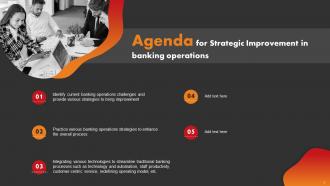
Slide 2: This is an Agenda slide. State your agendas here.
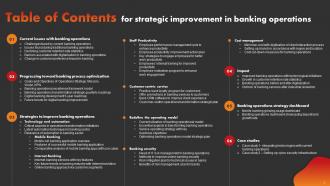
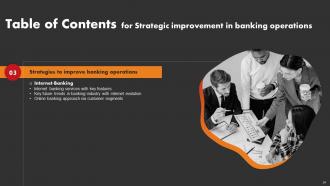
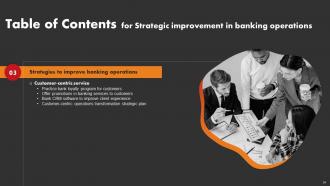
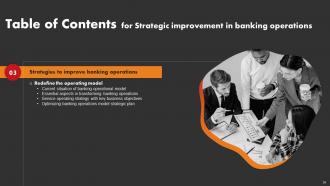
Slide 3: This slide shows Table of Content for the presentation.
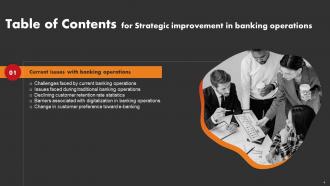
Slide 4: This slide shows title for topics that are to be covered next in the template.
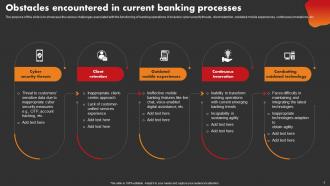
Slide 5: This slide showcases the various challenges associated with the functioning of banking operations. It includes cyber security threats, client retention etc.
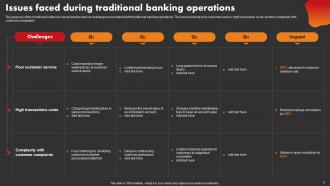
Slide 6: This slide presents various challenges encountered with traditional banking operations.
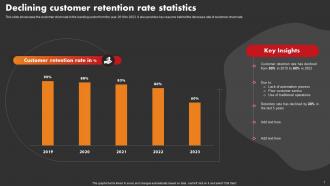
Slide 7: This slide showcases the customer churn rate in the banking sector from the year 2019 to 2023. it also provides key reasons behind the decrease rate of customer churn rate.
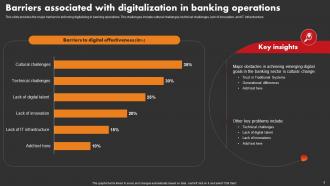
Slide 8: This slide provides major barriers to enforcing digitalizing in banking operations. The challenges include cultural challenges, technical challenges etc.
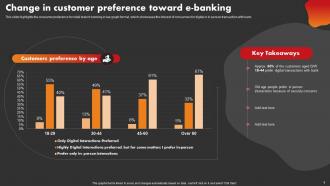
Slide 9: This slide highlights the consumer preference for retail branch banking in bar graph format, which showcases the interest of consumers.
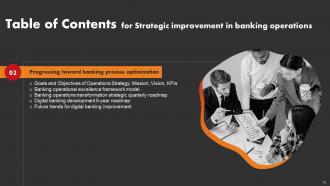
Slide 10: This slide shows title for topics that are to be covered next in the template.
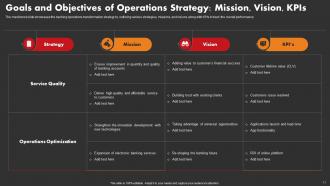
Slide 11: This slide showcases the banking operations transformation strategy by outlining various strategies, missions, and visions along with KPIs to track the overall performance.
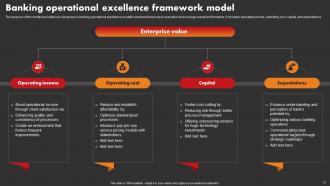
Slide 12: This slide presents a banking operational excellence model to enhance the process execution and manage overall performance.
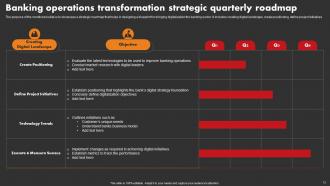
Slide 13: This slide displays a strategic roadmap that helps in designing a blueprint for bringing digitalization the banking sector.
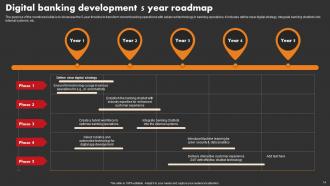
Slide 14: This slide presents the 5-year timeline to transform current banking operations with advanced technology in banking operations.
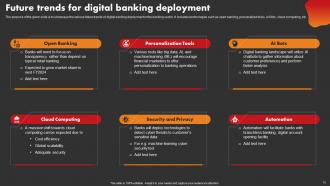
Slide 15: This slide displays the various future trends of digital banking deployment in the banking sector. It includes technologies such as open banking etc.
Slide 16: This slide shows title for topics that are to be covered next in the template.
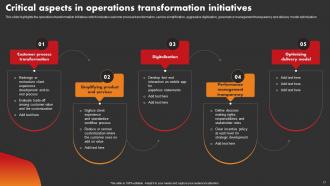
Slide 17: This slide highlights the operations transformation initiatives which includes customer process transformation, service simplification etc.
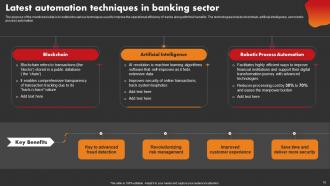
Slide 18: This slide outlines various techniques used to improve the operational efficiency of banks along with their benefits. The technologies include blockchain etc.
Slide 19: This slide presents the various benefits of utilizing automation to enhance banking operations.
Slide 20: This slide shows title for topics that are to be covered next in the template.
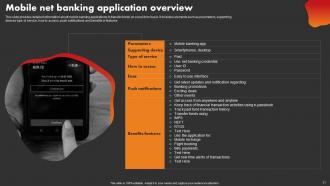
Slide 21: This slide provides detailed information about mobile banking applications to transfer funds on a real-time basis.
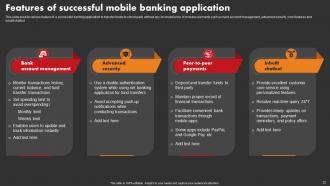
Slide 22: This slide displays various feature of a successful banking application to transfer funds to a third party without any inconvenience.
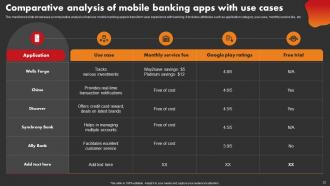
Slide 23: This slide showcases a comparative analysis of various mobile banking apps to transform user experience with banking.
Slide 24: This slide shows title for topics that are to be covered next in the template.
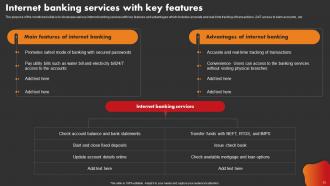
Slide 25: This slide presents various internet banking services with key features and advantages which includes accurate and real-time tracking of transactions etc.
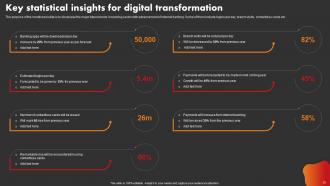
Slide 26: This slide displays the major future trends in banking sector with advancement of internet banking. Some of them include logins per day, branch visits etc.
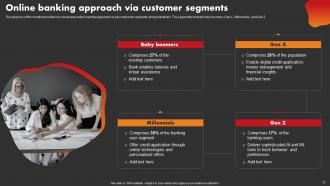
Slide 27: This slide presents online banking approach as per customer segments and generations. The segments include baby boomers, Gen X, Millennials, and Gen Z.
Slide 28: This slide shows title for topics that are to be covered next in the template.
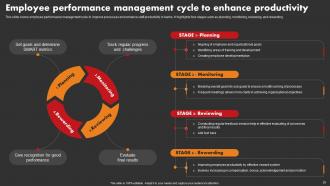
Slide 29: This slide covers employee performance management cycle to improve processes and enhance staff productivity in banks. It highlights four stages.
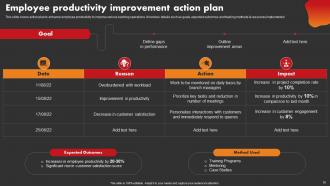
Slide 30: This slide displays action plan to enhance employee productivity to improve various banking operations. It involves details such as goals etc.
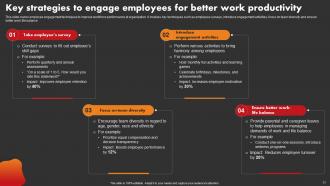
Slide 31: This slide covers employee engagement techniques to improve workforce performance at organization. It involves key techniques such as employees surveys etc.
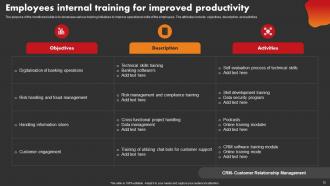
Slide 32: This slide presents various training initiatives to improve operational skills of the employees. The attributes include objectives, description etc.
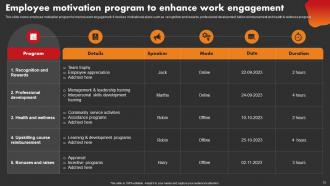
Slide 33: This slide covers employee motivation program to improve work engagement. It involves motivational plans such as recognition and rewards etc.
Slide 34: This slide shows title for topics that are to be covered next in the template.
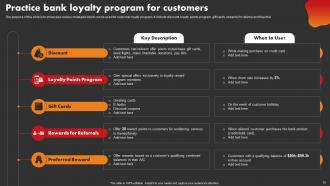
Slide 35: This slide presents various strategies which can be used for customer loyalty program. It include discount, loyalty points program etc.
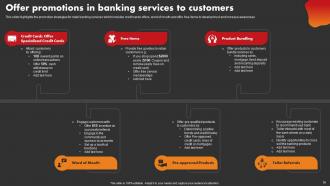
Slide 36: This slide highlights the promotion strategies for retail banking services which includes credit cards offers, word of mouth etc.
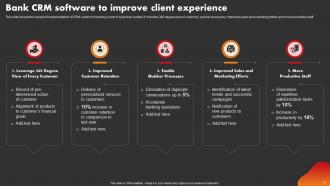
Slide 37: This slide shows the impact of implementation of CRM system in banking sector in business context. It includes 360 degree view of customer etc.
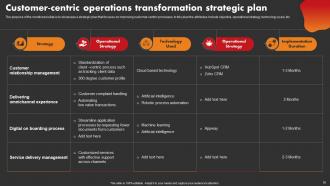
Slide 38: This slide presents a strategic plan that focuses on improving customer-centric processes.
Slide 39: This slide shows title for topics that are to be covered next in the template.
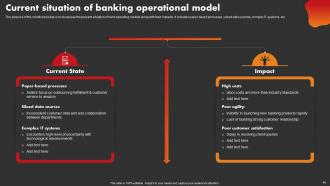
Slide 40: This slide presents the present situation of bank operating models along with their impacts. It includes paper-based processes etc.
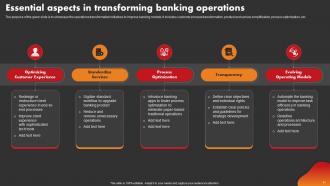
Slide 41: This slide is to showcase the operations transformation initiatives to improve banking models. It includes customer process transformation.
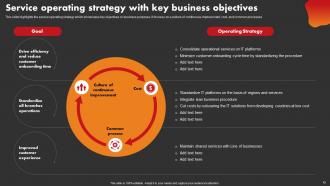
Slide 42: This slide highlights the service operating strategy which showcases key objectives or business purposes.
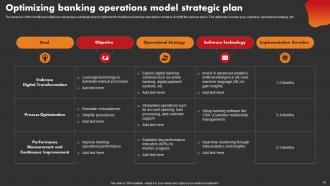
Slide 43: This slide presents a strategic plan to optimize the traditional banking operations model to simplify the various tasks.
Slide 44: This slide shows title for topics that are to be covered next in the template.
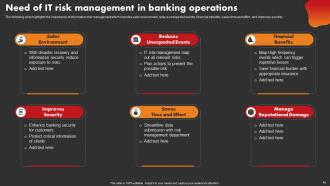
Slide 45: This slide highlights the importance of information risk management which includes safer environment, reduce unexpected events etc.
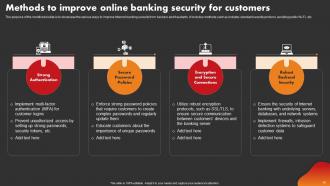
Slide 46: This slide presents the various ways to improve Internet banking security from hackers and fraudants.
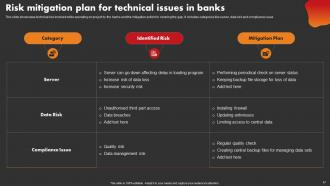
Slide 47: This slide showcases technical risk involved while operating on project by the banks and the mitigation action for covering the gap.
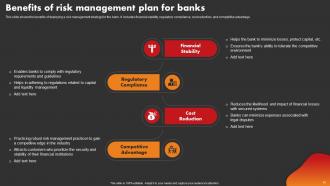
Slide 48: This slide presents the benefits of deploying a risk management strategy for the bank. It includes financial stability, regulatory compliance etc.
Slide 49: This slide shows title for topics that are to be covered next in the template.
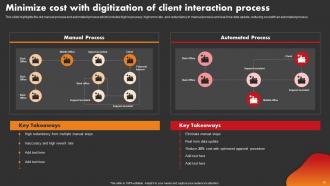
Slide 50: This slide highlights the old manual process and automated process which includes high inaccuracy, high error rate, and redundancy.
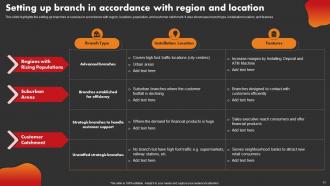
Slide 51: This slide presents the setting up branches or services in accordance with region, locations, population, and customer catchment.
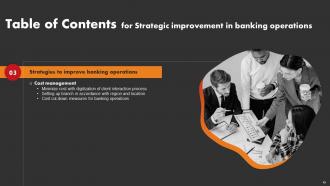
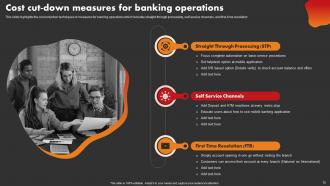
Slide 52: This slide highlights the cost reduction techniques or measures for banking operations which includes straight-through processing etc.
Slide 53: This slide shows title for topics that are to be covered next in the template.
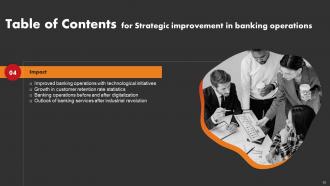
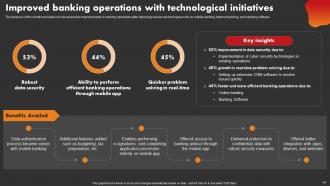
Slide 54: This slide presents the improvements in banking operations after deploying various technologies such as mobile banking, Internet banking, and banking software.
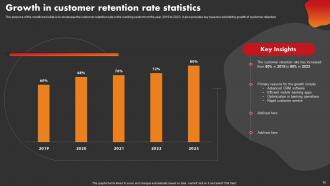
Slide 55: This slide displays the customer retention rate in the banking sector from the year 2019 to 2023. It also provides key reasons behind the growth of customer retention.
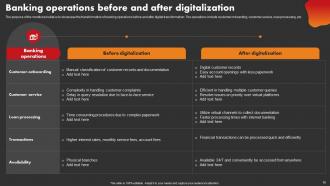
Slide 56: This slide presents the transformation of banking operations before and after digital transformation.
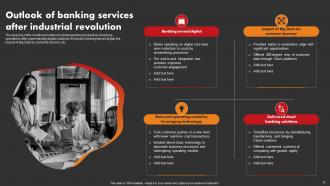
Slide 57: This slide displays the perspective of banking operations after implementing digital solutions. It includes banking turned digital etc.
Slide 58: This slide shows title for topics that are to be covered next in the template.
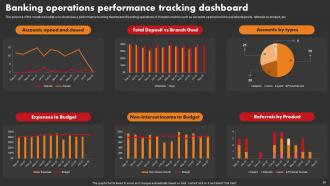
Slide 59: This slide presents a performance tracking dashboard of banking operations. It includes metrics such as accounts opened and closed, referrals by product, etc.
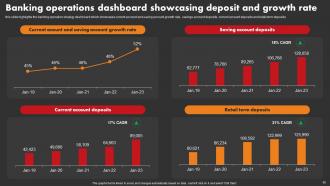
Slide 60: This slide highlights the banking operation strategy dashboard which showcases current account and saving account growth rate, savings account deposits etc.
Slide 61: This slide shows title for topics that are to be covered next in the template.
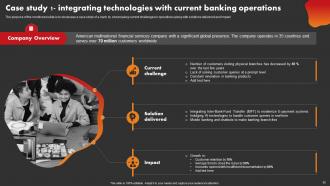
Slide 62: This slide presents a case study of a bank by showcasing current challenges in operations along with solutions delivered and impact.
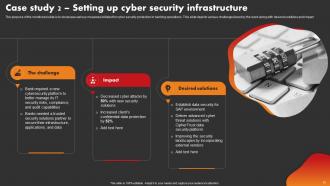
Slide 63: This slide displays various measures initiated for cyber security protection in banking operations.
Slide 64: This slide shows all the icons included in the presentation.
Slide 65: This slide is titled as Additional Slides for moving forward.
Slide 66: This slide depicts Venn diagram with text boxes.
Slide 67: This slide provides 30 60 90 Days Plan with text boxes.
Slide 68: This slide contains Puzzle with related icons and text.
Slide 69: This is an Idea Generation slide to state a new idea or highlight information, specifications etc.
Slide 70: This slide presents Roadmap with additional textboxes.
Slide 71: This is a Thank You slide with address, contact numbers and email address.
Strategic Improvement In Banking Operations Powerpoint Presentation Slides with all 79 slides:
Use our Strategic Improvement In Banking Operations Powerpoint Presentation Slides to effectively help you save your valuable time. They are readymade to fit into any presentation structure.














FAQs for Strategic Improvement In Banking Operations
Honestly, start with cost-to-income ratio - that's your main efficiency gauge. Transaction processing times and error rates matter too, plus how long customers are waiting around. Digital adoption is massive since online stuff costs way less than people walking into branches. Employee productivity metrics like transactions per person are solid, and definitely track operational risk incidents because compliance issues are a nightmare. Oh, and don't go crazy tracking everything. Pick 3-4 metrics that'll actually change how people work, not just pretty numbers for meetings. The dashboard can look boring if it drives real results.
Honestly, automation is a game-changer for cutting down those annoying human mistakes in transaction processing. No more "oops I typed 1000 instead of 100" moments that make everyone panic. The system handles all the validation stuff - checking account numbers, balances, cross-referencing details - without getting tired like we do after lunch. Real-time reconciliation catches problems right away instead of you discovering them at 5pm when you're trying to leave. Processing gets way faster and accuracy shoots up to like 99%+. I'd start with whatever transactions happen most often and cause the biggest headaches - that's where you'll see the best ROI.
Look, customer complaints are gold - they tell you exactly what's broken instead of you guessing. People griping about wait times? That's your cue to fix scheduling. Confusing processes making everyone mad? There's your next project right there. I always think it's wild how businesses ignore this stuff when customers are basically doing free consulting work. Start tracking complaints systematically and match them to actual workflow problems. If half your customers hate how long account setup takes, boom - that's priority number one. Way better than fixing random things that don't actually bug anyone.
Honestly, real-time risk detection is pretty straightforward once you get the hang of it. Monitor your transaction flows and watch for weird customer behavior shifts - sudden loan default spikes, sketchy transaction patterns, that kind of stuff. Historical data's your best friend here because it'll show you what usually happens before things go sideways. Build some dashboards to track your main risk metrics daily. Machine learning can auto-flag the weird outliers, which saves you tons of time. I'd probably start with just credit risk though - don't try to boil the ocean right away. You can always add more later.
Map out your whole process first - that's where you'll spot the worst bottlenecks. Then hit these three things: go digital with applications (online uploads, e-signatures, the works), automate credit checks and doc verification, and build clear approval workflows. Automated underwriting handles about 70% of straightforward apps without anyone touching them, which is honestly pretty sweet. The back-and-forth paperwork thing kills so much time it's not even funny. Set up communication checkpoints too so customers aren't constantly calling to ask "what's happening with my application?" Start with whatever's slowing you down most.
Honestly, digital transformation is a game changer for customer service. AI chatbots handle the boring FAQ stuff instantly. Your team gets freed up for actual complex problems. The routing systems are pretty smart too - they figure out which department customers need without that annoying phone tree thing. What's cool is the data side - you can actually predict what people want before they ask. Mobile apps let customers do most things themselves now, which they seem to prefer anyway. Just don't go overboard with flashy features that nobody uses. Focus on fixing real problems your customers complain about.
Honestly, start with automating the boring stuff - account opening, loan processing, all that routine paperwork. Frees up your people for actual customer conversations. Digital-first is where it's at right now. Close those branches that aren't pulling their weight and throw in some self-service kiosks instead. Cross-train your team so you're not scrambling during busy periods (learned that one the hard way). Oh, and definitely renegotiate those vendor contracts - I swear companies just auto-renew hoping you won't notice. Pick one thing, see how it goes, then expand from there.
Ugh, regulatory changes are such a headache initially - you're stuck redesigning processes, upgrading systems, retraining everyone. But honestly? Most companies end up way more efficient afterward. All that forced modernization actually streamlines your workflows and automates stuff you should've automated ages ago. Better data management, stronger risk controls, the whole nine yards. The smart move is getting ahead of these trends while your competitors are still panicking about compliance deadlines. I know it sounds backwards, but try thinking of each new regulation as a chance to finally fix those clunky processes you've been putting off.
Look, breaking down silos is huge - when IT actually talks to customer service and branch people, they spot problems nobody else sees. You'll get way better ideas too. Like yesterday our marketing girl was like "why does opening an account take three damn days?" and honestly, good point. Different perspectives just hit different, you know? Teams start questioning dumb processes when they're not stuck in their own bubbles. What works really well is doing monthly "process jams" where departments pick one banking thing that sucks and just... fix it together. Fresh eyes catch stuff that's been broken forever.
So you can use ML algorithms to spot transaction patterns in real-time that human analysts totally miss. These models learn from old fraud cases and customer habits - they catch weird stuff like unusual spending locations, sketchy amounts, or strange timing. Honestly, it's crazy how good they've gotten recently. Instead of just reacting to fraud, you're actually catching it before it blows up. Feed them quality data and keep training on new scams. Oh, and start with ML scoring on your riskiest transactions first - don't try to do everything at once.
Honestly, legacy systems are your biggest headache - banks run on infrastructure from like the 90s that fights every modern update. Security's insane too, way beyond what other companies deal with. Every single thing gets picked apart by compliance teams for months. Training older staff is brutal when they've used the same processes forever. Costs spiral fast. I'd say start with small pilots in departments that won't break everything if something goes wrong. Work out the bugs there first, then expand. Way less stressful than going all-in immediately.
Honestly, remote work has been pretty solid for most banking operations. Studies show 15-25% efficiency gains without commutes and office chaos. Data processing and loan reviews actually go smoother at home. Collaboration is trickier though - Zoom calls get exhausting fast. But turnaround times are better and people aren't quitting as much since work-life balance improved. You'll need decent digital tools and regular team check-ins. Oh, and definitely compare your current numbers to pre-2020 stuff. That's the only way you'll know if it's actually working for your specific setup or not.
Honestly, most banks think their disaster plans are solid until everything actually falls apart. You'll want to set up data centers in different locations so if one crashes, the backup kicks in automatically. But here's what really matters - test this stuff every few months with real scenarios, not just some checklist nobody follows. Staff need crystal clear instructions on who to call and what to do. Short sentences work. Longer communication protocols should flow naturally when people are panicking. I'd start by looking at your current plan this month. Find the biggest holes before they find you.
So your bank's probably already doing agile somewhere - it's how places stay competitive these days. Teams break big projects into quick sprints, which is smart because fintech moves crazy fast. When regulations shift or customers hate something, you can actually pivot instead of being stuck. Product development, compliance stuff, whatever - it just works better. The whole iterative testing thing means way less risk too. Plus you get new services out the door faster, which honestly should've happened years ago in banking. If you're not doing it yet, just try one small pilot project first.
So basically CRM puts all your customer info in one spot instead of having it scattered everywhere. Your team won't waste time digging around for account history or past complaints - it's all right there. Honestly, customers hate repeating their story to five different people anyway. You'll start noticing patterns too, like which issues come up most or what customers actually want. The best part? Your staff can focus on solving problems instead of playing detective with spreadsheets. Makes everything faster and keeps people happier.
-
Helpful product design for delivering presentation.
-
One-stop solution for all presentation needs. Great products with easy customization.