Strategic Meeting Pre Work Agenda

Rating:
90%
Strategic Meeting Pre Work Agenda Strategic Meeting Pre Work Agenda
Slide 1 of 9

or

Favourites Favourites

Try Before you Buy Download Free Sample Product

Audience Impress Your
Audience
Editable 100%
Editable
Time Save Hours
of Time
The Biggest Sale is ending soon in
0
0
:
0
0
:
0
0
Rating:
90%
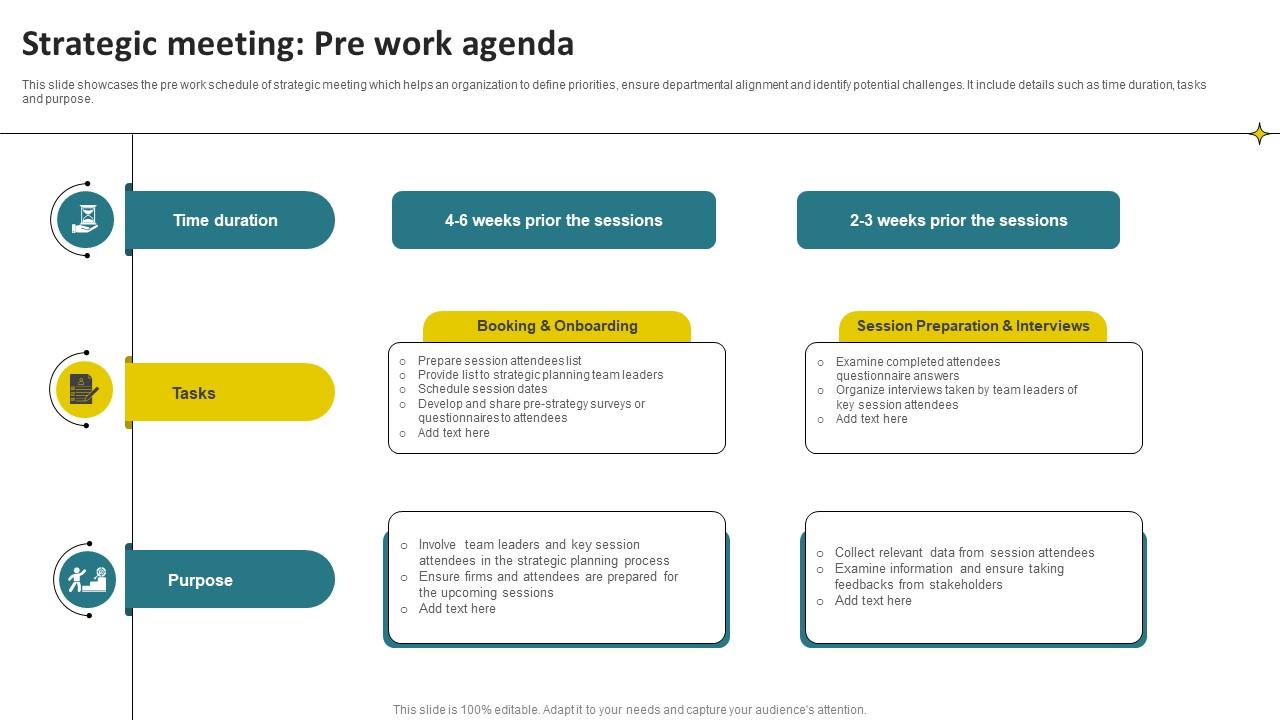
This slide showcases the pre work schedule of strategic meeting which helps an organization to define priorities, ensure departmental alignment and identify potential challenges. It include details such as time duration, tasks and purpose. Presenting our set of slides with Strategic Meeting Pre Work Agenda. This exhibits information on three stages of the process. This is an easy to edit and innovatively designed PowerPoint template. So download immediately and highlight information on Time Duration, Tasks, Purpose.

FAQs for Strategic Meeting

Key components of an effective strategic planning process include environmental analysis, vision and mission development, goal setting, strategy formulation, and implementation planning. These elements work together by assessing market conditions, defining organizational direction, and creating actionable roadmaps, with many organizations finding that this comprehensive approach delivers sustainable competitive advantage and measurable growth outcomes.

Organizations align strategic goals with their mission and vision by establishing clear connections between daily operations and overarching purpose, conducting regular alignment assessments, and cascading objectives through all organizational levels. This strategic integration enables companies across sectors like healthcare, manufacturing, and financial services to maintain focused decision-making, optimize resource allocation, and ultimately deliver consistent outcomes that reinforce their core identity while driving competitive advantage.

Stakeholder feedback provides critical insights into market needs, operational challenges, and strategic opportunities, helping organizations align their plans with real-world expectations and requirements. Through surveys, interviews, and collaborative sessions, companies gather diverse perspectives from customers, employees, and partners, enabling more informed decision-making and ultimately delivering strategies with broader buy-in and higher success rates.

Data analytics enhances strategic planning effectiveness by providing evidence-based insights, identifying market trends, predicting customer behavior, and measuring performance against objectives. Through advanced analytics tools, organizations streamline decision-making processes, minimize risks, and optimize resource allocation, with companies in retail and financial services finding significantly improved forecasting accuracy and competitive positioning.

Organizations should avoid unclear vision statements, lack of stakeholder involvement, unrealistic timelines, insufficient resource allocation, and poor communication throughout the process. These pitfalls often derail strategic initiatives in sectors like healthcare and manufacturing, with successful companies finding that regular progress reviews, cross-departmental collaboration, and flexible adaptation ultimately deliver stronger competitive positioning and operational efficiency.

Organizations should revisit strategic plans quarterly for progress assessment and annually for comprehensive revision, though dynamic markets may require more frequent adjustments. Many successful companies combine regular quarterly reviews with annual strategic overhauls, enabling them to adapt to market changes, capitalize on emerging opportunities, and maintain competitive advantage in increasingly volatile business environments.

Effective strategic planning tools include SWOT analysis, Porter's Five Forces, balanced scorecards, scenario planning, and OKRs (Objectives and Key Results). These frameworks enhance decision-making by providing structured analysis, competitive insights, and measurable goals, with many organizations finding that strategic combinations of these tools streamline resource allocation and ultimately deliver sustainable competitive advantage.

External factors significantly influence strategic planning by shaping market opportunities, resource allocation decisions, competitive positioning strategies, and risk management approaches. Through continuous environmental scanning, organizations adapt their strategic frameworks to capitalize on emerging trends, navigate economic volatility, and maintain competitive advantage, with many companies finding that flexible planning processes enable faster responses to market shifts and ultimately deliver sustained growth.

Technology streamlines strategic planning through data analytics platforms, collaborative planning software, scenario modeling tools, real-time dashboards, and automated reporting systems. These solutions enhance decision-making by providing deeper market insights, enabling cross-functional collaboration, and accelerating plan adjustments, with many organizations finding that integrated planning technologies deliver faster strategic responses and improved competitive positioning.

Organizations ensure strategic plan adaptability by implementing flexible frameworks, regular review cycles, scenario planning, cross-functional collaboration, and continuous market monitoring. Through agile methodologies and quarterly assessments, companies like Netflix and Amazon pivot strategies based on emerging trends, competitive shifts, and customer feedback, ultimately maintaining competitive advantage while minimizing risks in increasingly dynamic business environments.

Setting measurable objectives provides clear performance benchmarks, enables progress tracking, facilitates resource allocation, and ensures accountability across organizational levels. Through quantifiable metrics, companies can assess strategic effectiveness, make data-driven adjustments, and demonstrate ROI to stakeholders, with many organizations finding that measurable goals significantly enhance execution success and competitive positioning.

Companies integrate risk management into strategic planning by conducting comprehensive risk assessments during planning phases, embedding risk considerations into decision-making frameworks, and establishing continuous monitoring systems. This strategic combination enables organizations to anticipate market volatility, regulatory changes, and operational disruptions while maintaining competitive positioning, with many finding that proactive risk integration ultimately delivers more resilient business models and sustainable growth.

Strategies include leadership modeling, regular strategic workshops, cross-functional collaboration, scenario planning exercises, and embedding strategic metrics into performance reviews. These approaches enhance organizational agility by encouraging long-term thinking, breaking down silos, and aligning teams with broader objectives, with many companies finding that strategic thinking becomes ingrained when employees see direct connections between their roles and competitive advantage.

Successful organizations measure strategic plan success through key performance indicators, milestone tracking, financial metrics, customer satisfaction scores, and employee engagement levels. These measurement frameworks enable companies to assess progress quarterly, identify performance gaps, and adjust strategies dynamically, with many finding that regular evaluation cycles ultimately deliver improved operational efficiency and sustained competitive advantage.

Leadership drives strategic plan execution through clear communication, resource allocation, decision-making authority, and performance accountability across organizational levels. Effective leaders align teams with strategic objectives, navigate implementation challenges, and maintain momentum through change management, with many organizations finding that strong leadership commitment directly correlates with successful strategic outcomes and competitive advantage.

Ratings and Reviews

90% of 100
Review Form
Write a review
Most Relevant Reviews
  1. 80%

    by Edwardo Wheeler

    Great experience, I would definitely use your services further.
  2. 100%

    by Dalton Aguilar

    I loved the hassle-free signup process. A few minutes and, I had this giant collection of beautiful designs.

2 Item(s)

per page: