


Strategic Plan For Company Growth And Improvement Strategy CD V




Try Before you Buy Download Free Sample Product
 Impress Your
 Audience
 100%
100% Editable
 Save Hours
 of Time


A business growth strategy refers to a set of plans and actions designed to help a business achieve a goal, like achieving sustainable and profitable growth over the long term. Grab our Strategic Plan for Company Growth and Improvement template. It can help any business expand its customer base to increase its revenue and help to compete more effectively with other companies in the industry. Our Market Development and Penetration deck showcases an overview of business growth strategy describing its need and factors affecting it. The PPt also showcases various business growth strategies, including market development, market penetration, market disruption, product expansion, etc. It then highlights key steps to develop growth strategies for business. Further, our Market Disruption module outlines timelines to achieve goals. It also presents examples of successful growth strategies, like promotion, viral loops, pricing, quality, word of mouth, etc. Lastly, our Strategic Partnership PowerPoint presentation outlines future outlook and trends for growth strategies. Access this insightful resource right away.
People who downloaded this PowerPoint presentation also viewed the following :
Content of this Powerpoint Presentation
Slide 1: This slide introduces Strategic Plan for Company Growth and Improvement. Commence by stating Your Company Name.
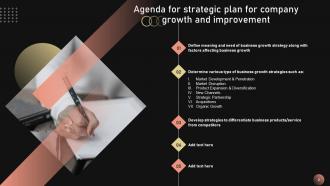
Slide 2: This slide depicts the Agenda of the presentation.
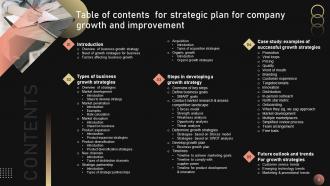
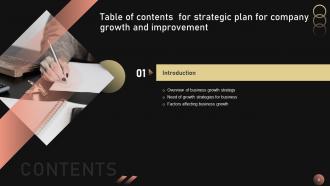
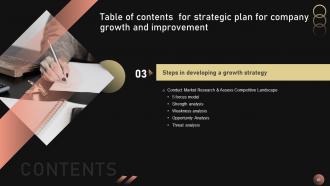
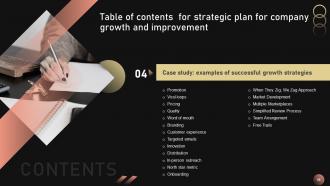
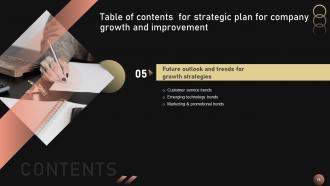
Slide 3: This slide incorporates the Table of Contents.
Slide 4: This slide highlights the Title for the Topics to be covered further.
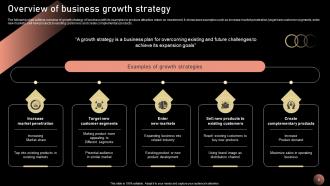
Slide 5: The following slide outlines overview of growth strategy of business with its examples to produce attractive return on investment.
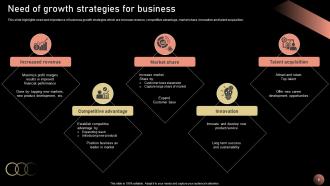
Slide 6: This slide exhibits the Need of growth strategies for business.
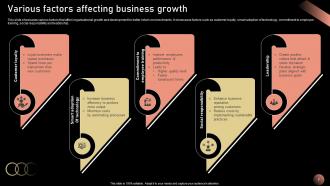
Slide 7: This slide showcases various factors that affect organizational growth and development for better return on investments.
Slide 8: This slide indicates the Heading for the Contents to be discussed next.
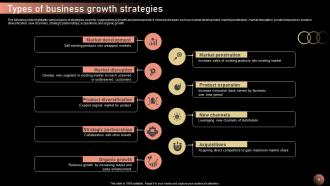
Slide 9: The following slide highlights various types of strategies used for organizational growth and development.
Slide 10: This slide depicts the Title for the Ideas to be covered further.
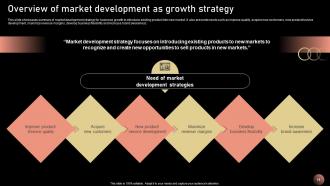
Slide 11: This slide showcases summary of market development strategy for business growth to introduce existing product into new market.
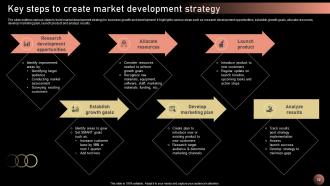
Slide 12: The slide outlines various steps to build market development strategy for business growth and development.
Slide 13: This slide reveals the Heading for the Ideas to be discussed next.
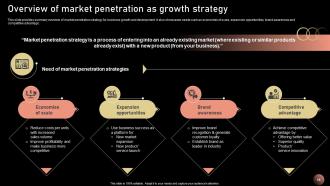
Slide 14: This slide presents the Overview of market penetration as growth strategy.
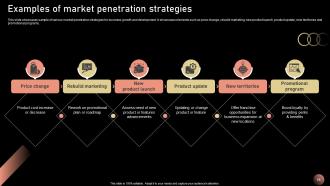
Slide 15: This slide showcases sample of various market penetration strategies for business growth and development.
Slide 16: This slide describes the Market penetration rate calculation.
Slide 17: This slide represents the TItle for the Contents to be covered further.
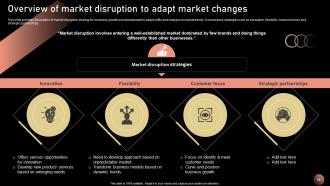
Slide 18: This slide provides description of market disruption strategy for business growth and development to adapt shifts and changes in market trends.
Slide 19: This slide highlights various factors showing impact of market disruption on business for growth and development.
Slide 20: This slide includes the Heading for the Topics to be discussed next.
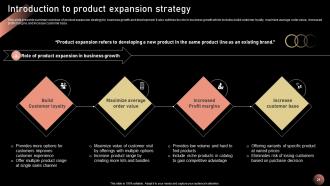
Slide 21: This slide presents summary overview of product expansion strategy for business growth and development.
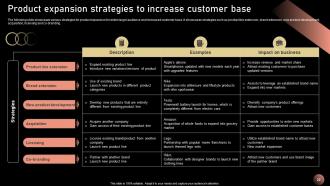
Slide 22: This slide depicts various strategies for product expansion for wider target audience and increased customer base.
Slide 23: This slide portrays the Title for the Topics to be covered in the following template.
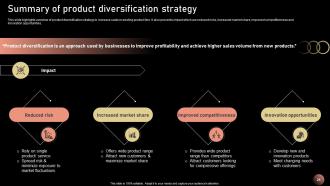
Slide 24: This slide highlights overview of product diversification strategy to increase sales in existing product line.
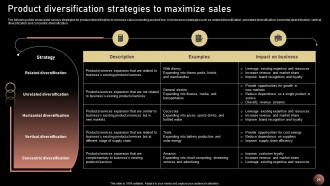
Slide 25: This slide talks about the Product diversification strategies to maximize sales.
Slide 26: This slide contains the Heading for the Contents to be discussed further.
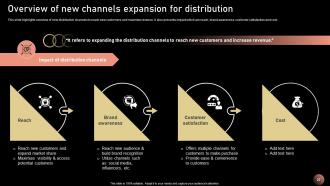
Slide 27: This slide highlights the overview of new distribution channels to reach new customers and maximize revenue.
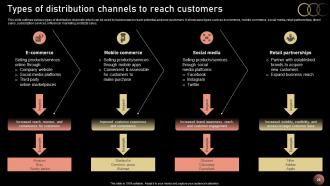
Slide 28: This slide outlines various types of distribution channels which can be used by businesses to reach potential and new customers.
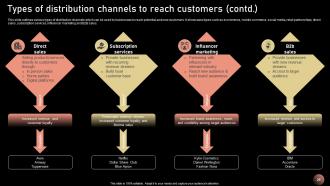
Slide 29: This slide states various types of distribution channels which can be used by businesses to reach potential and new customers.
Slide 30: This slide displays the Title for the Ideas to be covered next.
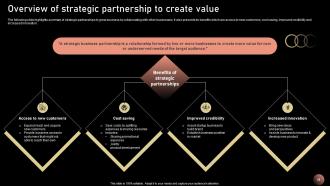
Slide 31: The following slide highlights summary of strategic partnerships to grow business by collaborating with other businesses.
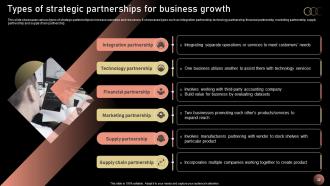
Slide 32: This slide showcases various types of strategic partnerships to increase expertise and resources.
Slide 33: This slide inlcudes the Heading for the Ideas to be discussed further.
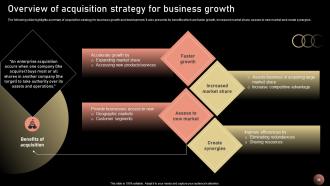
Slide 34: The following slide highlights summary of acquisition strategy for business growth and development.
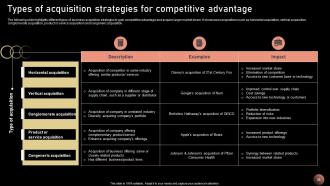
Slide 35: This slide shows different types of business acquisition strategies to gain competitive advantage and acquire larger market share.
Slide 36: This slide exhibits the Title for the Contents to be covered in the upcoming template.
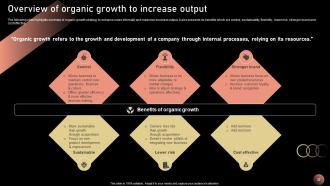
Slide 37: This slide showcases the Overview of organic growth to increase output.
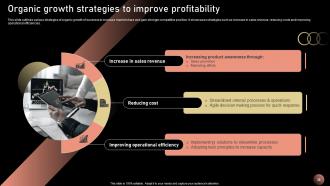
Slide 38: This slide displays the Organic growth strategies to improve profitability.
Slide 39: This slide reveals the Heading for the Topics to be discussed further.
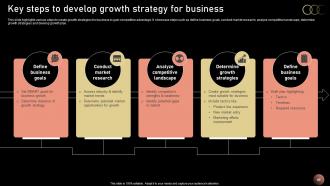
Slide 40: This slide highlights various steps to create growth strategies for business to gain competitive advantage.
Slide 41: This slide depicts the Title for the Topics to be covered in the next template.
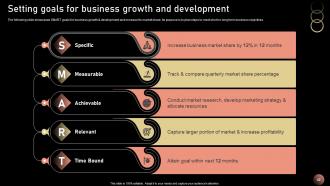
Slide 42: The following slide showcases SMART goals for business growth & development and increase its market share.
Slide 43: This slide includes the Heading for the Contents to be discussed further.
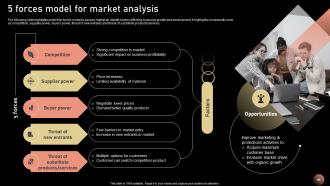
Slide 44: This slide incorporates the 5 forces model for market analysis.
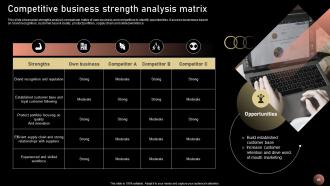
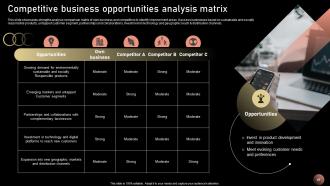
Slide 45: This slide showcases strengths analysis comparison matrix of own business and competitors to identify opportunities.
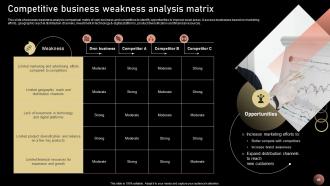
Slide 46: This slide reveals the Competitive business weakness analysis matrix.
Slide 47: This slide states strengths analysis comparison matrix of own business and competitors to identify improvement areas.
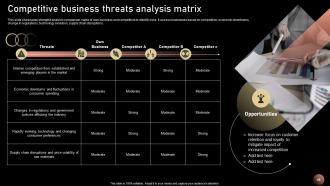
Slide 48: This slide portrays the strengths analysis comparison matrix of own business and competitors to identify risks.
Slide 49: This slide displays the Title for the Ideas to be covered in the following template.
Slide 50: The following slide outlines various business improvement strategies.
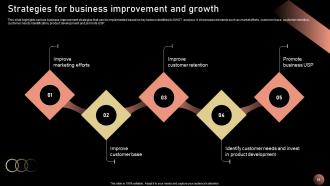
Slide 51: This slide highlights various business improvement strategies that can be implemented based on key factors identified in SWOT analysis.
Slide 52: This slide exhibits the Heading for the Ideas to be discussed further.
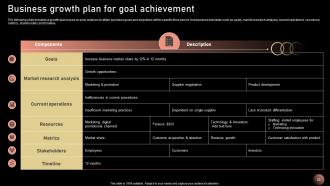
Slide 53: This slide presents a growth plan based on prior analysis to attain business goals and objectives within specific time period.
Slide 54: This slide reveals the Title for the Contents to be covered in the upcoming template.
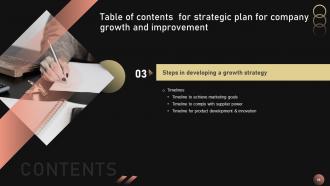
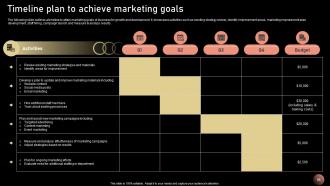
Slide 55: The following slide outlines a timeline to attain marketing goals of business for growth and development.
Slide 56: This slide shows a timeline to attain supplier performance management goals of business for growth and development.
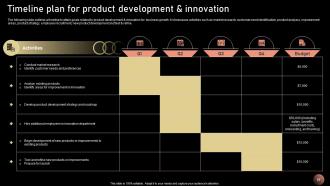
Slide 57: This slide represents the Timeline plan for product development & innovation.
Slide 58: This slide indicates the Heading for the Topics to be discussed next.
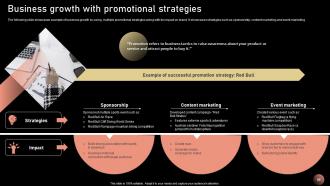
Slide 59: This slide states the Business growth with promotional strategies.
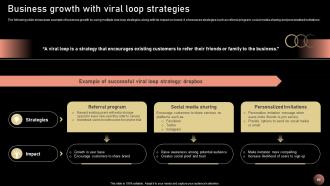
Slide 60: The following slide showcases example of business growth by using multiple viral loop strategies along with its impact on brand.
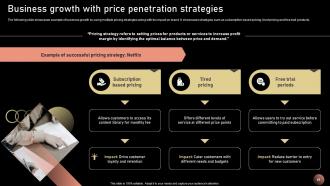
Slide 61: This slide presents example of business growth by using multiple pricing strategies along with its impact on brand.
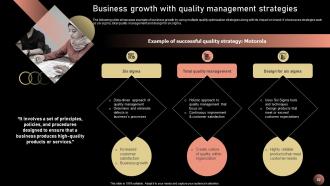
Slide 62: This slide exhibits the Business growth with quality management strategies.
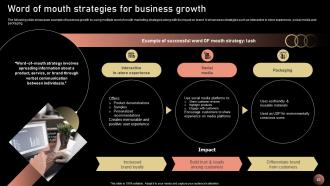
Slide 63: This slide depicts example of business growth by using multiple word of mouth marketing strategies along with its impact on brand.
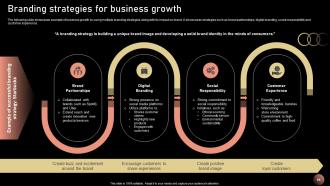
Slide 64: This slide talks about the Branding strategies for business growth.
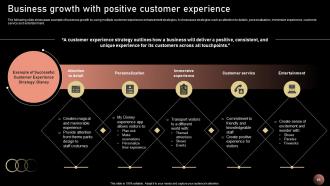
Slide 65: The following slide showcases example of business growth by using multiple customer experience enhancement strategies.
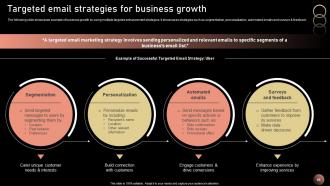
Slide 66: Thisslide mentions example of business growth by using multiple targeted enhancement strategies.
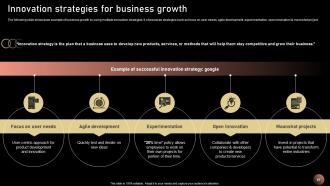
Slide 67: This slide focuses on the Innovation strategies for business growth.
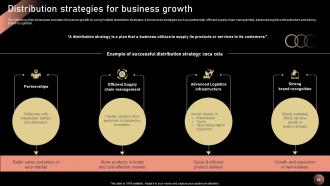
Slide 68: This slide displays the Distribution strategies for business growth.
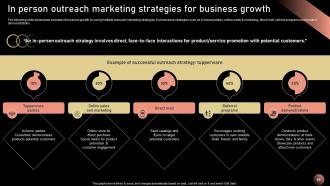
Slide 69: The following slide showcases example of business growth by using multiple outreach marketing strategies.
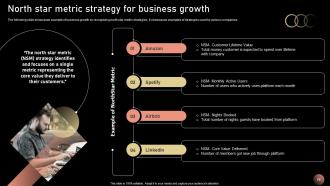
Slide 70: This slide highlights example of business growth by recognizing north star metric strategies.
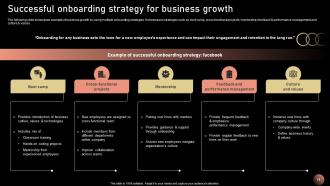
Slide 71: The following slide presents example of business growth by using multiple onboarding strategies.
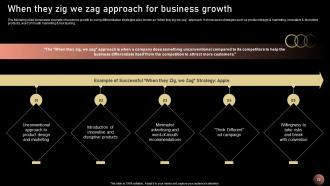
Slide 72: This slide shows example of business growth by using differentiation strategies, known as “when they zig we zag” approach.
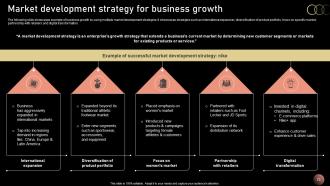
Slide 73: This slide emphasizes on the Market development strategy for business growth.
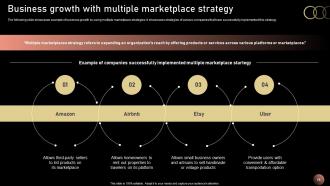
Slide 74: The following slide portrays example of business growth by using multiple marketplace strategies.
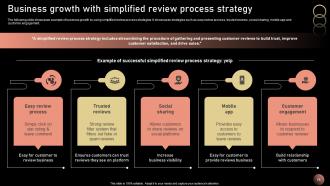
Slide 75: This slide reveals example of business growth by using simplified review process strategies.
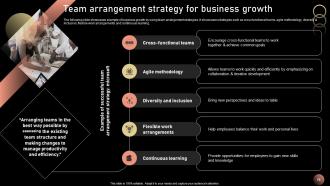
Slide 76: This slide exhibits example of business growth by using team arrangement strategies.
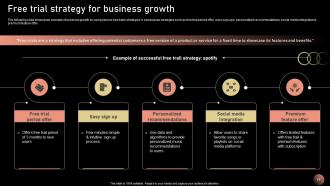
Slide 77: This slide mentions about the Free trial strategy for business growth.
Slide 78: This slide depicts the Title for the Topics to be covered next.
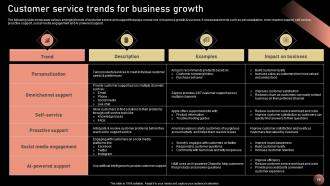
Slide 79: The following slide showcases various emerging trends of customer service and support that plays crucial role in business growth & success.
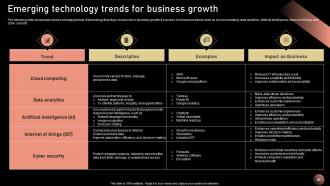
Slide 80: This slide deals with Emerging technology trends for business growth.
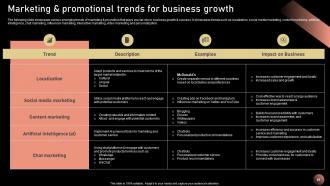
Slide 81: This slide states various emerging trends of marketing & promotion that plays crucial role in business growth & success.
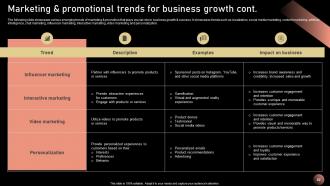
Slide 82: This slide displays various emerging trends of marketing & promotion that plays crucial role in business growth & success.
Slide 83: This is the Icons slide containing all the Icons used in the plan.
Slide 84: This slide is used for depicting some Additional information.
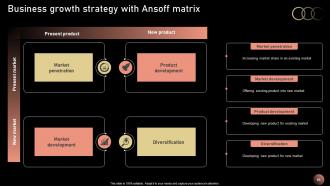
Slide 85: This slide presents the Business growth strategy with Ansoff matrix.
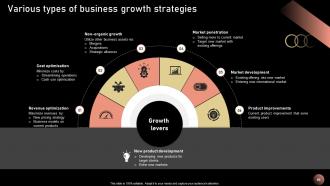
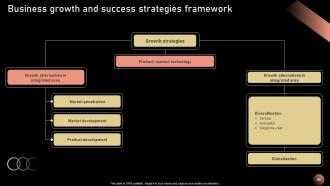
Slide 86: This slide states the Various types of business growth strategies.
Slide 87: This slide reveals the Business growth categories for effective decision making.
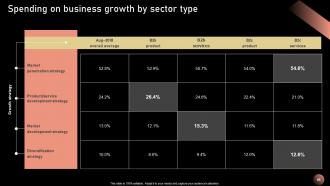
Slide 88: This slide focuses on Spending on business growth by sector type.
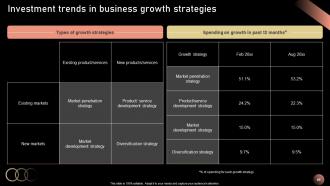
Slide 89: This slide illustrates the Investment trends in business growth strategies.
Slide 90: This slide depicts the Heading for the Contents to be discussed further.
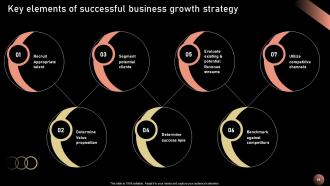
Slide 91: This slide portrays the Key elements of successful business growth strategy.
Slide 92: This slide presents the company's mission, Vision, and Goal.
Slide 93: This is the About us slide. State your organization-related information here.
Slide 94: This slide includes the firm's Timeline.
Slide 95: This slide presents the Mind map.
Slide 96: This is the Idea generation slide for encouraging fresh ideas.
Slide 97: This is Meet our team slide. State your team-related information here.
Slide 98: This slide represents the Column chart.
Slide 99: This is the Line chart slide.
Slide 100: This slide elucidates information related to the Financial topic.
Slide 101: This slide contains the Post it notes for reminders and deadlines.
Slide 102: This is the Thank You slide for acknowledgement.
Strategic Plan For Company Growth And Improvement Strategy CD V with all 97 slides:
Use our Strategic Plan For Company Growth And Improvement Strategy CD V to effectively help you save your valuable time. They are readymade to fit into any presentation structure.














FAQs for Strategic Plan For Company Growth And Improvement
Start with market analysis - who are your actual customers and what do competitors look like? Be brutally honest about what you're actually good at (not what you wish you were good at). Money's obviously a factor since growth isn't free upfront. Can your team and systems even handle more demand without breaking? That's the operational stuff nobody thinks about until it's too late. Timeline matters too - going aggressive vs. sustainable are completely different games. Honestly, I'd map this stuff out first before you get into the weeds with tactics. Way easier than backtracking later.
Honestly, trends are everything when you're planning growth. They show you where the real opportunities are hiding - and what's about to bite you in the ass if you're not paying attention. Watch how consumers are changing, what new tech is popping up, how your competitors are moving. That's how you decide which markets are worth your time. I learned this the hard way actually - you can't just wing it and hope things work out. Spot the shifts early (demo changes, regulations, whatever) then move your resources there. Set up some kind of regular monitoring system so you're not scrambling to catch up later.
Look, customer feedback is pure gold when you're trying to grow your business. It literally shows you where to put your money and energy. Their complaints? Those are your biggest opportunities waiting to happen. The stuff they love tells you what's already crushing it so you can do more of that. Why guess what people want when they're straight up telling you? Makes zero sense. When you're planning growth goals, let that feedback guide everything - which products to expand, new markets to hit, all of it. Don't just collect feedback and forget about it though. Actually use it in your strategy planning from day one.
Look at the usual suspects - revenue growth, customer acquisition, market share, profit margins. But here's the thing: you can't just live in spreadsheets. Pipeline health and customer satisfaction scores actually tell you what's coming next, which is way more useful than staring at last month's numbers. Oh, and employee engagement matters more than people think - unhappy teams kill performance fast. Set real targets upfront so you're not making stuff up later. I check mine monthly but only tweak strategy quarterly. Otherwise you'll drive yourself crazy changing directions every week.
Stick to what makes you different - trying to please everyone is a recipe for disaster. Customer retention beats acquisition every time since it's way cheaper. Partnerships are clutch if you build them early. Get your customers creating content for you (saves money on marketing tbh). Set up feedback systems so you can change direction fast when stuff isn't working. I can't stress this enough - know your unit economics inside out. If you don't know what it costs to get a customer vs what they're worth over time, you're basically gambling. Too many founders get obsessed with flashy numbers that don't actually matter for long-term growth.
You literally can't scale products without scaling operations - learned this the hard way watching startups implode. Your systems need to grow with your product line, otherwise you'll have angry customers and total internal mayhem. Plan both at the same time, not separately. Before committing to any launch date, map out what operational changes each product needs. Maybe that's more staff, better systems, whatever. The companies that treat these as separate projects? They crash hard. Oh and don't underestimate how much complexity each new product actually adds - it's always more than you think.
Dude, aggressive growth can totally screw you over if you're not careful. Cash flow dries up fast, your operations turn into a nightmare, and quality goes out the window. I've watched companies crash because they scaled way faster than their systems could keep up - it's brutal. Build solid processes first, keep plenty of cash on hand, and hire key people before you desperately need them. Oh, and track your quality metrics religiously throughout the whole thing. Seriously don't sacrifice your foundation just to grow faster.
Honestly, digital marketing is like having a superpower for growing your business. You can track everything (which is weirdly addictive once you start) and target exactly who you want to reach. Way cheaper than old-school advertising too. Here's what I'd do - pick maybe 2 or 3 places where your customers actually spend time online. Instagram, email, whatever. Don't spread yourself thin trying to be everywhere because you'll just suck at everything. Master those first, then branch out. The data alone will blow your mind compared to just hoping your newspaper ad worked.
So basically, M&A lets you skip the whole "build from scratch" thing and jump straight into new markets or snag competitors' customers. Way faster than organic growth, which takes forever. You're talking about transforming your business in months instead of years. The cost savings sound great on paper, but honestly? They're way trickier to actually pull off than CFOs like to admit. Real benefit is speed and getting tech/talent that would've taken you ages to develop. Just don't sign anything without a solid integration plan - I've seen too many deals crash because nobody thought about company culture fit.
Expanding geographically is honestly one of the smartest moves for growth. You're literally opening up whole new customer bases you couldn't reach before. Different regions have different demand patterns too, so you might balance out those annoying seasonal dips. Plus you're not stuck relying on just one market - if things go south locally, you've got other areas keeping you afloat. The tricky part though? You really need to do your homework on local rules and what people actually want there. I've seen companies assume their product will work everywhere and... yeah, that doesn't always pan out great.
Set clear metrics for both timeframes first - that's non-negotiable. Don't chase quarterly wins that screw your future self over (seen this disaster too many times). Pick initiatives that give you quick wins AND build what you'll need later. Customer retention programs are perfect for this - they boost revenue now while creating relationships that last. Oh, and make a simple dashboard tracking your 90-day stuff alongside 3-year goals. Review monthly so you're not flying blind. Honestly, most people skip this step and wonder why everything feels disconnected.
Honestly, start with market size and growth - is there actually room to grow or are you just gonna be fighting over crumbs? Check out your competition too, see how intense things are. Customer acquisition cost vs lifetime value is massive - don't ignore this one. Search volume tells you a lot about demand, plus look at how existing competitors are doing. Oh, and watch out for any regulatory stuff that could mess you up later. Market penetration rates matter but I'd run some small test campaigns first before you dump a ton of money into it.
Honestly, culture trumps strategy every time. I've watched brilliant growth plans die because the company culture just wasn't there to support them. Risk-averse teams will meeting your bold ideas to death - trust me on that one. Meanwhile, companies that actually embrace change? They pivot fast when stuff doesn't work. Your people need to handle the chaos that comes with scaling too. So yeah, figure out what your culture can realistically handle first, then build around that. Otherwise you're just making pretty slides nobody will act on.
Honestly, you can't survive without innovation these days. Companies get left behind so fast - just ask Blockbuster, right? The thing is, you need new revenue streams and ways to stay efficient. Otherwise competitors will eat your lunch while you're still doing the same old stuff. What works is being systematic about it instead of just hoping ideas happen. Set aside maybe 5-10% of your budget for testing new things. Could be small improvements, could be bigger experiments. The point is making it regular, not random. You'll adapt way better to whatever the market throws at you.
Honestly, partnerships are like taking a shortcut instead of building everything yourself. You instantly tap into their customer base and distribution - stuff that would normally take forever to create. The best part? You're splitting costs and risks, which is clutch when entering new markets. It's basically borrowing their credibility while they get access to yours. Just make sure you find partners who fill your gaps rather than compete with you - that's where things get messy. I'd start by figuring out what you actually need vs. what you bring to the table.
-
One word for SlideTeam–Versatile!
-
SlideTeam is a great place for PPT templates. They have many templates on a single topic. It has made my life a lot easier.