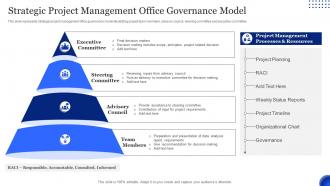
Strategic Project Management Office Governance Model
Try Before you Buy Download Free Sample Product
Audience
Editable
of Time
This slide represents strategic project management office governance model illustrating project team members, advisory council, steering committee and executive committee.
People who downloaded this PowerPoint presentation also viewed the following :
Strategic Project Management Office Governance Model with all 6 slides:
Use our Strategic Project Management Office Governance Model to effectively help you save your valuable time. They are readymade to fit into any presentation structure.
FAQs for Strategic Project Management
Honestly, start with transparency and accountability - those are your foundation. Get diverse people on your board because groupthink is real and it'll bite you. Clear roles matter too, so nobody's stepping on toes or passing the buck. Performance monitoring and risk management sound boring but they're lifesavers. Oh, and audit what you've got now first - no point building on a shaky foundation. The whole goal is creating systems that encourage good decisions instead of just putting out fires all the time. Fix your biggest gaps first, then work down the list.
So here's the deal - public sector is all about transparency and answering to taxpayers, which means everything takes forever with all these approval chains. Private companies? They're chasing profits and can make decisions way faster since they only answer to shareholders. Honestly, the speed difference will mess with your head if you switch between them. Public orgs have to justify every single decision publicly (kinda painful to watch sometimes), but private companies just pivot when the market shifts. Just prepare yourself for completely different timelines depending on which world you're in.
Honestly, tech makes governance so much less painful. Digital voting platforms are a game-changer - no more coordinating schedules for every little decision. Board portals save you from those nightmare email threads where nobody can find the latest version of anything. AI does the heavy lifting on risk monitoring and compliance stuff (though sometimes it feels like overkill). Data analytics actually help you make smarter strategic calls instead of just guessing. Blockchain keeps everything transparent, which board members love. But the real magic? Automation handles all that tedious administrative crap so you can focus on strategy that actually matters.
Stakeholders basically shape your entire governance setup. Board members set the big picture strategy, regulators tell you what you have to comply with, employees want transparency, investors want accountability. Yeah, it's like herding cats with all their different demands! But you need their input to spot risks and figure out what "good governance" actually means for your company. Their feedback creates those checks and balances that prevent things from going sideways. Don't just listen to whoever yells loudest though - make sure you're actually hearing from all the different groups regularly.
Honestly, just put your governance docs somewhere people can actually find them online. Hold public meetings regularly and write up minutes that don't sound like they were drafted by lawyers - I swear some organizations do this on purpose to confuse people. Quick feedback channels help too. Oh, and don't wait around for people to come asking questions. Post updates on a schedule so folks know what to expect. Start by looking at what you're already sharing publicly. You'll probably spot some easy fixes right away that'll make a huge difference.
Honestly, it's mostly about crappy institutions and corruption networks that don't want to give up power. These places often have weak rule of law, and their civil service just isn't equipped to handle much. Leadership changes constantly too - hard to build anything solid when there's a new government every couple years. Resources are always tight, and everyone's focused on putting out immediate fires instead of fixing the underlying mess. Oh, and transparency? Good luck with that. If you're actually working on this stuff, find local people who genuinely want change and start small. Don't try revolutionizing everything at once.
Yeah, culture totally changes how governance works. Like, Western companies love individual accountability and formal processes. Asian cultures? They're all about consensus-building - takes forever but everyone's actually on board afterward. African Ubuntu philosophy pushes participatory stuff, and those Nordic countries are obsessed with transparency (honestly, probably for the good). The thing is, you can't just steal what works for Google or whatever. Figure out your org's cultural mix first, then build around that. Short cuts don't work here.
Honestly, good corporate governance is like having your organizational house in order - it makes everything else run smoother. Better oversight means smarter decisions from your board. Companies with tight governance usually see higher ROI and less risk, which is pretty huge. The trust factor alone is massive though - stakeholders actually believe in what you're doing. Makes attracting investors and talent way easier. Oh, and your reputation gets a serious boost too. If performance is lagging, I'd start by looking at your governance gaps first. That's where the real wins are hiding.
Honestly, most companies mess this up by making everything too rigid. Start with quarterly check-ins instead of waiting for annual board meetings - way more responsive. Map out who can actually approve what when you're in a crunch, because nothing's worse than great ideas dying in committee limbo. Set up cross-functional teams that can actually move fast when the market shifts (which happens like every other week now). Oh, and document your decision-making chain clearly so people aren't constantly asking "who do I need to talk to?" Pick one bottleneck you're dealing with right now and fix that first.
Honestly, start with what "good governance" actually means for your org, then figure out how to measure it. Decision-making speed is huge - how fast does your board actually make calls? Also track stakeholder satisfaction and compliance audit results. Board attendance rates tell you a lot too, plus whether you're catching problems early (way better than playing cleanup). Financial performance matters obviously, but don't go crazy trying to measure everything - that's a rabbit hole. Pick maybe 3-4 metrics that actually align with your goals. Quality of strategic oversight is key though - are you just checking boxes or really preventing issues?
Honestly, risk management touches everything in governance - way more than you'd think. Board meetings have risk dashboards now. Strategic planning sessions too. Your oversight committees are basically built around it. Management reports on risk stuff constantly, and audit functions connect straight back to governance rules. Here's what I'd do: map out your current risk processes first. See where they already overlap with governance. I bet you'll find tons of connections you didn't notice before. The board uses those risk assessments for policy decisions all the time.
Honestly? Your governance setup will make or break sustainability efforts. I've watched companies with weak boards turn CSR into total fluff - just pretty reports that nobody reads. Strong oversight changes everything. You need structures that actually tie ESG performance to exec pay and give stakeholders real input. Transparent reporting matters too, obviously. Bad governance means your sustainability programs get starved of resources while looking good on paper. Start by looking at how your current structure either supports or sabotages these goals. It's usually pretty obvious once you dig in.
Ok so basically you need multiple people watching each other - separation of duties, regular audits, that whole thing. Map out who approves what right now because I bet you'll find some sketchy concentration of power. Independent boards help a ton, plus whistleblower protections (though honestly, some people will always find loopholes). The goal is preventing any single person from controlling critical stuff. Set up transparent processes where decisions get multiple sign-offs. Ethics training doesn't hurt either, even if it feels like corporate busy work sometimes.
Your leadership style totally shapes how well governance works - I've seen this play out so many times. Too controlling and you'll crush innovation, plus miss out on good ideas from your team. But if you're too hands-off, accountability goes out the window. What works best? Leaders who set clear expectations but actually listen to people. Honestly, it's kind of obvious when you think about it. This affects everything - decision-making, conflict resolution, whether anyone follows policies. Ask your team for honest feedback about your current approach.
Honestly, AI decision-making is everywhere now, and ESG reporting isn't optional anymore - it's becoming legally required in most places. Stakeholder capitalism is finally going mainstream too. The weird part? We're seeing these distributed governance models like DAOs that sounded totally insane just a few years ago. Boards are way younger and more diverse, which is definitely shaking things up. Real-time transparency through digital platforms is huge. My take? You should probably start learning governance tech platforms now. Manual processes are dying fast, and you don't want to get left behind.
-
“There is so much choice. At first, it seems like there isn't but you have to just keep looking, there are endless amounts to explore.”
-
“Easy to use. I always wanted to have a quick search for products and SlideTeam has helped me have it.”