Streamlining The Accounts Payable Workflow For Business
Try Before you Buy Download Free Sample Product
Audience
Editable
of Time
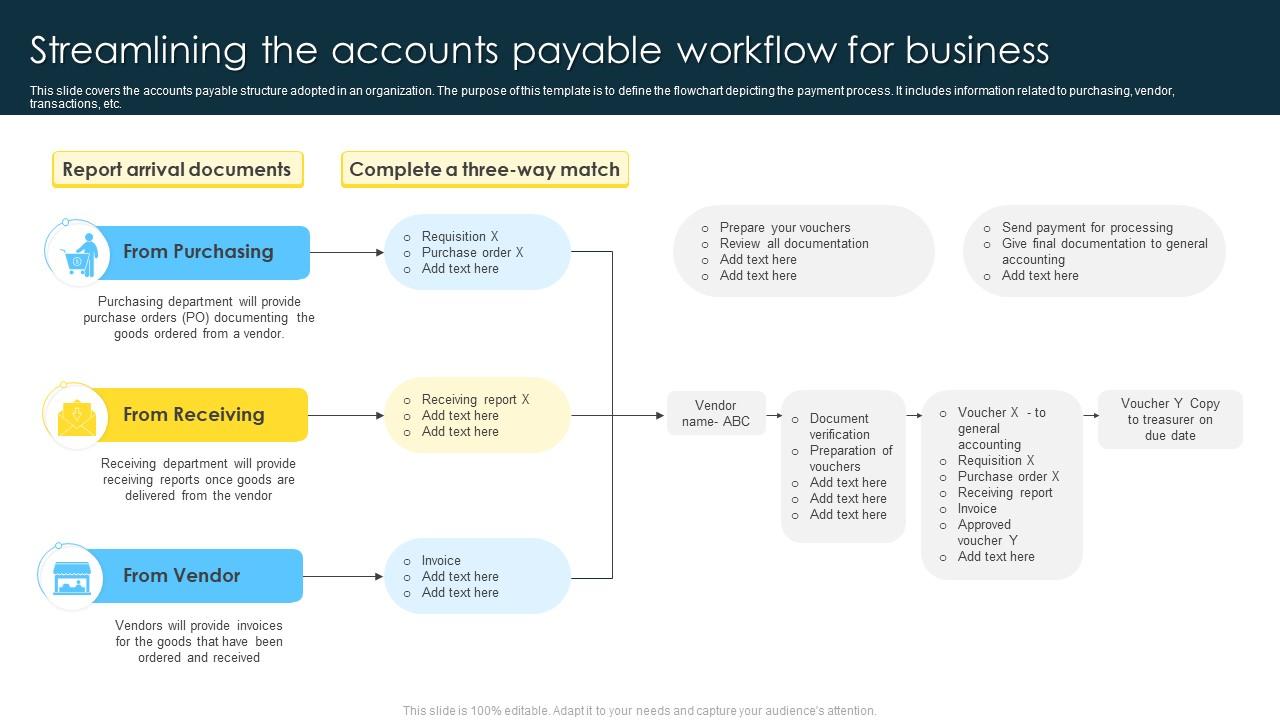
This slide covers the accounts payable structure adopted in an organization. The purpose of this template is to define the flowchart depicting the payment process. It includes information related to purchasing, vendor, transactions, etc.
People who downloaded this PowerPoint presentation also viewed the following :
Streamlining The Accounts Payable Workflow For Business with all 6 slides:
Use our Streamlining The Accounts Payable Workflow For Business to effectively help you save your valuable time. They are readymade to fit into any presentation structure.
FAQs for Streamlining The Accounts Payable
The key stages in an accounts payable workflow include invoice receipt and validation, approval routing, purchase order matching, payment processing, and record keeping. These stages streamline financial operations by automating data capture, ensuring proper authorization, and maintaining accurate audit trails, with many organizations finding that structured workflows reduce processing time by 60% while enhancing vendor relationships and cash flow management.
Automation improves accounts payable efficiency by streamlining invoice processing, reducing manual data entry, and accelerating approval workflows through digital routing systems. These technologies enable organizations to minimize processing times, reduce errors, and enhance vendor relationships, with many financial departments finding that automated solutions deliver faster payment cycles and improved cash flow visibility.
Invoice matching serves as a critical control mechanism in accounts payable workflows, involving the systematic verification of invoices against purchase orders, delivery receipts, and contracts to ensure accuracy and prevent fraud. This three-way matching process enables organizations to identify discrepancies, avoid duplicate payments, and maintain financial accuracy, while streamlining approval processes and ultimately delivering enhanced operational efficiency and stronger vendor relationships.
Organizations ensure compliance by implementing automated approval workflows, maintaining detailed audit trails, and establishing clear segregation of duties across payment processes. These controls streamline vendor verification, invoice matching, and regulatory reporting while reducing manual errors, with many companies finding that automated systems deliver faster processing, enhanced transparency, and stronger financial controls.
Common accounts payable workflow challenges include invoice processing delays, data entry errors, approval bottlenecks, vendor payment disputes, and compliance tracking difficulties. These issues often result from manual processes, disconnected systems, and unclear authorization hierarchies, with many organizations finding that streamlined automation and centralized workflows significantly reduce processing times while enhancing accuracy and vendor relationships.
Companies optimize approval processes by implementing automated workflows, establishing clear approval hierarchies, setting dynamic spending thresholds, and integrating digital documentation systems. These streamlined approaches reduce processing time, minimize manual errors, and enhance compliance tracking, with many organizations finding that automated routing and real-time visibility ultimately deliver faster vendor payments and improved cash flow management.
Key metrics include days payable outstanding, invoice processing time, cost per invoice processed, early payment discount capture rates, and supplier payment accuracy percentages. These measurements streamline financial operations by identifying bottlenecks, optimizing cash flow management, and enhancing vendor relationships, with many finance teams finding that consistent monitoring ultimately delivers reduced operational costs and improved supplier satisfaction.
Digital transformation revolutionizes accounts payable operations by automating invoice processing, enabling electronic approvals, and integrating real-time data analytics across financial systems. Through cloud-based platforms and AI-powered validation, organizations streamline vendor payments, reduce processing costs by up to 70%, and enhance cash flow visibility, while minimizing manual errors and accelerating month-end closing cycles significantly.
Emerging technologies shaping accounts payable management include artificial intelligence, robotic process automation, optical character recognition, blockchain, and cloud-based platforms. These innovations streamline invoice processing, enhance fraud detection, and automate approval workflows, with many organizations finding that strategic implementation reduces processing costs by 60-80% while delivering faster vendor payments and improved cash flow visibility.
Outsourcing accounts payable functions enables companies to reduce operational costs, access specialized expertise, improve processing accuracy, and enhance compliance management. Through dedicated AP service providers, organizations streamline invoice processing, accelerate payment cycles, and minimize errors, while freeing internal resources for strategic activities, ultimately delivering improved cash flow management and competitive operational efficiency.
Organizations can streamline accounts payable by implementing automated invoice processing, establishing centralized approval workflows, digitizing document management, setting up vendor self-service portals, and creating standardized payment schedules. These practices enhance efficiency by reducing manual data entry, accelerating approval cycles, and improving vendor relationships, with many companies finding that automation delivers faster processing times and better cash flow management.
Effective vendor management enhances accounts payable workflow by standardizing payment terms, centralizing vendor information, and automating invoice processing. Through integrated vendor portals and streamlined communication channels, organizations reduce processing delays, minimize duplicate payments, and improve cash flow management, with many companies finding that strategic vendor relationships ultimately deliver cost savings and operational efficiency.
Timely payments significantly strengthen supplier relationships by building trust, improving negotiation power for better terms, and ensuring priority service during high-demand periods. This reliability enables organizations to secure favorable pricing, extended credit terms, and preferential treatment, with many companies finding that consistent payment schedules ultimately deliver enhanced supply chain stability and competitive procurement advantages.
Data analytics enhances accounts payable decision-making by identifying payment patterns, predicting cash flow needs, and detecting duplicate invoices or fraud risks. Through predictive modeling and spend analysis, finance teams streamline vendor negotiations, optimize payment timing, and reduce processing costs, with many organizations finding that analytics-driven insights ultimately deliver improved working capital management and stronger supplier relationships.
Employee training significantly enhances accounts payable efficiency by reducing processing errors, accelerating invoice approvals, and ensuring consistent compliance with financial protocols and regulatory requirements. Well-trained teams streamline vendor communications, optimize software utilization, and implement best practices more effectively, with many organizations finding that comprehensive training programs ultimately deliver faster payment cycles, improved vendor relationships, and enhanced operational accuracy.
-
SlideTeam has helped me take my presentation to the next level. Everyone at the office is impressed! I’ll be using their designs for a long-long time.
-
“Immediate response, professional support, and effective solutions that were customized and immediately provided. Well done- Thank you!”