Succession planning template ppt sample download
Try Before you Buy Download Free Sample Product
Audience
Editable
of Time
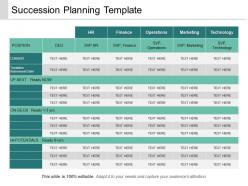
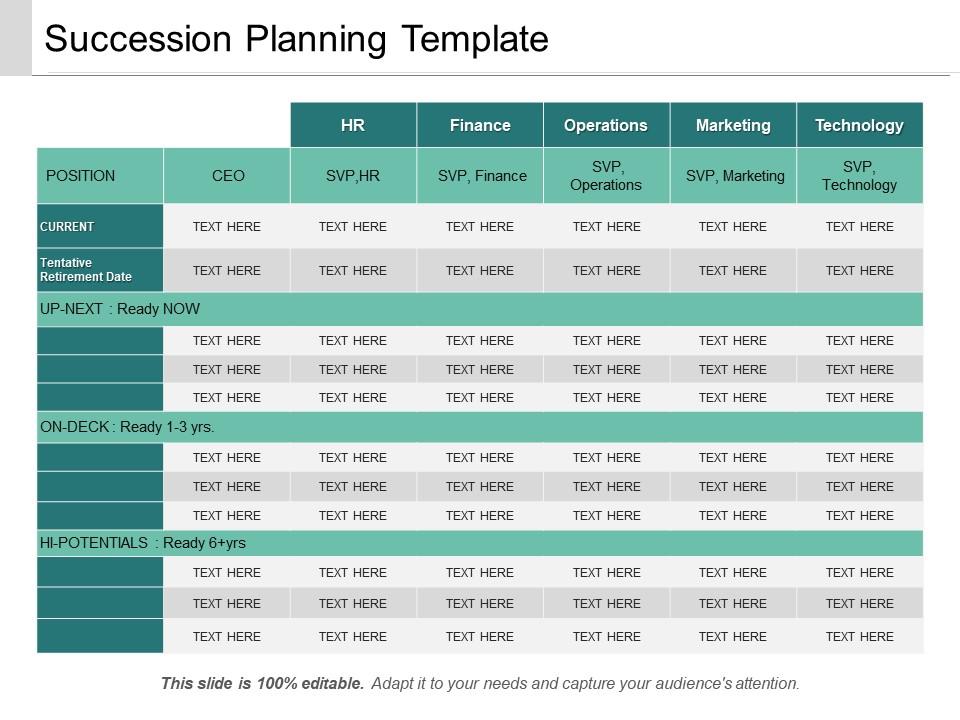
The succession planning strategy presentation slide is suitable for describing that it is the strategy for passing on leadership roles and often the company's ownership to an employee or group of employees. The succession plan PowerPoint template is perfect for a user to illustrate a set of instructions from different business departments. You can take help of the succession planning PPT slide design to describe the required consideration of questions such as who will take over, how long it will take, as well as what procedures need to pass on. Further, you can explain that it takes a lot of time as well as effort to answer those questions, this is the reason that business owners usually start planning five to six years before transition. This succession planning template for PowerPoint helps the business owner to consider different scenarios. It will direct him through steps such as choosing the successor as well as determining whether to sell the business using life insurance, an acquisition loan, or any other method to take. When you have written a plan, there is requirement to back up with a formal contract, such as a buy-sell agreement, you can share that plan with the help of the succession planning model presentation template. Appreciate the journal with our Succession Planning Template Ppt Sample Download. Give folks an incentive to buy a copy.
People who downloaded this PowerPoint presentation also viewed the following :
Succession planning template ppt sample download with all 5 slides:
Set your imagination free with our Succession Planning Template Ppt Sample Download. They will be the building blocks of your impressive presentation.
FAQs for Succession planning template
Look, you need to figure out which roles are actually critical first - not just the obvious C-suite stuff but your key tech people too. Map out who could potentially step up, then build development plans for those gaps. Document all the tribal knowledge before it walks out the door. Most companies totally botch this by waiting too long or only thinking about executives. People job-hop way more now, so update these plans regularly. Honestly though? Just start somewhere. Even a messy first draft is better than panicking when your star developer quits with two weeks notice and takes half the system knowledge with them.
Start with performance reviews, but honestly? Don't just pick your top performers - they're not always leadership material. Look for people who mentor others naturally and jump into cross-functional stuff. 360 feedback is huge here - see what their peers actually think. Give potential candidates stretch assignments or temp leadership roles. That's where you'll really see how they handle things. Coffee chats work great too for gauging interest (some people hate managing, surprisingly). Focus on how they develop others, not just their own numbers. The influence piece matters way more than individual output.
Honestly, mentorship is what actually makes succession planning work instead of just being some useless chart on the wall. You get high-potential people paired with seasoned leaders, and boom - direct knowledge transfer happens. Not just the technical stuff either, but all those unwritten leadership rules nobody talks about. Way better than dumping someone into a role and crossing your fingers. Oh, and mentors end up being great talent scouts too since they're working so closely with future leaders. Don't wait until someone's walking out the door to start matching people up.
Honestly, the best thing about using tech for succession planning is you're not digging through random spreadsheets anymore. HR platforms let you track who's crushing it, what skills people have, and where they want their careers to go. The AI stuff is actually pretty neat - it'll flag who might quit and suggest training paths. Learning systems help you build custom programs for your rising stars. Dashboard views are clutch because you can see your whole succession pipeline at a glance instead of panicking when someone leaves. Oh, and definitely check what tools you already have first before buying anything new.
Honestly, finding the right people to step up is probably your biggest headache. Leadership gets so weird about succession planning - like, why is everyone so territorial? You'll definitely kick yourself if you wait too long and someone important walks out with all their knowledge still stuck in their head. Plus there's always that "we don't have time for this right now" pushback. Knowledge transfer is brutal too since people rarely write anything down. Oh, and document stuff even when it feels pointless - trust me on that one. Better to start these conversations way earlier than you think you need to.
Honestly, succession planning is just having backup people ready for when someone quits or retires. You don't want to be totally screwed if your best manager suddenly leaves, right? Map out which roles would really hurt if they went empty - then start grooming people internally who already get your company culture. Way better than hiring some random outsider who'll take months to figure things out. Plus you keep all that knowledge and experience in-house instead of losing it forever. I learned this the hard way at my last job when our director bailed with zero notice.
Honestly, 360 feedback is your best starting point - get input from everyone who works with them. Throw them into some stretch assignments too, because that's where people either step up or completely fall apart. I've seen so many "rising stars" crumble under real pressure. Leadership assessments are solid, and maybe bring in an external coach for a fresh perspective. Watch how they develop their team members - that's the real test of whether someone can actually lead. Oh, and set up regular check-ins to track their progress against specific goals.
Track your internal fill rate first - like what percentage of leadership spots you're filling from within. Time-to-fill for critical roles matters too. But honestly? The best metric is comparing how your internal promotions perform vs external hires in year one. That'll tell you if this whole thing actually works or if you're just promoting people because they've been around forever. Don't skip retention rates for high-potential folks either. Oh, and survey people about career development - succession planning's useless if everyone wants to bail anyway. Start with 2-3 metrics quarterly.
Honestly, once a year is the absolute minimum but I'd bump it to every 6 months. Big changes like key people leaving or new hires in critical spots? That's your cue to revisit everything immediately. Career goals shift way faster than most of us realize - I've seen perfectly good succession plans become totally useless in just a few months. Leadership changes and restructuring are obvious triggers too. Oh, and definitely set a calendar reminder right now because this stuff is so easy to forget about until you actually need it.
Compliance can't be an afterthought - build it right into your succession plan from the start. Employment law stuff around promotions, tax hits from equity changes, industry regs for leadership roles. Public companies have those fun SEC disclosures too (ugh, the paperwork). Don't forget non-competes, confidentiality agreements, and whatever fiduciary duties come with the role. Oh, and get your legal and HR people involved early. Trust me on this one - way better than panicking later trying to fix everything. I've seen too many companies scramble at the last minute.
Honestly, I'd be transparent but smart about it. Talk openly about the career development stuff and general framework with everyone. But keep the specific names and timing under wraps until you're actually close to making moves - I made that mistake once and it was a total mess! Focus on how succession planning helps people grow instead of the whole "who's taking over" drama. Team meetings work great for broad updates, then do the personal career stuff in one-on-ones. You want people excited about their own path forward, not gossiping about who's getting what job next.
Honestly, culture is everything when it comes to succession planning. Good culture means people actually want to mentor others and grow into bigger roles. Toxic workplaces? Forget it - nobody's sharing knowledge when they're worried about job security. I've seen this play out so many times. Plus, your best people won't even stick around if the environment sucks, so who are you planning to promote? You need to figure out if your culture actually supports development before worrying about org charts and leadership pipelines.
Honestly, you've gotta build diversity checkpoints right into your succession pipeline from day one. Most companies mess this up by only looking at the obvious leadership candidates. Instead, cast a wider net early - find high-potential people from underrepresented groups and actually invest in developing them. Set up mentorship programs that prep diverse candidates for bigger roles. Here's the thing though - you need measurable goals and regular tracking, otherwise you'll just repeat the same demographic patterns over and over. Oh, and definitely review your advancement criteria. Sometimes they accidentally weed out exactly the fresh perspectives you need.
Honestly, the best approach mixes workshops with real mentoring and cross-department rotations. Hard skills matter - strategic planning, financials, all that stuff. But don't sleep on soft skills like communication and handling pressure. Job shadowing is incredible though, way better than any classroom training. I'm a big believer in 360-degree feedback too. Stretch assignments work great for pushing people beyond what they're comfortable with. Oh, and make it ongoing - one-and-done training is pretty useless. Pick your top 2-3 people and build custom development plans for each. That's where you'll see real results.
So here's what works: shoot for like 70-80% internal promotions, fill the rest externally. Your team will hate you if you keep bringing outsiders into leadership spots they could handle. Trust me on that one. But yeah, you still need some outside blood or everyone starts thinking the same way. Map out development paths for your best people first. Then figure out 2-3 roles where you actually need external expertise - those game-changer positions. Check your promotion numbers every quarter and ask people how they feel about growth opportunities. If someone's not quite ready yet? Invest in developing them instead of immediately posting the job online.
-
Colors used are bright and distinctive.
-
Easily Understandable slides.