Supplier Lifecycle Management Challenges And Mitigation Strategies

Rating:
100%
Supplier Lifecycle Management Challenges And Mitigation Strategies Supplier Lifecycle Management Challenges And Mitigation Strategies
Slide 1 of 9

or

Favourites Favourites

Try Before you Buy Download Free Sample Product

Audience Impress Your
Audience
Editable 100%
Editable
Time Save Hours
of Time
The Biggest Sale is ending soon in
0
0
:
0
0
:
0
0
Rating:
100%
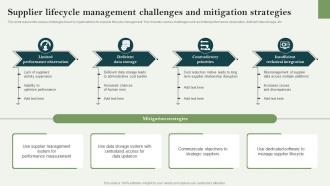
This slide represents various challenges faced by organizations for supplier lifecycle management. This includes various challenges such as limited performance observation, deficient data storage, etc. Introducing our Supplier Lifecycle Management Challenges And Mitigation Strategies set of slides. The topics discussed in these slides are Limited Performance Observation, Deficient Data Storage, Contradictory Priorities. This is an immediately available PowerPoint presentation that can be conveniently customized. Download it and convince your audience.

FAQs for Supplier Lifecycle Management Challenges

Key stages in the Supplier Lifecycle Management process include supplier identification and sourcing, qualification and onboarding, performance monitoring and evaluation, contract management and renewals, and eventual offboarding or termination. These stages streamline procurement operations by ensuring compliance, minimizing risks, and optimizing vendor relationships, with many organizations finding that structured supplier management delivers cost savings, enhanced quality control, and stronger strategic partnerships.

Organizations can effectively assess supplier performance through continuous monitoring using key performance indicators, regular scorecards, milestone reviews, compliance audits, and feedback mechanisms. These systematic approaches enable businesses to track delivery times, quality standards, cost efficiency, and relationship health across manufacturing, retail, and healthcare sectors, ultimately delivering improved supplier partnerships, reduced risks, and enhanced operational performance while maintaining competitive advantage in increasingly complex supply chains.

Essential supplier risk metrics include financial stability ratios, compliance audit scores, delivery performance rates, quality defect percentages, and cybersecurity assessment ratings. These metrics enable procurement teams to identify potential disruptions early, with manufacturing companies and healthcare organizations finding that comprehensive risk dashboards ultimately reduce supply chain vulnerabilities while enhancing operational resilience.

Technological advancements enhance Supplier Lifecycle Management by automating procurement processes, providing real-time performance analytics, and enabling predictive risk assessment through AI and machine learning algorithms. These digital tools streamline vendor onboarding, contract management, and compliance monitoring, with many organizations finding that automated workflows reduce procurement cycles by 40% while delivering improved supplier transparency and strategic cost optimization.

Data analytics improves supplier selection through performance scoring, risk assessment, cost analysis, compliance tracking, and predictive modeling capabilities. These technologies streamline procurement by identifying optimal partnerships, minimizing supply chain disruptions, and enhancing vendor relationships, with many organizations finding that analytics-driven supplier management delivers significant cost reductions and operational efficiency gains.

Collaboration enables transparent communication, shared goal alignment, and real-time information exchange between organizations and their suppliers throughout procurement, onboarding, performance monitoring, and contract renewal phases. This strategic partnership approach streamlines decision-making processes, reduces operational risks, and enhances supply chain resilience, with many manufacturing and retail companies finding that collaborative supplier relationships ultimately deliver cost savings and competitive advantage.

Companies align supplier strategies with business goals by establishing clear performance metrics, integrating supplier capabilities with strategic objectives, and conducting regular alignment reviews. Through strategic supplier segmentation, organizations can prioritize partnerships that enhance innovation, reduce costs, and improve market responsiveness, with many finding that collaborative planning sessions and shared KPIs ultimately deliver competitive advantage and operational excellence.

Supplier relationship challenges include communication gaps, performance inconsistencies, contract disputes, cultural misalignments, and evolving compliance requirements. These obstacles can be overcome through regular performance reviews, transparent communication channels, and collaborative partnership frameworks, with many organizations finding that strategic supplier development programs and digital relationship management platforms ultimately deliver stronger partnerships and enhanced operational efficiency.

Regulatory changes significantly impact Supplier Lifecycle Management by requiring enhanced compliance monitoring, updated risk assessment frameworks, and stricter documentation protocols throughout vendor relationships. Organizations must adapt their supplier onboarding, performance evaluation, and contract management processes to meet new standards, with many financial services and healthcare companies finding that proactive regulatory alignment ultimately delivers competitive advantage and reduces operational risk.

Best practices for onboarding new suppliers include comprehensive due diligence assessments, standardized documentation processes, clear performance expectations, integrated system access, and structured communication protocols. These practices streamline vendor integration by reducing onboarding time, ensuring compliance adherence, and establishing strong partnerships from day one, with many organizations finding that systematic approaches ultimately deliver enhanced supplier relationships and operational efficiency.

Organizations ensure compliance and sustainability by implementing comprehensive supplier assessment frameworks, establishing clear environmental and ethical standards, conducting regular audits, and utilizing digital monitoring tools for real-time visibility. Through strategic supplier partnerships, companies in manufacturing, retail, and pharmaceuticals streamline regulatory adherence, reduce environmental impact, and enhance transparency, ultimately delivering competitive advantage while meeting increasingly stringent stakeholder expectations.

Effective supplier negotiation strategies include leveraging data analytics for market benchmarking, building long-term partnerships, consolidating purchase volumes, and implementing competitive bidding processes. These approaches enable organizations to secure better pricing, payment terms, and service levels while maintaining quality standards, with many companies finding that strategic supplier relationships ultimately deliver cost savings and enhanced operational efficiency.

Supplier Lifecycle Management significantly enhances supply chain efficiency by optimizing vendor selection, streamlining procurement processes, and ensuring consistent performance monitoring throughout partnerships. Through strategic supplier evaluation and relationship management, organizations reduce procurement costs, minimize supply disruptions, and accelerate delivery times, with many manufacturing and retail companies finding that comprehensive supplier oversight ultimately delivers competitive advantage and operational resilience.

Common Supplier Lifecycle Management pitfalls include inadequate vendor vetting, poor contract management, limited performance monitoring, weak relationship maintenance, and insufficient risk assessment protocols. These challenges can be avoided by implementing comprehensive evaluation frameworks, automated contract tracking systems, and regular performance reviews, with many organizations finding that proactive communication and strategic supplier partnerships ultimately deliver enhanced operational efficiency and reduced supply chain vulnerabilities.

Stakeholder engagement improves supplier relationship outcomes by fostering transparent communication, aligning strategic objectives, and enabling collaborative problem-solving across procurement teams, operations, and supplier partners. Through regular stakeholder input, organizations streamline decision-making processes, reduce contract disputes, and enhance supplier performance monitoring, with many companies finding that structured engagement delivers stronger partnerships, improved service levels, and ultimately greater competitive advantage.

Ratings and Reviews

100% of 100
Review Form
Write a review
Most Relevant Reviews
  1. 100%

    by Cyrus Ellis

    Innovative and creative templates with high-quality designs. Helped me with my presentation as the slides were easy to edit.
  2. 100%

    by Darron Hunter

    Innovative and Colorful designs.

2 Item(s)

per page: