

Supply Chain Management And Logistics Process Flow




Try Before you Buy Download Free Sample Product
 Impress Your
 Audience
 100%
100% Editable
 Save Hours
 of Time


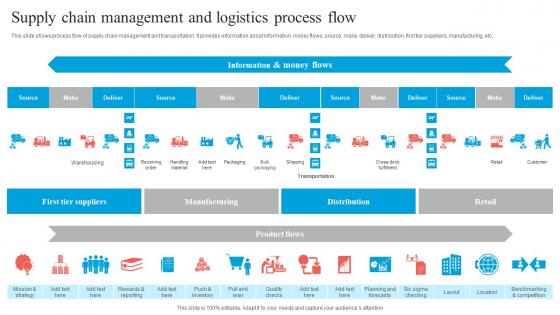
This slide shows process flow of supply chain management and transportation. It provides information about information, money flows, source, make, deliver, distribution, first tier suppliers, manufacturing, etc.
People who downloaded this PowerPoint presentation also viewed the following :
Supply Chain Management And Logistics Process Flow with all 6 slides:
Use our Supply Chain Management And Logistics Process Flow to effectively help you save your valuable time. They are readymade to fit into any presentation structure.





FAQs for Supply Chain Management And
Key components include demand forecasting, supplier relationship management, inventory optimization, logistics coordination, and performance analytics. These elements work together by streamlining operations, reducing costs, and enhancing responsiveness, with many manufacturing and retail organizations finding that strategic integration of these components delivers improved customer satisfaction and competitive advantage.
AI and blockchain enhance supply chain transparency by providing real-time tracking, immutable transaction records, and predictive analytics capabilities. Through AI-powered sensors and blockchain's distributed ledger, companies like Walmart and Maersk achieve end-to-end visibility, faster contamination detection, and automated compliance monitoring, ultimately delivering reduced fraud, improved quality control, and enhanced consumer trust.
Sustainability plays a central role in modern supply chains through waste reduction, carbon footprint minimization, ethical sourcing, circular economy practices, and renewable energy adoption. These approaches streamline operations while meeting consumer expectations, with companies in retail, manufacturing, and food services finding that sustainable practices ultimately deliver cost savings, enhanced brand reputation, and competitive advantage in increasingly environmentally conscious markets.
Global events like pandemics expose supply chain vulnerabilities by disrupting manufacturing, transportation, and demand patterns, while simultaneously highlighting the critical importance of diversification and flexibility. These disruptions compel organizations to redesign their networks with multiple suppliers, enhanced visibility technologies, and adaptive logistics strategies, ultimately delivering greater resilience and competitive advantage.
Businesses should evaluate supply chain performance using metrics like on-time delivery rates, inventory turnover, order accuracy, lead times, and cost per shipment. These measurements enable organizations to identify bottlenecks, optimize resource allocation, and enhance customer satisfaction, with many manufacturers and retailers finding that comprehensive tracking ultimately delivers improved operational efficiency and competitive advantage.
Companies effectively manage global supplier relationships through strategic communication, performance monitoring systems, cultural adaptation, and diversified sourcing portfolios that minimize risk exposure. These approaches streamline operations by establishing clear expectations, implementing regular assessments, and fostering collaborative partnerships, with many multinational organizations finding that proactive relationship management ultimately delivers enhanced supply chain resilience and competitive advantage.
**INPUT**: What strategies can be implemented to mitigate supply chain disruptions? **OUTPUT**: Supply chain disruption mitigation strategies include diversifying suppliers, implementing predictive analytics, building strategic inventory buffers, establishing alternative logistics routes, and developing supplier partnerships with real-time visibility. These approaches enable organizations to respond faster to disruptions while maintaining operational continuity, with many manufacturers and retailers finding that proactive risk management ultimately delivers competitive advantage and enhanced customer satisfaction.
Consumer behavior directly influences supply chain decisions through demand forecasting, inventory planning, distribution strategies, and product lifecycle management. Retailers increasingly leverage consumer data analytics to optimize warehouse locations, adjust production schedules, and enhance last-mile delivery options, with many organizations finding that responsive supply chains significantly improve customer satisfaction while reducing operational costs and inventory waste.
Future trends shaping supply chain management include AI-powered demand forecasting, blockchain transparency, autonomous logistics, circular economy principles, and real-time visibility platforms. These technologies revolutionize operations by minimizing waste, enhancing traceability, and streamlining decision-making, with manufacturers and retailers finding that integrated digital ecosystems ultimately deliver greater resilience and competitive advantage.
Businesses can leverage data analytics for better supply chain forecasting by analyzing historical demand patterns, real-time market conditions, seasonal trends, and external factors like weather or economic indicators. Through predictive analytics and machine learning algorithms, companies in retail, manufacturing, and logistics enhance inventory optimization, reduce stockouts, and minimize carrying costs, while improving customer satisfaction and operational efficiency in an increasingly complex marketplace.
Inventory management is crucial for supply chain efficiency because it balances product availability with cost control, minimizes storage expenses, and prevents stockouts or overstock situations. Effective inventory systems enable retailers, manufacturers, and distributors to optimize cash flow, reduce waste, and enhance customer satisfaction through reliable product delivery, ultimately delivering competitive advantage in increasingly demanding markets.
Collaboration among supply chain partners enhances performance by improving information sharing, coordinating demand forecasting, and streamlining joint planning processes across all stakeholders. Through integrated systems and shared visibility, partners can reduce inventory costs, minimize disruptions, and accelerate response times, with many manufacturing and retail organizations finding that strategic partnerships ultimately deliver competitive advantage and operational efficiency.
Supply chain managers face disruptions from geopolitical tensions, natural disasters, and economic volatility, alongside increasing customer demands for faster delivery, transparency, and sustainability. These challenges are compounded by labor shortages, rising costs, and complex global networks, with many organizations finding that strategic technology investments and diversified supplier relationships help deliver greater resilience and competitive advantage.
E-commerce revolutionizes supply chain logistics by demanding faster delivery speeds, sophisticated inventory management, and flexible fulfillment networks including warehouses, distribution centers, and last-mile solutions. Through advanced tracking systems and automated processes, retailers streamline operations, reduce costs, and enhance customer experiences, while many companies find that strategic omnichannel integration ultimately delivers competitive advantage.
Supply chain returns management best practices include automated return authorization systems, centralized processing facilities, real-time inventory tracking, predictive analytics for return forecasting, and integrated reverse logistics networks. These approaches streamline operations by reducing processing times, minimizing handling costs, and improving customer satisfaction, with many retailers finding that efficient returns management ultimately delivers competitive advantage and enhanced customer loyalty.
-
Crisp and neat slides. Makes it fun and easier to curate presentations.
-
I looked at their huge selection of themes and designs. They appeared to be ideal for my profession. I'm sure I'll grab a few of them.