

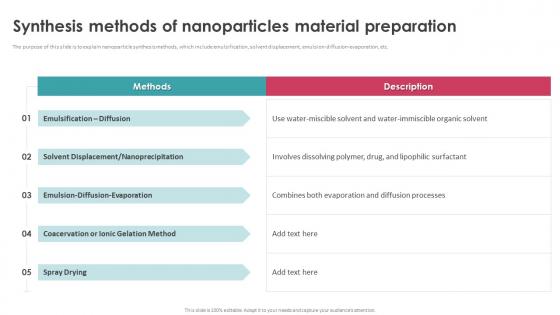
Synthesis Methods Of Nanoparticles Material Preparation




Try Before you Buy Download Free Sample Product
 Impress Your
 Audience
 100%
100% Editable
 Save Hours
 of Time


The purpose of this slide is to explain nanoparticle synthesis methods, which include emulsification, solvent displacement, emulsion-diffusion-evaporation, etc.
People who downloaded this PowerPoint presentation also viewed the following :
Synthesis Methods Of Nanoparticles Material Preparation with all 9 slides:
Use our Synthesis Methods Of Nanoparticles Material Preparation to effectively help you save your valuable time. They are readymade to fit into any presentation structure.








FAQs for Synthesis Methods Of
So there's three main ways to do this. Chemical reduction is probably your best bet to start - it's cheap and you can control particle size pretty well, though some of the chemicals are kinda sketchy. Sol-gel takes forever but you get amazing control over composition. Then there's PVD which makes perfect, super pure particles, but damn, the equipment will cost you a fortune. Honestly? Unless you absolutely need perfect uniformity, I'd just go with chemical reduction first and see how it works out.
So chemical methods are all about mixing precursor molecules - sol-gel, precipitation, hydrothermal stuff where you're tweaking pH and temperature. Physical methods? More like breaking down bulk materials or depositing atoms. Think laser ablation, ball milling, vapor deposition. Chemistry gives you way better control over size and shape, which honestly makes a huge difference. But physical methods are cleaner since you don't have all those leftover reagents to deal with. Need ultra-pure particles? Go physical. Want specific functionalization? Chemical's definitely the way. Oh, and ball milling is surprisingly satisfying to watch if you ever get the chance.
Yeah so surfactants are basically your main tool for controlling particle shape. They stick to different crystal faces with varying strength, which directs how the particles grow. Oleic acid usually gives you nice spherical ones since it's long-chain, but shorter surfactants or different head groups push you toward rods or cubes. Higher concentrations = smaller particles, though you might lose some shape control. I'd honestly just start with oleic acid/oleylamine for spheres - works like 90% of the time. Then try CTAB or phosphonic acids if you want weirder shapes. Just remember to tweak the concentration along with your other conditions.
Honestly, sol-gel is pretty sweet for control. You're literally building nanoparticles molecule by molecule - metal precursors in solution that hydrolyze and condense into this gel network. Kinda mesmerizing to watch if you're into that sort of thing. Want bigger particles? Adjust the pH. Different shapes? Play with temperature and reaction time. The mixing happens at molecular scale so you get really uniform results. I'd start with metal alkoxides - they're way more forgiving when you're figuring out your parameters. Much less likely to completely mess up your first few attempts.
So green synthesis is basically blowing up right now. Plant extracts, microorganisms, even waste biomass - people are using all this stuff instead of nasty chemicals to make nanoparticles. Honestly sounds crazy but it works. Tea extracts are huge for this apparently. The cool thing is you get way better biocompatibility for medical uses, plus it's obviously better for the environment. Downside? Less control over particle size and shape than traditional methods. If you're diving into this, definitely check out recent papers on plant-mediated synthesis first - that's where the good results are happening.
Particle size is your biggest factor here - smaller means way more surface area and reactive sites. Control it through temp and reaction time (lower/shorter keeps things small). pH matters a ton for precipitation methods too. Surfactants are honestly a game changer for controlling shape and stopping particles from clumping together. Different capping agents will block or expose certain crystal faces, which changes reactivity. I'd probably start by figuring out what size range you're actually aiming for first. Makes it easier to dial in your conditions from there. Oh, and don't sleep on morphology - it's just as important as size sometimes.
Microfluidics is where it's at right now - you get crazy precise control over particle size and drug loading. Layer-by-layer assembly is solid too. Flow chemistry basically solved the whole reproducibility mess, which honestly was getting annoying. Some labs are doing interesting stuff with cell membranes as natural coatings, plus there's stimulus-responsive polymers that only release when pH or temperature hits certain triggers. Oh, and biomimetic approaches are picking up steam. I'd probably start with microfluidics though - the scalability alone makes it worth exploring first if you're serious about this.
Yeah, environmental conditions are honestly everything for nanoparticle synthesis. Higher temps speed up reactions but you'll get less uniform particles - it's a tradeoff. pH is massive too since it controls surface charge and how stable your precursors are. I totally screwed up my first batch because the pH was off and got clumps instead of individual particles. Even tiny pH shifts mess with your size distribution big time. Temperature matters way more than most people think. Always do small test runs when you change parameters, and seriously keep detailed notes of everything you tried!
Honestly, continuous flow is your best bet here - way less unpredictable than batch processes. Temperature control gets tricky at scale, so nail down your monitoring for temp, mixing, and residence time. Those tiny variations? They'll bite you hard in large volumes. Start with pilot testing though - trust me on this one. Full production equipment is expensive to mess up. Your purification steps will probably become the real pain point, so map those out early. Oh, and document literally everything as you go. I know it's boring but future you will be so grateful when something inevitably goes sideways.
So laser ablation shoots high-energy pulses at materials and literally blasts nanoparticles off - honestly kinda cool to watch. You get super pure particles since there's no chemical mess involved. Size control happens by tweaking laser settings like pulse duration and energy. But here's the thing - yield is usually pretty low and scaling up gets expensive fast. Plus you're stuck with materials that actually absorb your laser wavelength well. Perfect for proof-of-concept stuff or when you need ultra-pure samples, but chemical methods probably make more sense for big production runs.
So with electrochemical methods, you're basically controlling voltage, current, and what's in your electrolyte to get the nanoparticles you want. Works pretty well actually. You can either grow them straight onto electrodes through electrodeposition or do reduction in solution - both let you mess with size and shape in real time. Pulse techniques are your best bet for getting uniform sizes. Template-assisted stuff using porous membranes is solid too. Honestly, the biggest win is how reproducible it gets once you dial in your settings. Makes scaling up way less of a headache. I'd start with basic metal nanoparticles first though.
Honestly, your precursor choice is like 80% of the battle here. Size, shape, how crystalline everything ends up - it all comes back to what you started with. Metal salts versus organometallic compounds? Totally different particle shapes even if you keep everything else identical. The reactivity rates are different too, so nucleation happens at weird speeds. Oh and don't forget about ligands acting like little capping agents. I learned this the hard way - always do a tiny test run when you switch precursors. Even stuff that should be "equivalent" will throw you curveballs.
Honestly, microwave heating is a game changer - you'll get way more uniform particles in minutes instead of waiting around for hours. Traditional heating works from the outside in, but microwaves heat everything at once throughout the whole mixture. Your temperature control gets so much better, and the particles end up smaller with tighter size distributions. The rapid heating pushes nucleation over growth, which is exactly what you want for controlling size. Your electricity bill will be lower too, which is nice I guess. Seriously though, try it for your next synthesis - just the time savings make it totally worth it.
Ugh, the hardest part is that sol-gel vs vapor-phase methods give you completely different particle properties even at identical sizes. TEM shows morphology but you're blind to surface chemistry. DLS gives hydrodynamic size but can't tell aggregates from actual large particles - super frustrating honestly. Different synthesis routes = different surface characteristics, so one technique never tells the whole story. XPS, FTIR, XRD all reveal different pieces. Start with 3-4 complementary methods minimum and correlate everything together. Don't rely on just one or you'll miss something important. It's like solving a puzzle sometimes but that's half the fun I guess.
So computational modeling is like having a crystal ball for nanoparticle synthesis - you can predict size, shape, and distribution before wasting lab time and materials. I'd start with basic thermodynamic models if you're new to this stuff. They'll give you solid groundwork before jumping into the heavier simulations. Molecular dynamics and Monte Carlo are really good at this, though honestly they can be pretty computationally intensive. You can simulate different temps, concentrations, precursor types to see what happens virtually first. The whole point is understanding nucleation and growth kinetics so you're not just randomly trying things and hoping something works.
-
Thanks to SlideTeam, we have an ideal template to present all the info we need to cover. Their slides give our numbers and projections a more clear and enchanting look.
-
Huge collection of high-quality templates. Worth each penny.