Talent Management And Succession Planning Process Powerpoint Presentation Slides
Try Before you Buy Download Free Sample Product
Audience
Editable
of Time
Every organization wants the right succession plan to guide, train and prepare its existing talent pool for future roles. Succession planning is developing future leaders for critical roles within the organization. Check out our professionally designed Talent Management and Succession Planning Process presentation that will assist organizations in meeting their objective of having the right talent at a suitable place and time through a succession planning program. Our Succession Planning Guide PPT showcases the performed section to understand their past performance and slides, namely workforce trends and the need for investing in succession planning to ensure improvement in business performance. This Employee Development Strategy module will assist the Organizations in successfully introducing, implementing, and tracking succession plans using slides consisting of the Succession Planning Guide. It also incorporates establishing future business goals, introducing sequence planning programs, identifying key positions and employee development plans, preparing staff for future roles, and monitoring succession planning programs. Lastly, the dashboard section will assist organizations in evaluating their business performance. Get access to this powerful template now
People who downloaded this PowerPoint presentation also viewed the following :
Content of this Powerpoint Presentation
Slide 1: This slide introduces Talent Management and Succession Planning Process. Begin by stating Your Company Name.
Slide 2: This slide depicts the Agenda of the presentation.
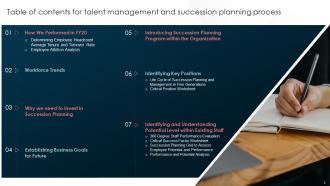
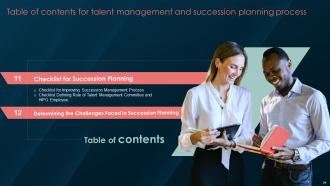
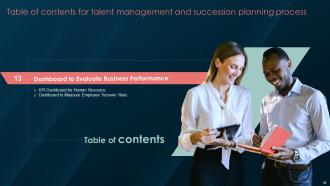
Slide 3: This slide includes the Table of contents.
Slide 4: This is yet another slide coninuing the Table of contents.
Slide 5: This slide potrays the Title for the Topics to be covered in the next template.
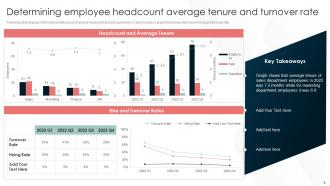
Slide 6: The following slide displays informational stats about employee headcount, average tenure, and turnover rate.
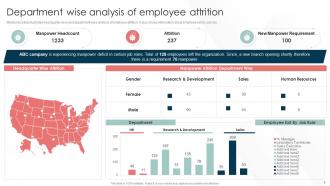
Slide 7: This slide illustrates headquarter wise and department wise analysis of employee attrition.
Slide 8: This slide reveals the Heading for the Contents to be discussed further.
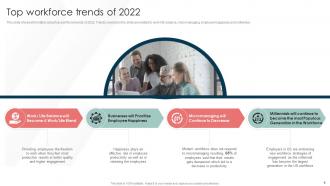
Slide 9: This slide shows information about top workforce trends of 2022.
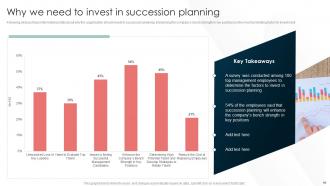
Slide 10: The following slide portrays informational stats about why the organization should invest in succession planning.
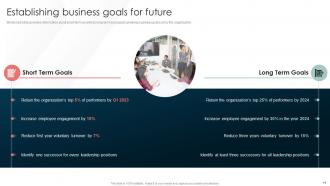
Slide 11: This slide provides information about short-term as well as long-term succession planning business goals set by the organization.
Slide 12: This slide illustrates five stage process of succession planning program introduced by the organization to meet its short term business goals.
Slide 13: This slide incorporates the Heading for the Ideas to be covered next.
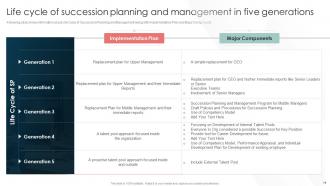
Slide 14: The following slide shows information about Life Cycle of Succession Planning and Management along with Implementation Plan and Major Components.
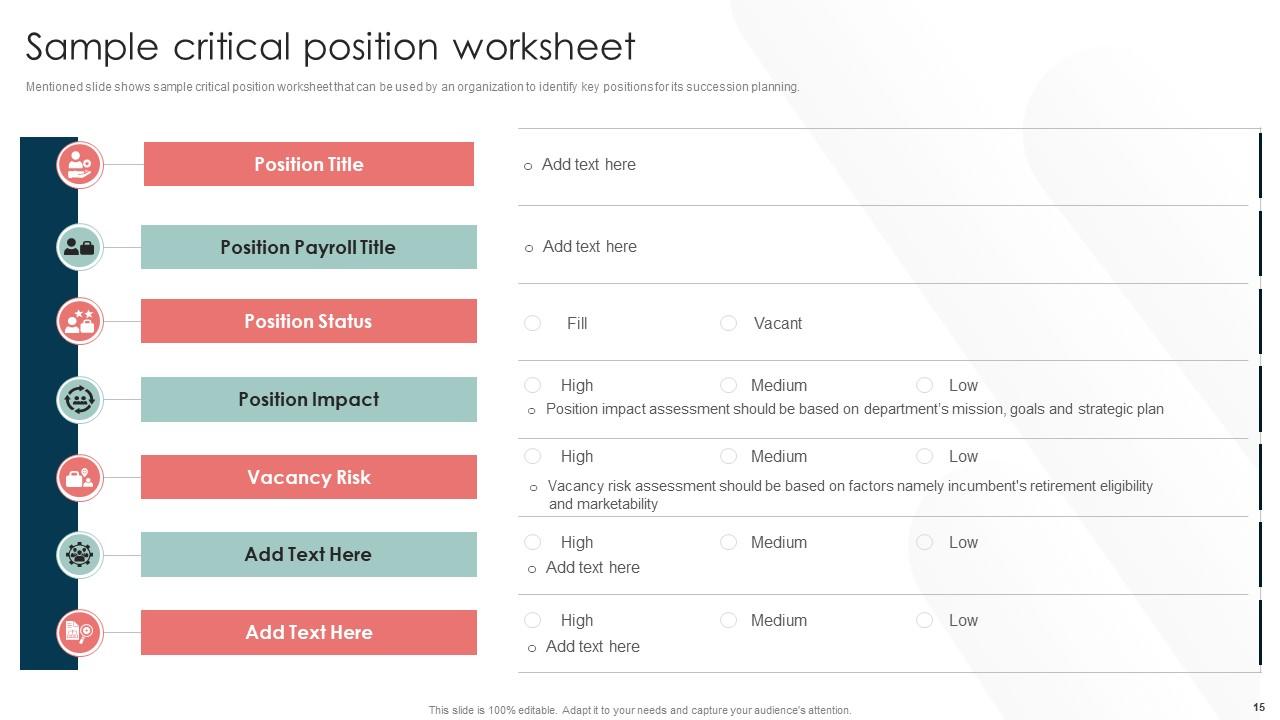
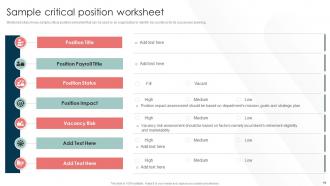
Slide 15: This slide elucidates sample critical position worksheet that can be used by an organization to identify key positions for its succession planning.
Slide 16: This slide presents the Heading for the Topics to be covered further.
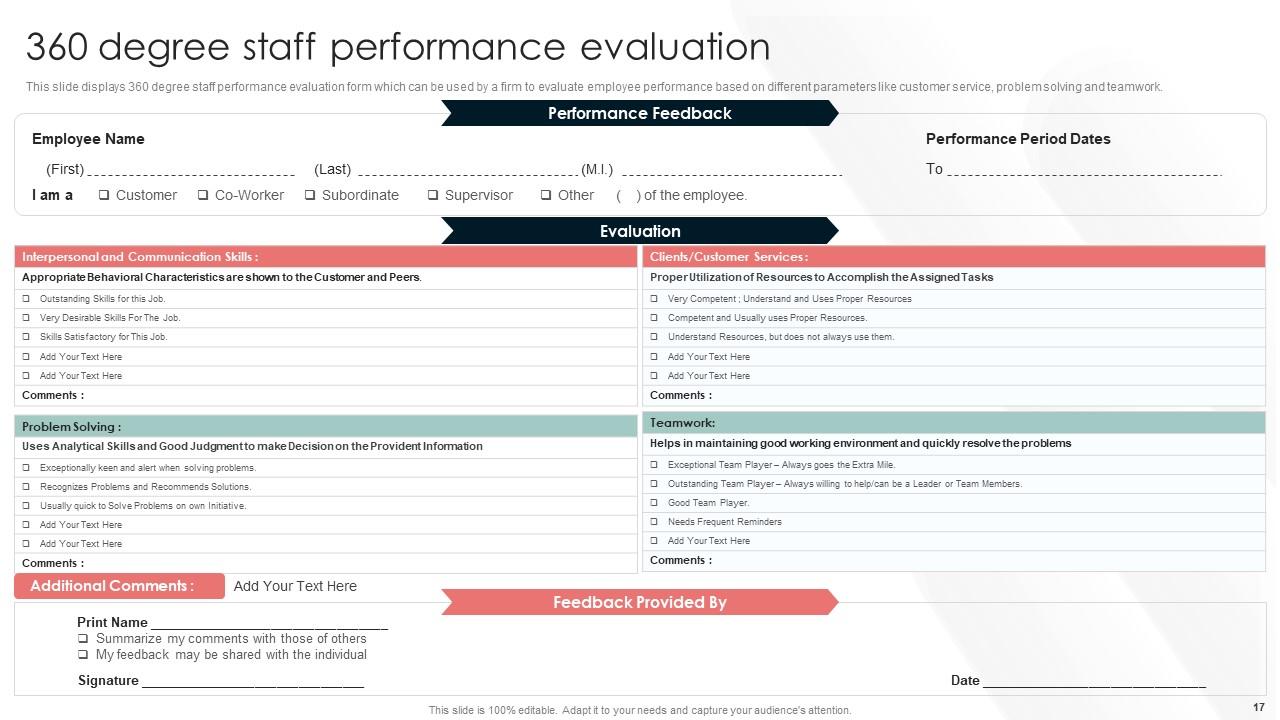
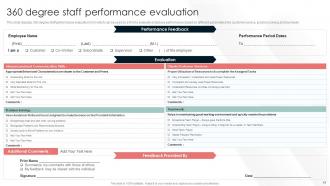
Slide 17: This slide displays 360 degree staff performance evaluation form.
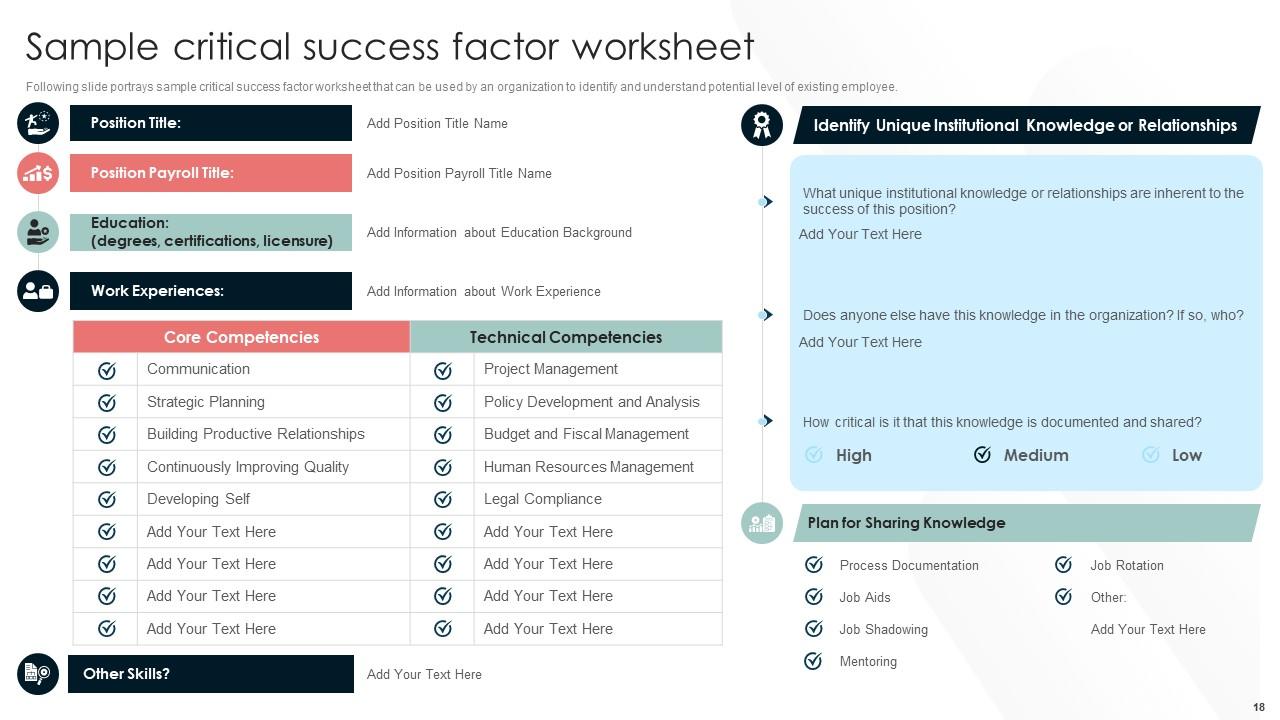
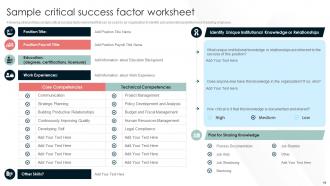
Slide 18: The following slide portrays sample critical success factor worksheet that can be used by an organization to identify and understand potential level of existing employee.
Slide 19: This slide shows information about Life Cycle of Succession Planning and Management along with Implementation Plan and Major Components.
Slide 20: This slide provides informational stats about current employee performance and potential.
Slide 21: This slide depicts the Title for the Contents to be discussed further.
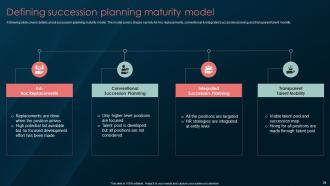
Slide 22: This slide covers details about succession planning maturity model.
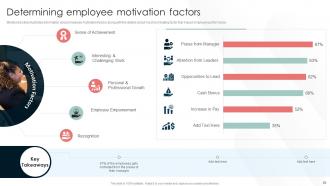
Slide 23: This slide illustrates information about employee motivation factors along with the details about most dominating factor that impact employee performance.
Slide 24: This slide displays Sample Readiness Level Checklist that can be used by an Organization to determine the Readiness Level of Existing Employees.
Slide 25: This slide incorporates the Title for the Topics to be covered in the next template.
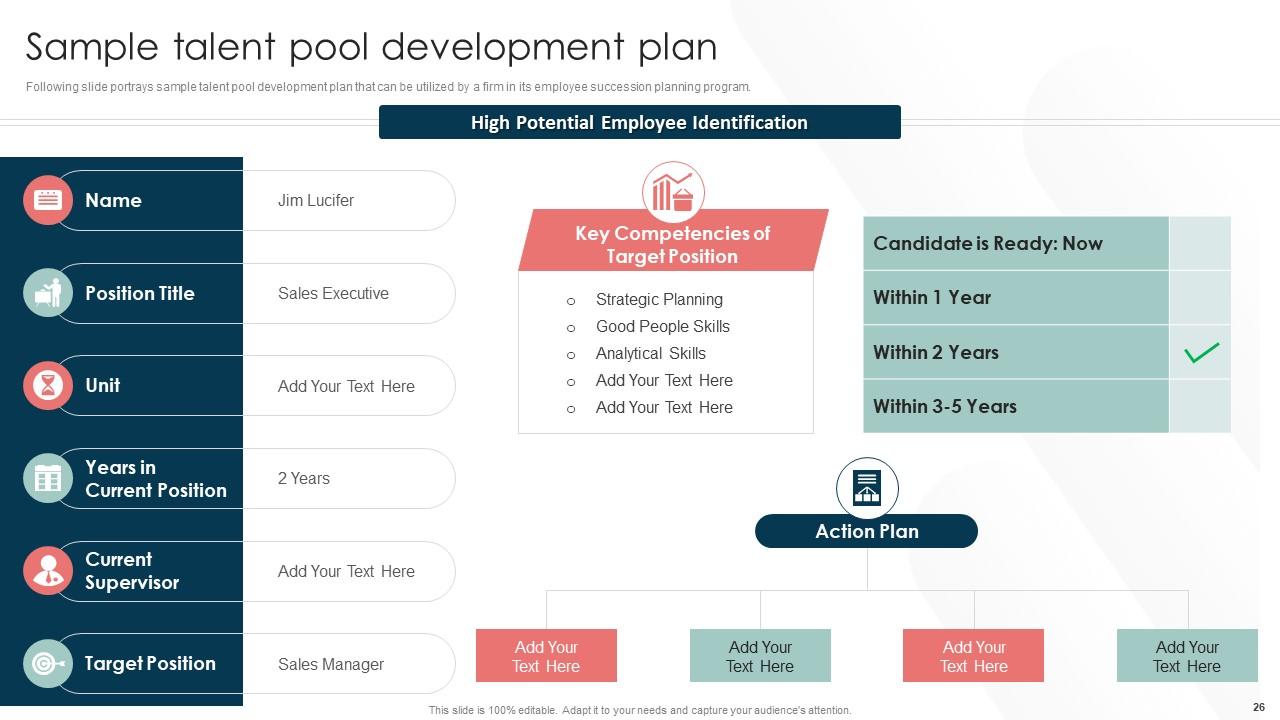
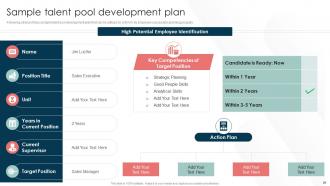
Slide 26: This slide portrays the sample talent pool development plan that can be utilized by a firm in its employee succession planning program.
Slide 27: This slide displays three layered model that can be used by a firm to maximize its employee learning.
Slide 28: This slide contains the Heading for the Contents to be covered further.
Slide 29: This slide defines criteria for evaluating leadership development initiatives.
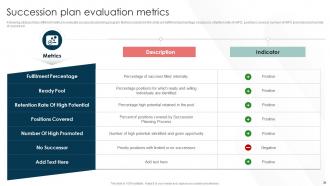
Slide 30: This slide portrays different metrics to evaluate succession planning program.
Slide 31: This slide mentions the Heading for the Contents to be discussed further.
Slide 32: This slide displays the checklist that can be used by a firm for improving its succession planning management process.
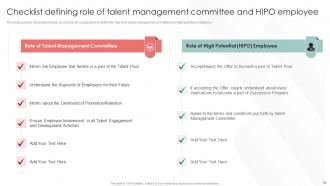
Slide 33: This slide portrays checklists that can be used by an organization to define the role of its talent management committee and high potential employees.
Slide 34: The following slide illustrates information about most common challenges faced by the organizations while implementing succession planning program.
Slide 35: This slide reveals the Title for the Topics to be covered in the forth-coming template.
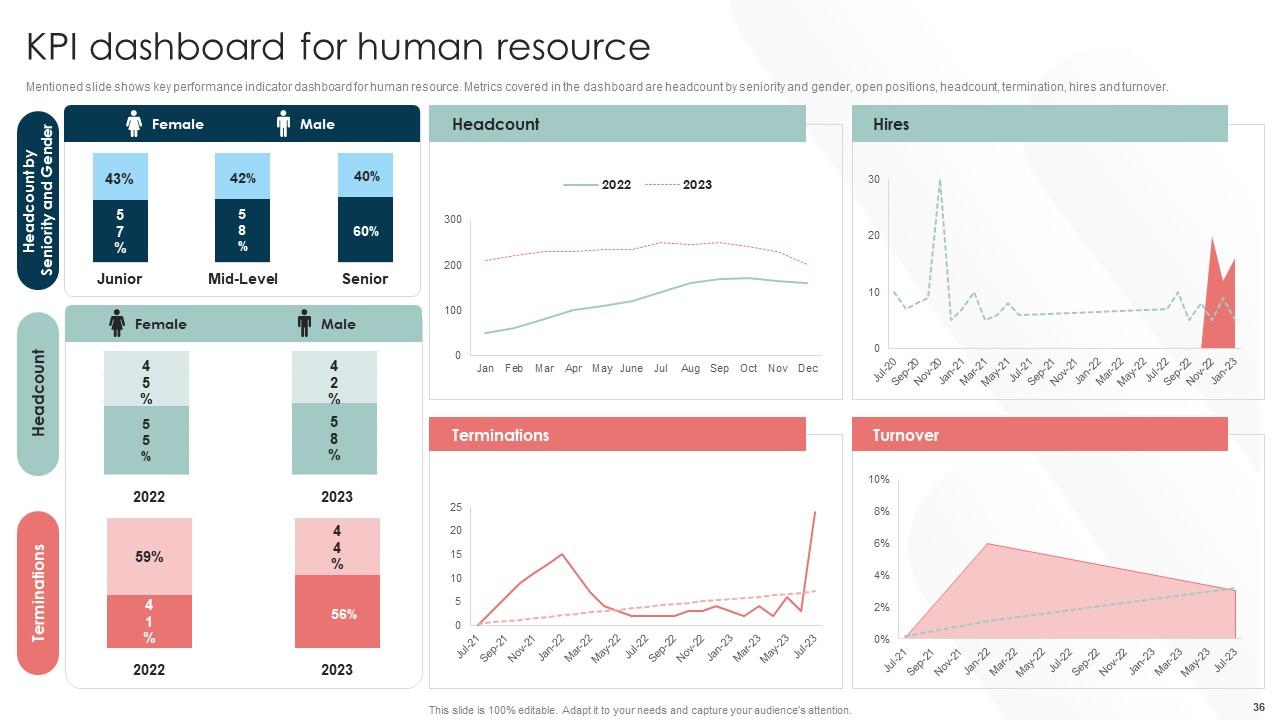
Slide 36: This slide shows key performance indicator dashboard for human resource.
Slide 37: This slide displays a dashboard that can be used by a firm to measure its employee turnover rate at different locations.
Slide 39: This is the slide used for depicting some Additional information.
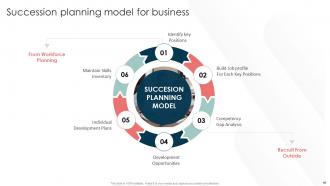
Slide 40: This slide elucidates the Succession planning model for business.
Slide 41: This slide highlights the HR performance management dashboard.
Slide 42: This slide exhibits information about the Seven pointed star model for succession planning and management.
Slide 43: This slide presents information through a Bar chart.
Slide 44: This is the Roadmap slide for depicting organization's journey.
Slide 45: This slide states information related to the Financial topic.
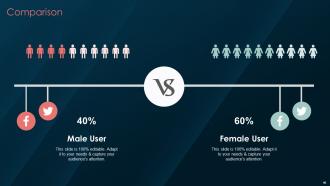
Slide 46: This is the Comparison comparison slide for comparing Company related information.
Slide 47: This is Our goal slide for showcasing the Company's goals.
Slide 48: This slide includes the Post it notes for reminders and deadlines.
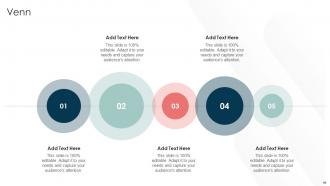
Slide 49: This is the Venn diagram slide for revealing some relevant Organization related information.
Slide 50: This is the slide showcasing the Company's Timeline.
Slide 51: This is the Puzzle slide with related imagery.
Slide 52: This is the Idea generation slide for encouraging fresh ideas.
Slide 53: This is the Thank you slide for acknowledgement.
Talent Management And Succession Planning Process Powerpoint Presentation Slides with all 58 slides:
Use our Talent Management And Succession Planning Process Powerpoint Presentation Slides to effectively help you save your valuable time. They are readymade to fit into any presentation structure.
FAQs for Talent Management And Succession Planning Process
So you'll want to focus on talent acquisition, development, performance management, succession planning, and retention. Basically think of it as a pipeline - constantly bringing people in, growing skills, measuring performance, prepping them for bigger roles. Onboarding and clear career paths are huge too so people actually know where they're going. Honestly, keeping your best people is way harder than it sounds - losing top talent absolutely sucks to recover from. I'd start by looking at what you have now in each area. Find your biggest gaps first and tackle those. Performance management is probably where most companies mess up, just saying.
Honestly, don't just focus on who's killing it right now - that's not always the best predictor. Look for people who learn crazy fast and actually want to move up. Watch how they handle projects outside their wheelhouse or influence people when they don't have any real power over them. 360 feedback helps a ton here, but sometimes you just get a gut feeling about someone, you know? Give them tough assignments early and see if they rise to it or crumble. The formal process matters, but trust your instincts too.
Honestly, engagement is huge for talent management - like, it affects literally everything. Your engaged people stick around longer and perform way better. They'll even refer their friends, which is free recruiting basically. Plus they actually want to learn and grow instead of just coasting. Without it though? Good luck keeping anyone. I've seen companies throw money at retention programs while ignoring engagement surveys - total waste. The key is measuring it regularly and then actually doing something with that data. Otherwise you're just collecting feedback for no reason.
Honestly, start with whatever's driving you crazy right now - that's your entry point. AI recruiting tools will screen people way faster than you can, and performance platforms give you instant feedback instead of waiting for annual reviews. There's analytics that'll predict who's about to quit (weirdly accurate, btw). Learning systems can auto-train your team, chatbots handle vacation requests and other tedious stuff. Just make sure everything talks to each other - nobody needs more disconnected systems. Pick one problem area first. You'll figure out what works from there.
So you definitely want to look at both the stuff that predicts problems and what's happening right now. Employee retention is huge - start there along with engagement scores. Time-to-fill for open roles, internal promotions, and performance review data are solid picks too. Though honestly, performance reviews can be total BS depending on the manager doing them. Cost-per-hire and how strong your talent pipeline looks matter as well. Don't go crazy tracking twenty different things - pick maybe 5-7 that actually connect to what your business needs. I'd focus on retention and engagement first if I were you.
Oh man, this is such a big deal and companies screw it up constantly. What motivates people is totally different depending where they are. That direct feedback style that works great in New York? It'll blow up in your face in Tokyo - some cultures think it's super disrespectful. You've gotta adapt everything - how you do performance reviews, leadership programs, even compensation. Work-life balance expectations are huge too. Build flexibility into your global approach but keep some consistency. Honestly, just survey your teams in different regions first and ask what actually drives them.
Start reaching out before their first day - send welcome stuff, get their desk set up, maybe pair them with someone who isn't their boss. Week one shouldn't be information overload (seriously, nobody retains that much). Space things out over 90 days instead. Check in at 30, 60, 90 days - catch problems early before people start updating their LinkedIn, you know? The biggest thing though? Help them see how their job actually matters in the bigger picture. Otherwise they'll just feel like they're doing random tasks for no reason.
Start by casting a wider net - hit up different universities, job fairs you wouldn't normally consider, post jobs on platforms beyond LinkedIn. Clean up those job descriptions too (honestly, "culture fit" is usually just bias in disguise). Structure your interviews better to cut down on unconscious bias. Set up real mentorship programs connecting underrepresented folks with leadership - not just the fake networking events nobody wants to attend. Oh, and track everything obsessively. You can't fix what you're not measuring, and the data will probably surprise you anyway.
Look, people will bolt if they feel stuck - I've watched it happen way too many times. You gotta invest in their growth or they'll find someone who will. It's honestly that simple. Ask your team what skills they actually want to build, then help them get there. Skip the boring annual training nonsense though. Make it ongoing and real. When employees see you're serious about their development, they stick around longer. Plus your whole team stays sharp with whatever's happening in your industry. The best talent managers I know treat learning like it's part of the job, not some extra thing.
Performance reviews are actually super useful for way more than just annual feedback. Look at the patterns over time - that's where you'll find your future leaders and spot who needs what kind of development. I use mine to figure out promotions, salary bumps, and who can handle bigger projects. Way more reliable than just winging it based on whoever speaks up the most in meetings, you know? Don't waste time on generic training though. Take what you're seeing in the actual data and build programs around those specific gaps. One review cycle tells you nothing - but three or four? That's gold.
Honestly, mentoring programs are game-changers for talent development. They speed up skill building and get employees way more engaged. Knowledge transfers so much faster when experienced people directly coach newer hires, plus you're basically building your future leaders. The retention piece is massive - people don't bail when they feel like you're actually investing in them. Mentees pick up technical skills AND the soft stuff, while mentors often realize they're natural leaders (which is cool to watch). I'd start with maybe 5-10 pairs as a pilot program first. Track engagement scores before you go bigger.
Start with figuring out what skills actually matter for where your company's going. Expanding markets? New products? Digital stuff? Map that out first. Most places just hire whoever without thinking this through - it's wild how common that is. Once you know your direction, spot the talent gaps and focus everything on filling those specific needs. Your recruiting, training, all of it should target the capabilities that'll actually move the needle. I always think of hiring decisions like investments. Will this person get us closer to our goals? If not, keep looking.
Honestly, the biggest pain points are gonna be data silos and people just hating change. Your managers will roll their eyes at another new platform for performance reviews - I've seen this so many times. Integration with existing HR systems is a nightmare too, and your IT folks won't be thrilled about connecting everything without breaking what already works. Different departments define "talent" completely differently, so good luck with consistent data. Oh, and start small - maybe just performance management with your most cooperative teams first. Get some wins before you expand and deal with all the inevitable headaches.
Oh man, succession planning is huge and most companies totally blow it. When key people leave or retire, you're scrambling to fill spots instead of having someone ready to step up. It's also great for keeping people around - nobody wants to feel stuck with zero growth opportunities ahead of them. I'd start by figuring out which roles would screw you over if they went vacant tomorrow. Then look at who might be able to fill those spots in a year or two. Build some development plans around those gaps. Honestly wish more places took this seriously - saves so much chaos down the road.
Honestly, the biggest shifts I'm seeing are companies dropping degree requirements and just testing for actual skills instead. AI matching is getting pretty good too - saves tons of time screening. Remote hiring obviously blew everything wide open, which is amazing for finding talent. Start building those talent communities now, even before you have openings. LinkedIn's still king for recruiting, but don't sleep on TikTok if you want Gen Z candidates (I know, I know, but it actually works). Employee referrals are getting way better incentives too. First step? Go through your job posts and cut the unnecessary degree stuff. Skills assessments work so much better anyway.
-
If you have visited their site and failed to find the products, try reaching the customer service because it will be the case that you didn't use the search bar well.
-
“Excellent information with easy access.”