


Target board three arrows target achievement flat powerpoint design




Try Before you Buy Download Free Sample Product
 Impress Your
 Audience
 100%
100% Editable
 Save Hours
 of Time


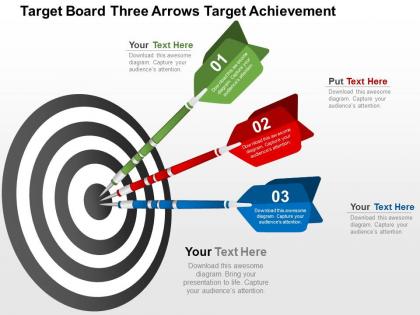
Are you looking for resourceful design for your next sales presentation? Well if yes then here is our target board three arrow target achievement PowerPoint slide design for you. Achieving the success is the ultimate goal of the corporate firms and it can only be possible if the business targets are meet. This PPT visual demonstrate the concept of target achievements in the most desired manner. The dart board with multicolored arrows allows you to share the most valuable information with your viewers and make them be part of the design. Sales and marketing professionals are always required to meet whatever the target set up by the management team. Our presentation illustration helps you to inspire them to achieve their desired goals as well as business objectives. Apart from this, the PPT template is beneficial in demonstrating the business idea planning and corporate development process. The PowerPoint slide is impeccable for you in every respect. So, quickly download and get access to it. Glide over all obstacles in your way. Get the lift you need with our Target Board Three Arrows Target Achievement Flat Powerpoint Design.
People who downloaded this PowerPoint presentation also viewed the following :
Content of this Powerpoint Presentation
Description:
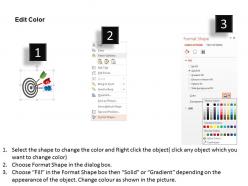
The image is of a PowerPoint slide titled "Target Board Three Arrows Target Achievement." It features a graphical representation of a target board with three arrows, each labeled with a number from 1 to 3, indicating a sequence or priority of steps. Around this central image are text boxes for additional information, with prompts like "Your Text Here," suggesting that the slide is customizable for specific content.
Use Cases:
The design can be used across various industries for strategic presentations:
1. Sales and Marketing:
Use: To show target sales goals or marketing campaign milestones.
Presenter: Sales Director.
Audience: Sales team, marketing department.
2. Project Management:
Use: For illustrating project milestones or deliverable completion.
Presenter: Project Manager.
Audience: Project team, stakeholders.
3. Education:
Use: To outline educational objectives or curriculum targets.
Presenter: Academic Dean.
Audience: Faculty, educational administrators.
4. Finance:
Use: To present financial targets, such as revenue or budget goals.
Presenter: CFO or Finance Manager.
Audience: Investors, financial analysts.
5. Healthcare:
Use: For setting patient care objectives or health outcome benchmarks.
Presenter: Healthcare Administrator.
Audience: Medical staff, hospital board.
6. Manufacturing:
Use: To demonstrate production targets or efficiency goals.
Presenter: Operations Manager.
Audience: Production team, operational staff.
7. Technology:
Use: To depict software development milestones or product release plans.
Presenter: CTO or Product Manager.
Audience: Development team, tech company employees.
Target board three arrows target achievement flat powerpoint design with all 4 slides:
Our Target Board Three Arrows Target Achievement Flat Powerpoint Design are like the morning dew. They add to the freshness of your thoughts.
FAQs for Target board three arrows target achievement
Honestly, start with goals you can actually measure - none of that vague "improve efficiency" nonsense. Build in realistic deadlines because nobody hits impossible ones anyway. Check-ins are huge, maybe weekly? That way you catch problems before they blow up. Half the time teams don't even know what "done" looks like, which is wild but happens constantly. When scope creeps (and it will), don't be stubborn about adjusting targets. Oh, and have backup plans ready. Communication keeps people from working in different directions. Trust me, catching issues early beats scrambling later.
Honestly, SMART goals are a game-changer because they force you to stop being so vague about what you want. Instead of saying "increase sales" (which tells nobody anything), you'd say "boost Q4 software sales by 15% through targeted email campaigns." See the difference? With Specific, Measurable, Achievable, Relevant, and Time-bound targets, your team actually knows what they're working toward. You can track progress easily. Success becomes obvious. I'd grab one of your current fuzzy goals and run it through the framework – it's like having GPS instead of wandering around hoping you'll find your destination.
Honestly, just break that big goal into smaller chunks and check in every week or two. I use a basic spreadsheet but even scribbling on paper works. The traffic light thing is actually pretty genius - green for good, yellow for meh, red for "oh crap." You'll catch problems way earlier this way. Pick maybe 3-4 things that actually tell you if you're winning or not, then just track those. Don't overcomplicate it with a million metrics - I learned that the hard way. Regular check-ins with yourself sound weird but they work.
Honestly, team dynamics are everything when you're trying to hit your goals. If people communicate well and trust each other, you'll crush whatever you're working on. Bad vibes though? Total project killer. I've seen it happen so many times. Good teams solve problems faster, keep each other accountable, and don't fall apart when stuff gets stressful. My advice is to nail down how you'll work together right at the start - like how you'll communicate, who does what, that kind of thing. Don't let conflicts fester either, because they'll wreck your momentum later.
Think of feedback like having a buddy spot you at the gym - you need someone telling you if your form's off before you hurt yourself. I learned this the hard way on a project last year where I waited too long to check in. Weekly or bi-weekly loops work best so you can pivot fast. Get input from your boss, check your numbers, talk to whoever's actually affected by what you're doing. The trick is mixing formal sit-downs with quick informal chats. Honestly, most people skip this step and wonder why they missed their targets. Don't shoot blind - you'll just waste time.
So here's the thing about visual stuff - it actually works because people can see their progress instead of just hoping they're doing okay. Like, you put up a simple chart or dashboard and suddenly everyone gets it. Way better than some vague "we're doing great" update, right? Your team can literally watch their work turn into results, which honestly feels pretty good. Plus everyone's looking at the same picture, so you're not getting those weird miscommunications about what you're even trying to accomplish. I'd start with just a basic weekly tracker - nothing fancy. You'll probably be shocked how much people care about moving that little bar forward.
Honestly, just expect things to go sideways from day one. I always break big goals into smaller chunks so when something inevitably breaks, I'm not scrambling to fix everything at once. Having backup plans ready before you actually need them is a game changer - learned that the hard way lol. Check in on your progress regularly instead of waiting until crunch time. And seriously, don't be stubborn about asking for help when you hit a wall. Most people actually respect the honesty. Just stay flexible while keeping your eyes on the prize.
Honestly, look at your last 12 months of data first - that's where the gold is. You'll spot patterns in what actually worked vs what flopped. Way too many people just throw random numbers at the wall and then act shocked when they miss targets (guilty of this myself back in the day). Historical performance shows you what's realistic but still pushes you. Real-time tracking is clutch too because you can catch problems early instead of scrambling at month-end. Pull those numbers and see what trends jump out. Makes goal-setting way less of a guessing game.
Honestly, it's mostly about whether you actually believe you can hit the target in the first place. That confidence thing is massive. Also matters if you think your effort will make a difference, or if you're just at the mercy of random stuff happening. Some people get paralyzed by failure fears, others use it as fuel - weird how that works. Oh and imposter syndrome definitely messes with people too. My advice? Start stupidly small to build up that confidence first. Like embarrassingly small wins. Then you can go after the bigger stuff when you're not second-guessing yourself constantly.
Honestly, time management can make or break whether you actually hit your goals. Here's the thing - when you're good at it, you focus on stuff that matters and don't waste energy on random busywork. But mess it up? You'll blow deadlines and stress everyone out. I've watched teams with solid plans completely fall apart because they couldn't stick to realistic timelines (it's painful to see). Figure out what activities give you the biggest bang for your buck, then block out specific time slots for them. No exceptions. Short bursts work better than marathon sessions anyway.
Honestly, you've gotta work top-down with this stuff. Take your company's big goals and chop them into smaller pieces for each department, then break those down for individuals. Everyone should be able to connect their daily tasks back to what the company's trying to achieve - I can't tell you how many places I've worked where people are just doing random stuff with zero clue why it matters. Try to use similar metrics across teams when you can. Oh, and definitely get people involved in setting their own targets. They'll actually care about hitting them that way. Check in regularly so you catch problems before they get ugly.
Honestly, case studies are gold because you get to see the real messy path someone took, not just fluffy theory. Seeing how people in your space actually hit their targets makes your goals feel less impossible, you know? You can literally copy their playbook - how they chunked down big goals, what they did when stuff went sideways. The thing that always gets me is realizing successful people had the exact same "wtf am I doing" moments you're having right now. I'd grab 2-3 good ones from your industry and just map out their actual tactics. Way better than generic advice.
Honestly? Your leadership style makes or breaks whether people actually hit their goals. Clear expectations are huge - nobody can succeed when they're guessing what you want. Remove the stupid roadblocks that waste everyone's time, and when someone's struggling, help them instead of just asking about deadlines every five minutes (so annoying). Celebrating small wins keeps morale up. Think of yourself as the team's GPS - you're keeping everyone headed the same direction but smart enough to find detours around problems. Ask "what do you need?" Way better question than "when's this done?"
Honestly, I'd start with something like Asana or Monday - they're great for chopping up those massive goals into bite-sized tasks. The automated reminders are a lifesaver. Analytics dashboards will show you where things are getting stuck way before you miss deadlines (learned that one the hard way). If it's sales stuff, CRM systems handle all that tedious follow-up work automatically. Pick something that meshes with what you're already doing though - don't create more headaches for yourself. I'd say master one tool first, then maybe add others later. Way less overwhelming that way.
Track the obvious stuff first - hit rates, how close you got when you missed, timelines. But honestly? The soft metrics are just as crucial. Team morale tells you if people are burning out. Resource use shows if you're being realistic. Quality matters too - I've seen teams hit every target but create garbage that falls apart later. My buddy at work swears by keeping it simple: pick 3-5 key things, throw them on a dashboard, review monthly. Don't overcomplicate it or you'll spend more time measuring than actually doing the work.
-
It saves your time and decrease your efforts in half.
-
Professional and unique presentations.